
An architectural designer plans buildings and spaces, carrying a project from a first sketch through to construction-ready drawings. In practical terms, what does an architectural designer do? They turn a client’s brief and a site’s constraints into a workable design, produce technical drawings and 3D models, handle planning applications, and support the build until it is finished. The role spans the full design of buildings and outdoor spaces, a scope the U.S. Bureau of Labor Statistics documents for design professionals who shape the function and form of the built environment.
This guide answers two things at once: what the job involves day to day, and when you, as a UK homeowner or developer, actually need one on your project.
What Is an Architectural Designer?
An architectural designer is a design professional who plans and develops buildings and spaces, from concept to detailed drawings, but who is not necessarily an ARB-registered architect. In the UK, “architectural designer” and “building designer” are often used for the same role. The work centres on function, spatial quality, and compliance rather than on a protected professional title.
The practical takeaway: an architectural designer can carry out most of the design tasks a client associates with an architect, including drafting plans, modelling in 3D, and preparing planning submissions. The main distinction is legal and regulatory, not a measure of skill, and we cover that difference in full below.
An architectural designer is someone who may do things beyond drafting whereas a drafter would be someone who only drafts.
What Does an Architectural Designer Do Day to Day?
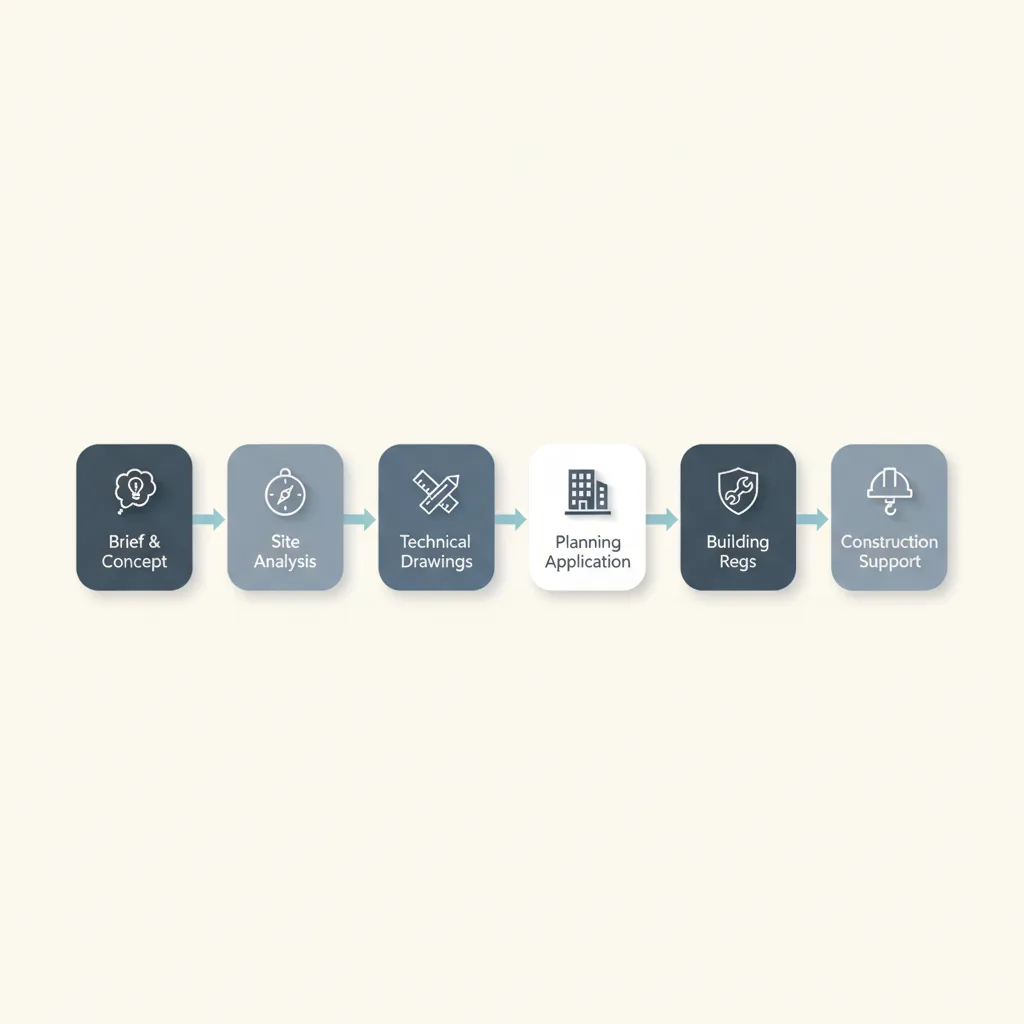
Most days mix creative work with technical detail and client contact. The core responsibilities break down like this:
| Area of work | What it involves |
|---|---|
| Concept and spatial design | Turning a brief and site into layouts, forms, and spatial arrangements |
| Technical drawings and 3D visualisation | Producing construction-ready drawings and visual models |
| Planning applications | Preparing and submitting documents to local planning authorities |
| Building regulations | Detailing drawings so the build meets UK construction standards |
| Site analysis and feasibility | Assessing what a site can realistically support |
| Coordination and construction support | Working with engineers, builders, and clients through to completion |
Concept and spatial design
Every project starts with a brief: how a family wants to live, how a developer wants to use a plot, or how a business needs its space to work. The designer tests options for layout, light, circulation, and form, weighing what the client wants against what the site and budget allow. This early stage sets the direction for everything that follows.
Technical drawings and 3D visualisation
Once a concept is agreed, it becomes precise. Architectural designers produce detailed plans, sections, and elevations, plus 3D drawings that let clients see a proposal before any building work starts. These visuals cut misunderstanding and help clients approve decisions with confidence, while the technical set gives builders the exact information they need on site.
Planning applications and building regulations
In the UK, most projects touch the planning system. Designers prepare and submit planning applications, respond to planning officers, and adjust schemes to meet local policy. Separately, they develop building regulations drawings that show how the design meets standards for structure, fire safety, insulation, and access. These are two different approvals, and knowing how each works is a large part of the job.
Site analysis and feasibility
Before committing to a design, a good designer studies the site: orientation, levels, drainage, neighbouring buildings, access, and local planning history. Thorough site study shapes the quality of the final scheme, a link examined in research published in Frontiers of Architectural Research on the impact of site analysis and representation. Feasibility work at this stage stops clients spending money on ideas a site cannot support.
Coordination and construction support
Design rarely happens in isolation. Architectural designers coordinate with structural engineers, surveyors, and other specialists, and answer builders’ questions once work begins. This support keeps the finished building faithful to the approved design and helps resolve the practical issues that surface on any site.
Architects are often focused on one thing, planning or technical. Me as an architectural designer do everything (incl making my own coffee 🙂 …
Skills and Qualifications of an Architectural Designer
Core skills
The role rewards people who combine creative and technical strengths. The skills that matter most include:
- CAD and BIM proficiency for accurate drawings and models
- Spatial reasoning to design layouts that work in three dimensions
- Working knowledge of UK building regulations and the planning system
- Site and construction awareness so designs can actually be built
- Communication to guide clients, planners, and contractors through decisions
These are the practical architectural designer qualifications that clients and employers value, alongside formal study.
Qualifications and routes into the role
Entry usually follows a design-related education, such as a degree or diploma in architectural technology, architectural design, or a related field, often backed by studio or practice experience. There is no single mandatory licence to work as an architectural designer in the UK, which is the key contrast with the title “architect.” That openness is why routes into the role vary, and why hands-on experience often counts as much as a specific certificate.
Architectural Designer vs Architect: What’s the Difference?
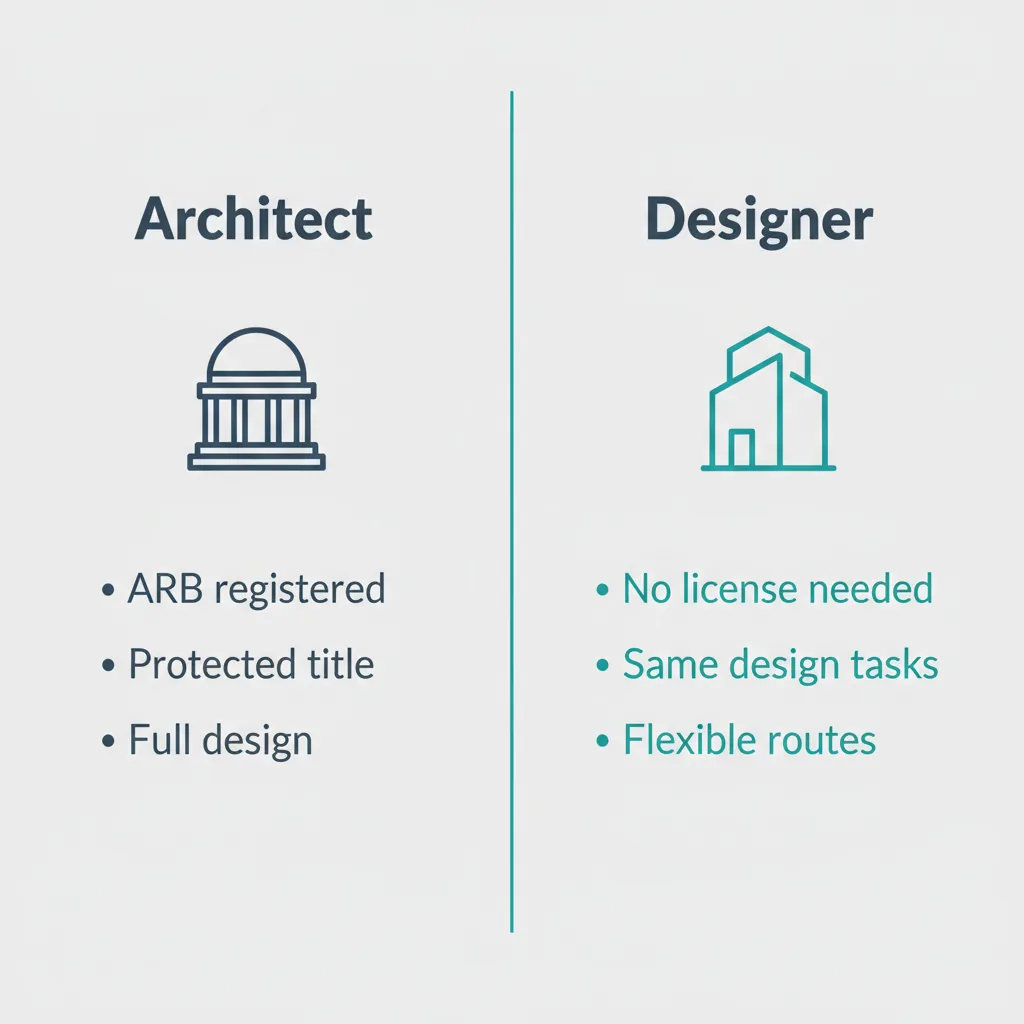
The most common question clients ask is how the two roles differ. In short: “architect” is a legally protected title in the UK, regulated by the Architects Registration Board (ARB), and only people on the ARB register may use it. “Architectural designer” is not a protected title, yet the day-to-day design work overlaps heavily.
| Factor | Architectural designer | Architect |
|---|---|---|
| Title protection | Not a protected title | Protected by law (ARB) |
| Registration | No mandatory register | ARB registration required; often RIBA chartered |
| Typical scope | Concept, drawings, planning, building regs, most domestic and many commercial schemes | Same design scope, plus complex, high-risk, and large projects |
| Typical fees | Often lower for comparable domestic work | Can be higher, reflecting registration and training |
| When needed | Extensions, conversions, straightforward new builds | Listed buildings, large or technically complex schemes |
What does an architect do? An architect is an ARB-registered professional who designs buildings and manages projects, having completed the formal training and examinations required to use the protected title. The design tasks look similar to an architectural designer’s; the difference lies in regulation, formal qualification, and the type of project each is typically suited to.
The same logic answers a related question, the difference between an architect and a building designer: “building designer” is generally another name for an architectural designer, so the same title and registration distinction applies.
On pay, comparisons of an architectural designer vs architect salary usually show architects earning more on average, reflecting registration and training, though experience, region, and project type influence both roles heavily.
The main distinction between an architectural designer and an architect is legal and regulatory, not a measure of skill.
How Much Do Architectural Designers Earn?
Earnings for architectural designers vary widely, so treat any single figure with caution. The main factors are:
- Experience, junior designers earn less than those running projects independently
- Region, London and the South East typically pay more than other UK areas
- Employment type, employed staff earn a salary, while freelance designers set fees per project
- Project mix, commercial and development work can pay more than small domestic jobs
Rather than quote a precise UK figure, it helps to see how the wider profession is measured. The U.S. Bureau of Labor Statistics publishes detailed occupational earnings for architects, a useful benchmark for the field, though it reflects the US market rather than the UK. For accurate current numbers, UK architectural designer job listings and national labour data are the most reliable guides.
As a career, the role suits people who enjoy design, problem-solving, and steady client contact. That blend of creative and technical work is a large part of what makes it a durable job rather than a narrow drafting position.
When Do You Need an Architectural Designer?
For most residential and many commercial projects in the UK, an architectural designer covers everything you need, from first idea to finished build. The real question is matching the professional to the project.
Projects where an architectural designer is ideal
- Home extensions, including rear, side, and wraparound designs
- Loft and garage conversions
- Full property refurbishments and internal reconfigurations
- Straightforward new build homes
- Commercial conversions, such as offices or retail into flats
- Feasibility studies and early planning advice
For these, a full-service practice can run the whole process: feasibility, concept design, planning application, technical and building regulations drawings, and construction support. Handling all of it under one roof keeps a project consistent and gives a wide range of clients, from single homeowners to developers, one point of contact from start to finish.
When a chartered architect may be warranted
Some projects genuinely call for a chartered architect: listed buildings, structurally complex schemes, large-scale developments, or work with high regulatory risk, where formal registration and specialist experience add real value. Being honest about this matters. Choosing the right professional protects your budget and your build, and a good designer will tell you when a project sits outside their ideal scope.
When builders find an architectural designer who helps projects run smoothly, they tend to stay loyal. The reason is simple. They’ve …
The Architectural Design Process Step by Step
Most UK projects move through the same five stages, whichever professional runs them:
| Stage | What happens | Typical output |
|---|---|---|
| 1. Feasibility | Assess site potential, constraints, and rough budget | Feasibility report and options |
| 2. Concept design | Develop layouts and form around the brief | Concept drawings and 3D views |
| 3. Planning application | Submit to the local authority and manage feedback | Planning drawings and documents |
| 4. Technical and building regs | Detail the design to construction standards | Building regulations drawing set |
| 5. Construction support | Answer site queries and coordinate trades | Guidance through to completion |
Two approvals here are often confused. Planning permission is your local council’s agreement that a building can be built in principle, judged on size, appearance, and impact on the area. Building regulations approval is separate and confirms the construction meets standards for safety, structure, energy, and access. Many projects need both, assessed by different routes. Knowing this early prevents delays, because a scheme can pass planning yet still need substantial building regulations detailing before work starts.
Frequently asked questions
What is the role of an architectural designer?
What is the difference between an architect and an architectural designer?
Do architectural designers need qualifications?
Can an architectural designer submit planning applications in the UK?
Is being an architectural designer a good job?
Key Takeaway
An architectural designer takes a project from first idea to finished building: designing spaces, producing drawings and 3D models, handling planning and building regulations, and supporting construction. For most extensions, conversions, and straightforward new builds in the UK, a designer covers everything you need, while complex or listed schemes may point toward a chartered architect.