
What if the ancient oak standing between you and your dream home extension isn’t an obstacle, but the most important design partner you’ll ever have? While many homeowners feel that a Tree Preservation Order (TPO) renders their land undevelopable, these protected landmarks often provide the framework for the most striking property evolutions. Many residents searching for an architectural designer for a property with a Tree Preservation Order (TPO) in Storrington discover that what they actually need is a specialist architectural technologist who masters the intersection of structural integrity and arboricultural health.
It’s natural to feel trepidation when balancing a bespoke vision with the strict planning rules of Horsham District Council. The fear of accidental root damage or a rejected application can be paralyzing. At ArchEvolve, we promise to show you how to navigate these complexities to unlock your property’s potential without compromising its natural heritage. This guide provides a clear technical path for foundations and planning strategies that turn environmental constraints into architectural triumphs, ensuring your 2024 development plans remain firmly on track.
Key Takeaways
-
Understand how Tree Preservation Orders issued by Horsham District Council protect Storrington’s ancient Oaks and Cedars, and what these legal safeguards mean for your development ambitions.
-
Discover how a specialist architectural technologist navigates the complexities of being an architectural designer for a property with a Tree Preservation Order (TPO) Storrington to harmonise your vision with the natural landscape.
-
Explore innovative structural solutions, from cantilevered layouts to tree-friendly foundations, that allow your bespoke extension or new build to sit lightly upon the land.
-
Gain a clear, step-by-step roadmap for securing planning approval through meticulous site surveys and proactive engagement with Horsham District Council’s tree officers.
-
Learn how to transform environmental constraints into a design evolution that enhances your lifestyle while preserving the timeless character of the West Sussex countryside.
Table of Contents
-
What is a Tree Preservation Order (TPO) and How Does it Affect Your Storrington Project?
-
The Role of the Architectural Technologist in Navigating TPO Restrictions
-
Strategic Design Solutions: Foundations and Layouts for TPO Sites
What is a Tree Preservation Order (TPO) and How Does it Affect Your Storrington Project?
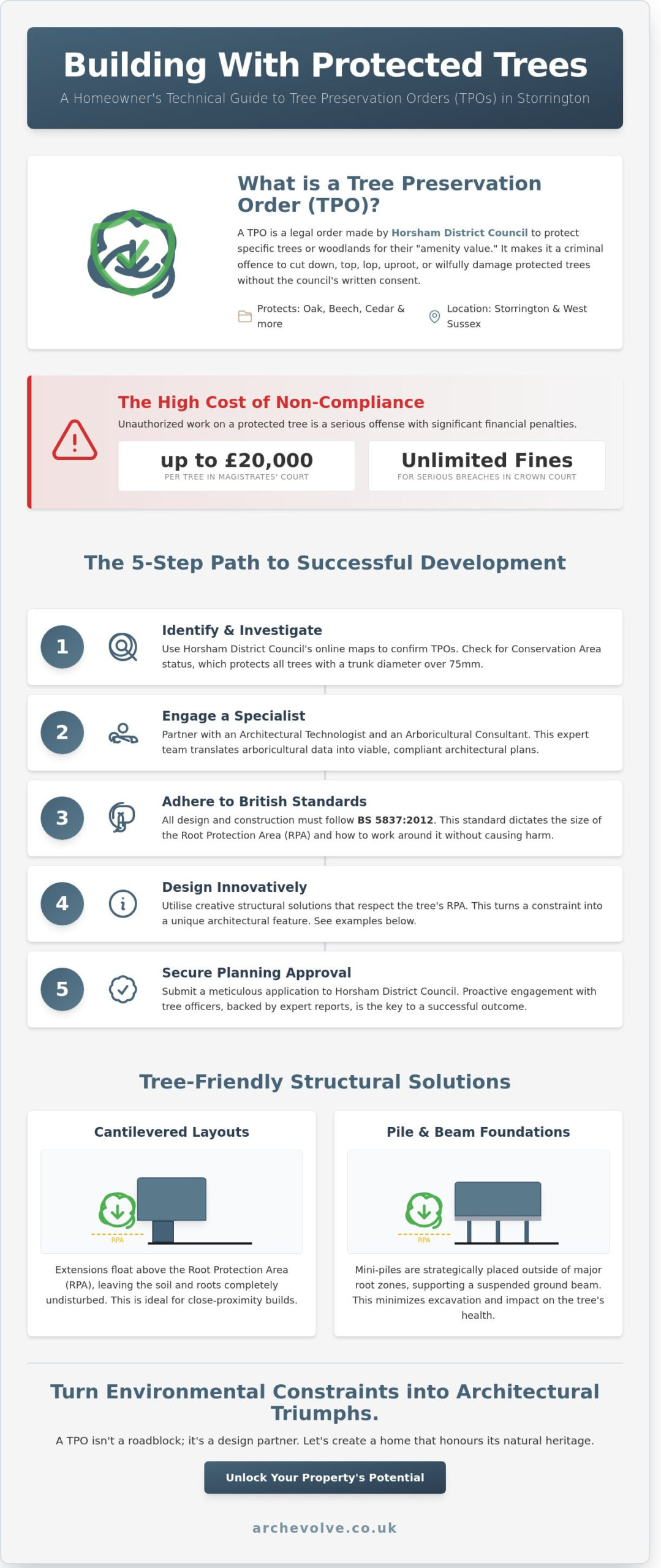
A Tree Preservation Order (TPO) represents a significant legal commitment by Horsham District Council to maintain the aesthetic and ecological character of our local environment. It’s a formal instruction that safeguards specific trees or entire woodlands from being felled, lopped, topped, or deliberately damaged without explicit written consent. In Storrington, these orders often focus on the majestic Oak, Beech, and Cedar specimens that frame our views and ground our properties in history. These trees provide what the council terms "amenity value," a measure of the visual or environmental benefit a tree offers the public and the wider West Sussex landscape.
Understanding what a Tree Preservation Order is remains the first step in any successful site transformation. It isn’t merely a hurdle; it’s a design parameter that shapes the evolution of a home. When searching for an expert to serve as an architectural designer for a property with a Tree Preservation Order (TPO) Storrington, it’s vital to choose a professional architectural technologist who prioritizes technical accuracy. Unauthorized work carries heavy consequences. Penalties can reach £20,000 per tree in a Magistrates’ Court, while the Crown Court can issue unlimited fines for particularly egregious breaches that result in the loss of a protected asset.
Identifying Protected Trees on Your Land
Precise identification begins with the Horsham District Council online mapping tool. This digital resource reveals whether your land is subject to individual TPOs or if it falls within a Conservation Area blanket protection. While an individual order specifies a single tree, Conservation Area status protects every tree with a trunk diameter over 75mm. Identifying these constraints during the initial feasibility stage prevents costly redesigns later and starts your project journey on solid ground. Early detection allows an architectural draftsman to design around the landscape, ensuring a seamless path toward planning approval.
The Legal Implications for Property Development
A TPO doesn’t signal the end of your extension or new build dreams. Instead, it shifts the focus toward technical precision and bespoke engineering. The BS 5837:2012 standard dictates how we design around root protection areas to ensure the tree’s longevity during and after construction. This British Standard is the benchmark for UK planning law and serves as the primary language of communication between your design team and the local authority. Securing an architectural technologist to act as your lead for a property with a Tree Preservation Order (TPO) Storrington is the most effective way to balance development goals with environmental stewardship. In a Storrington planning context, a TPO carries the legal weight of a statutory constraint that requires meticulous mitigation strategies to satisfy council arboriculturists.
The Role of the Architectural Technologist in Navigating TPO Restrictions
Designing a home within the leafy enclaves of Storrington requires more than just aesthetic flair; it demands a deep respect for the living landscape. When you engage an architectural technologist for a property with a Tree Preservation Order (TPO) Storrington, you’re partnering with a professional who views constraints as a catalyst for innovation. We don’t see a TPO as a barrier. Instead, we see it as a defining characteristic of a bespoke site. The process begins with a tree-centric site survey, conducted long before any conceptual sketches take shape. This meticulous data collection ensures the design evolves in harmony with the existing canopy rather than in conflict with it.
Our role involves a seamless coordination with arboricultural consultants to translate biological data into buildable plans. We map the site with precision, ensuring every structural element is positioned to protect the long-term health of the trees. This collaborative approach is vital for securing planning permission from Horsham District Council, where the preservation of the local character is a primary concern. By integrating technical authority with creative vision, we ensure your project moves from a dream to a tangible reality without compromising the natural heritage of West Sussex.
Understanding the Root Protection Zone (RPZ)
The Root Protection Zone is the most critical technical boundary on your site. It’s often misunderstood as a simple circle around the trunk, but it represents the essential volume of soil required to keep the tree viable. Under British Standard 5837:2012, this area is typically calculated as a radius 12 times the stem diameter. It’s a "no-go" area where traditional trenching or heavy machinery can cause irreparable harm. Surface-level soil compaction is a silent killer; it crushes the delicate pore spaces that carry oxygen and water to the roots. We document these zones with absolute precision to ensure the structural integrity of your build remains high while the tree’s biology remains undisturbed.
The Arboricultural Impact Assessment (AIA)
A successful planning application hinges on the Arboricultural Impact Assessment. This mandatory document evaluates how the proposed development will affect the surrounding trees. Your architectural technologist uses the AIA to refine the building footprint, perhaps suggesting a cantilevered floor or specialized pile foundations to bridge over sensitive roots. You should consult the official government guidance on TPOs to understand the legal weight these assessments carry. Following the AIA, we produce Tree Protection Plans (TPP) that act as a blueprint for the construction phase. These plans dictate where protective fencing is placed, ensuring contractors don’t stray into protected territory. This level of detail is what defines a sophisticated property transformation, where every leaf and joist is accounted for in the final vision.
Strategic Design Solutions: Foundations and Layouts for TPO Sites
Building on a site with protected trees requires a shift from standard construction to surgical precision. Traditional trench foundations are often a non-starter near specimen trees because they sever critical roots and destabilise the specimen’s health. When you’re searching for an architectural technologist to act as your architectural designer for a property with a Tree Preservation Order (TPO) Storrington, the design focus shifts to systems that respect the Root Protection Area (RPA). We often propose cantilevered structures that allow a floor plate to "hover" above the ground. This preserves the soil structure while creating a striking, modern aesthetic. Permeable paving is another essential tool in our kit. It ensures that rainwater continues to reach the root system, maintaining the ecological balance required by the official government guidance on Tree Preservation Orders.
Non-Invasive Foundation Techniques
Instead of heavy machinery and deep digging, we utilise screw piles and "pile and beam" systems. These steel anchors are wound into the earth with minimal vibration, bypassing major roots rather than cutting through them. Before a single pile is placed, we often employ air-spades. These tools use compressed air to safely expose root patterns without causing damage. It’s a meticulous process. Horsham planning officers look favourably on these technical solutions because they provide empirical evidence that the tree’s long-term survival is a priority. This technical rigour transforms a potential planning hurdle into a robust, approved strategy for your Storrington home.
Designing for Light and Growth
A tree isn’t a static object. It’s a living entity that will change significantly by 2026 and beyond. Our design process accounts for future canopy spread and height to ensure the building remains functional as the landscape evolves. We use advanced 3D visualisations to model exactly how shadows will move across your living space throughout the seasons. This data helps us position large glass panes where they’ll capture the best light without being obscured by heavy summer foliage. We also address practicalities like seasonal debris. By choosing the right glazing coatings and gutter guards, we ensure the relationship between your home and the protected tree remains harmonious. It’s about creating a bespoke layout where the tree becomes a framed masterpiece viewed from your sofa.
Securing Planning Approval from Horsham District Council
Obtaining consent for development on a site constrained by protected woodland requires a strategic marriage of design ambition and environmental stewardship. Horsham District Council (HDC) maintains a rigorous stance on canopy preservation, meaning your submission must be flawless from the first instance. The process begins with a detailed topographical survey, followed by a formal planning application that explicitly addresses the TPO constraints. Success isn’t merely about following rules; it’s about demonstrating an evolved understanding of the site’s ecology. Engaging an architectural technologist for a property with a Tree Preservation Order (TPO) Storrington ensures that your vision aligns with the council’s Green Infrastructure policies.
Proactive engagement with the HDC tree officer is a cornerstone of our approach. We don’t wait for objections; we initiate a professional dialogue to resolve potential conflicts before the formal consultation period ends. This transparency builds trust and often accelerates the decision-making process. Many applications fail because they treat trees as obstacles rather than assets. Common rejection reasons include insufficient Root Protection Area (RPA) calculations or vague construction methodologies. Our comprehensive planning application management service mitigates these risks by providing the technical depth HDC demands. We transform potential hurdles into design features that enhance the character of the Storrington landscape.
The Pre-Application Consultation
Seeking informal advice from HDC can prevent months of costly delays. This stage allows us to present preliminary sketches that reflect a "protection-first" mindset, showing the council that we’ve already considered the long-term health of the trees. We utilize local precedents in Storrington, such as successful sensitive extensions near the South Downs, to support your case. By referencing specific £1m+ refurbishments that balanced heritage trees with modern living, we provide a proven framework for your project’s approval.
Assembling the Technical Package
The technical submission is the backbone of your application. It must include an Arboricultural Impact Assessment (AIA), a Tree Protection Plan (TPP), and a bespoke Arboricultural Method Statement. These documents prove that the proposed construction won’t compromise the root systems or the canopy. It’s vital that building regulation packages reflect these measures exactly. The ideal relationship between a technical drawing and a tree protection plan is one of total synchronicity, where every structural foundation is mathematically offset to respect the biological limits of the Root Protection Area. This precision ensures that your project is not only beautiful but also legally and ecologically sound.
Ready to transform your Storrington property while respecting its natural heritage? Contact ArchEvolve today to discuss your bespoke design journey.
Preserving Storrington’s Character Through Bespoke Design
True design doesn’t impose itself on the environment; it emerges from it. In Storrington, where the South Downs meet ancient woodland, every structure should feel like a natural evolution of its site. Our architectural technologists specialise in this delicate balance. We don’t see a Tree Preservation Order as a barrier to progress. Instead, we view it as a blueprint for character. A property that respects its surroundings isn’t just beautiful. It represents a long-term investment in the village’s heritage and ecological health.
Transforming Constraints into Features
We’ve successfully designed home extensions that thrive alongside protected specimens. One project in 2023 involved a cantilevered glass room that allowed root systems to remain undisturbed while offering panoramic views of a 200 year old oak. Advanced 3D rendering allows us to show you exactly how light will filter through the canopy into your new living space. This technology helps you fall in love with the "tree-integrated" lifestyle before the first stone is laid. Finding a specialist to serve as an architectural designer for a property with a Tree Preservation Order (TPO) Storrington turns technical hurdles into breathtaking aesthetic statements.
Framing views of ancient woodland or specimen trees adds an emotional depth that standard builds lack. These trees aren’t just obstacles to be avoided; they’re living art pieces that change with the seasons. By integrating these natural features into the floor plan, we create high-quality spaces that feel grounded and timeless. Our meticulous approach ensures that the structural integrity of your home and the biological health of the trees exist in perfect harmony.
Your Journey with ArchEvolve
Our team is committed to visionary, sustainable design across West Sussex. We act as your expert guide through the complex planning landscape, handling the technical details that TPOs require. Whether you’re planning a refurbishment or a new build block, we ensure your project is functional and visually striking. The journey from concept to completion should be exciting rather than overwhelming. Our role is to provide the technical authority and creative spark needed to bring your vision to life.
Your property has the potential to become a local landmark. By choosing an architectural technologist who understands the nuances of an architectural designer for a property with a Tree Preservation Order (TPO) Storrington, you’re choosing a partner invested in your lifestyle. Let’s start that conversation today. Contact our Storrington-based team to discuss how we can elevate your TPO project into something truly extraordinary.
Cultivating Your Vision Within the Storrington Canopy
Building within a protected landscape doesn’t have to stall your vision. It’s an opportunity for a design evolution that respects Storrington’s ancient canopy while enhancing your lifestyle. By employing non-invasive pile-and-beam foundations, we ensure your home’s footprint leaves the root protection areas of Horsham District Council’s most prized trees entirely undisturbed. Our team navigates the specific nuances of South Downs planning policy with a level of precision that transforms technical hurdles into aesthetic triumphs. We use high-end 3D visualisations to provide planners with absolute clarity, ensuring every bespoke detail is understood long before ground is broken. Securing a specialist architectural designer** for a property with a Tree Preservation Order (TPO) Storrington** or a qualified architectural technologist is the first step toward a seamless build. Your project deserves a partner who sees the trees as an asset, not an obstacle. It’s time to move your project from a conceptual sketch to a tangible reality.
Discuss your TPO project with our Storrington design team
Frequently Asked Questions
Can I prune a tree with a TPO if it is overhanging my proposed extension?
You cannot prune a protected tree without formal written consent from Horsham District Council. Even if branches physically overhang your proposed extension, performing unauthorized work is a criminal offence under the Town and Country Planning (Tree Preservation) (England) Regulations 2012. A skilled architectural technologist will design your project to respect the tree’s natural canopy; they’ll often suggest a bespoke pruning application as part of the wider planning journey.
How much does a tree survey (BS 5837) usually cost for a Storrington property?
A BS 5837 tree survey for a standard residential property in Storrington typically costs between £500 and £1,500. This investment provides a meticulous map of Root Protection Areas and categorizes every specimen by its health and longevity. These precise figures depend on the quantity of trees and the site’s topographical complexity. Having this data allows your architectural draftsman to create a viable design that navigates local planning hurdles with technical authority.
Will a TPO significantly increase the cost of my building foundations?
Protected trees often necessitate specialized foundation designs, which can increase substructure costs by 20% to 50% compared to standard footings. Traditional strip foundations are frequently replaced by "no-dig" pile and beam systems to protect sensitive root systems from damage. By engaging an expert architectural technologist for a property with a Tree Preservation Order (TPO) Storrington, you ensure these technical requirements are integrated into your initial budget and design evolution.
What happens if a protected tree is accidentally damaged during construction?
Damaging a protected tree can result in fines of up to £20,000 per tree in a Magistrates’ Court, or unlimited fines if the case reaches Crown Court. Beyond financial penalties, the council often issues a Tree Replacement Notice, requiring you to plant a new specimen of a specific size and species. We implement rigorous Tree Protection Plans to ensure your site remains compliant and your property transformation proceeds without these costly legal disruptions.
Can I get a TPO removed if the tree is in poor health or dangerous?
You can apply to remove a protected tree if a qualified arboriculturist proves the specimen is dead, dying, or poses an immediate safety risk. Horsham District Council typically requires a 5-day notice for urgent safety works, while standard removal applications follow an 8-week decision cycle. Successful removals usually require a commitment to plant a replacement tree, ensuring the verdant character of the Storrington landscape remains preserved for future generations.
Does a TPO apply to the roots of a tree if they cross onto my property from a neighbor?
A TPO protects the entire biological structure of the tree, including any roots that extend beneath your property boundary. You’re legally prohibited from severing these roots without express permission, as it could destabilize the tree or lead to its decline. An experienced architectural draftsman will use survey data to position your new extension or loft conversion outside the Root Protection Area, maintaining a seamless balance between your lifestyle needs and the neighboring environment.
How long does it take for Horsham District Council to decide on a TPO-related application?
Horsham District Council usually reaches a decision on TPO applications within 8 weeks of the application being registered. This timeframe is a statutory requirement, though complex cases involving large-scale property enhancements may take longer if they’re tied to a full planning application. We manage this timeline with professional reliability, ensuring all technical reports are submitted correctly to prevent unnecessary delays in your project’s delivery.
Do I need a TPO application for a small garden room or outbuilding?
You must submit a TPO application if your garden room involves any excavation or construction within the designated Root Protection Area of a protected tree. Even small outbuildings can cause soil compaction or root severance that threatens the tree’s health. When working with an architectural technologist for a property with a Tree Preservation Order (TPO) Storrington, we often specify "no-dig" floor plates to create beautiful, functional spaces that coexist harmoniously with the landscape.