
You’ve measured the space, browsed the ideas, and maybe even spoken to a builder. Then the question hits: do you actually need planning permission before you start?
The short answer is that it depends. Your extension type, size, property location, and whether your permitted development rights are still active all shape the outcome.
What applies to your neighbour’s rear extension may not apply to yours, and the cost of getting planning permission for a house extension in the UK wrong goes well beyond a delayed build.
This article covers:
- When planning permission is and is not required
- What permitted development rights allow in 2026
- The difference between planning permission and building regulations
- What steps to take before spending money on drawings or builders
Do I Need Planning Permission for a House Extension in the UK?
Not always. Many UK home extensions qualify as permitted development, meaning they can go ahead without a formal planning application. That classification comes with strict size, placement, and design conditions that all have to be met at the same time.
In the year ending December 2025, local planning authorities across England made 154,500 decisions on householder development applications, accounting for 51% of all planning decisions nationally.
Of those, 90% were granted. Planning permission for a house extension in the UK works reliably when homeowners understand which route applies from the start.
| Scenario | Likely Outcome |
| Small single-storey rear extension on a standard house | Likely permitted development |
| Double-storey rear extension | Likely needs full planning permission |
| Any extension on designated land or conservation area | Check with local authority before proceeding |
The Fastest Way to Think About the Answer
Run through four checks before booking an architect or pricing a build. Each one can change the answer.
| Check | What to Review | Why It Matters |
| Extension type | Rear, side, wrap-around, double-storey | Each type carries different PD limits |
| Property type | House, flat, listed building | Flats and listed buildings fall outside standard PD |
| Location | Standard residential or designated land | Designated zones often require full planning |
| Prior extensions | What has already been built | Past builds count against your current PD allowance |
Understanding how far you can extend your house without planning permission depends on all four factors working together. Missing even one can push a project from permitted development into a full formal application.
Why Getting This Wrong Can Be Costly
Building without permission where it is required is a breach of planning control. District planning authorities in England issued 905 enforcement notices in the quarter to September 2025 alone, according to GOV.UK data.
Since April 2024, the Four-Year Rule has been abolished. Under the Levelling Up and Regeneration Act 2023, all unauthorised extensions now fall under the Ten-Year Rule.
Any unlawful build must exist continuously and without enforcement action for a full decade before it can be regularised, and a Certificate of Lawfulness is still required after that period.
An unauthorised extension can also block a future property sale. Solicitors will flag it, and mortgage lenders may withdraw.
When an Extension May Be Allowed Under Permitted Development
Permitted development rights allow certain home improvements to proceed without a formal planning application. These rights come from the Town and Country Planning (General Permitted Development) (England) Order 2015 and apply to most houses in England.
In the quarter to December 2025, large householder extensions accounted for 53% of all permitted development right applications nationally. The route is established and widely used.
| Extension Type | Standard PD Limit | Larger Home Extension (Prior Approval) |
| Rear extension on a detached house | 4m depth | Up to 8m depth |
| Rear extension on a semi-detached or terraced house | 3m depth | Up to 6m depth |
| Side extension | Single-storey, max 50% of original house width | Not available under this scheme |
| Double-storey extension | Not permitted under PD | Full planning permission required |
Rear Extensions
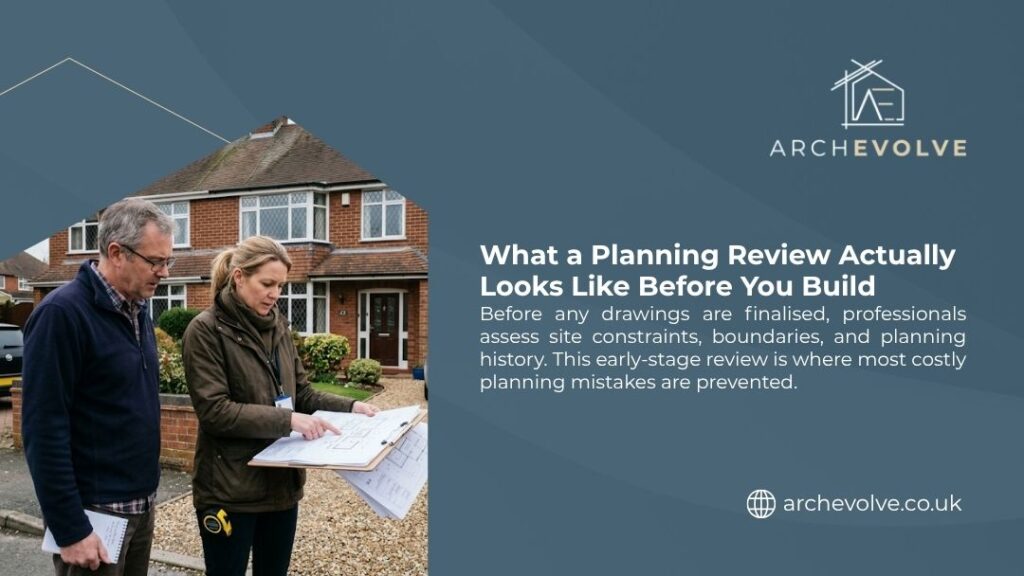
Rear extensions are the most searched scenario. For a detached house, a single-storey rear extension can go up to 4 metres under standard permitted development, or up to 8 metres through the Larger Home Extension prior approval route.
For semi-detached and terraced homes, those limits are 3 metres and 6 metres respectively. In the quarter to December 2025, most of permitted development right applications were approved without needing to go through the full planning process.
| Scenario | Route |
| Rear extension within standard depth limits | Permitted development |
| Rear extension beyond standard PD limits | Prior approval (neighbour consultation required) |
| Rear extension on designated land | Full planning permission typically required |
Side Extensions and Boundary Checks
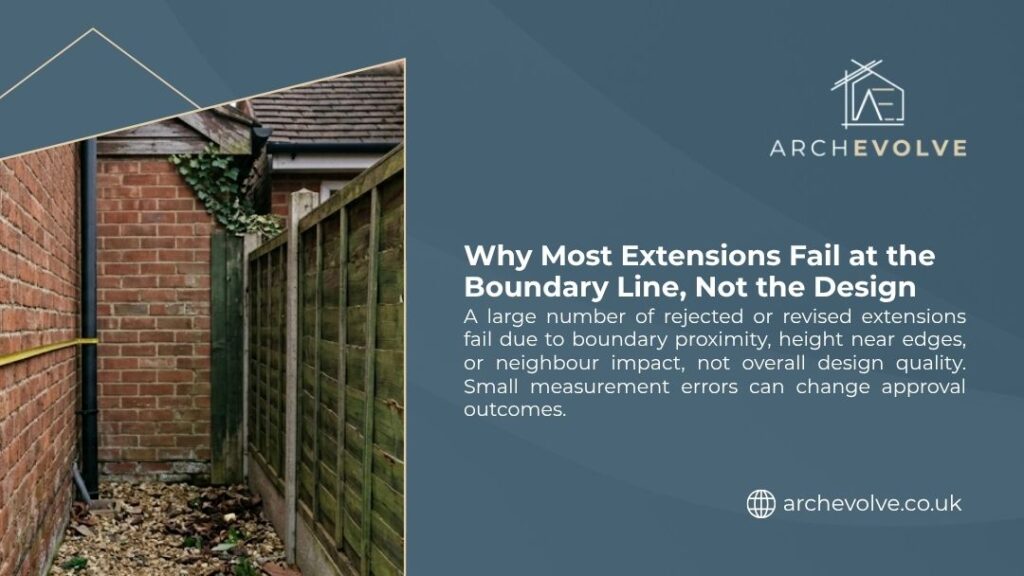
Side extensions attract closer scrutiny. The maximum permitted under PD is 50% of the original house width, and the extension must be single-storey only.
What catches homeowners out is how the rules interact. Width, eaves height, boundary proximity, and land designation all compound.
A side extension that appears to meet the width limit can still fall outside PD if the roof height exceeds the threshold, or if the footprint connects to a previous addition in a way that pushes total coverage past the permitted amount.
| Condition | Requirement |
| Width | Maximum 50% of the original house width |
| Height | Eaves must not exceed 4m for a pitched roof |
| Land type | Designated land restricts PD rights for side additions |
| Prior side builds | Existing additions count toward total width coverage |
Height, Roofline, and Overall Limits
Every PD extension must stay within overall scale and height limits, and cannot cover more than 50% of the original curtilage.
| Measurement | Within PD | Likely Requires Planning |
| Single-storey eaves height | Maximum 4m | Anything above 4m |
| Total coverage of curtilage | Up to 50% | Over 50% |
| Ridge height | Must not exceed existing ridge | Any excess triggers a formal application |
When Planning Permission Is Usually Required
Some projects will almost always need a full application. Identifying these early prevents significant wasted cost.
| Situation | Planning Permission Required |
| Double-storey extension | Yes, in almost all cases |
| Extension on designated land | Yes |
| Flat or maisonette extension | Yes (standard household PD rights do not apply) |
| PD rights removed by Article 4 Direction | Yes |
| Any extension exceeding PD limits | Yes |
Designated Land, Conservation Areas, and Similar Restrictions
Properties in conservation areas, national parks, Areas of Outstanding Natural Beauty, the Broads, or World Heritage Sites face additional restrictions. Extensions that qualify as PD in a standard residential area often require a formal application in these locations.
The rules you need to follow if you want to extend your house in a conservation area are considerably more restrictive, with materials, design, and the impact on the surrounding street scene all assessed in detail.
| Location | Impact on Permitted Development |
| Standard residential area | Standard PD conditions apply |
| Conservation area | Some works require full planning; materials more closely assessed |
| National Park or AONB | Scale and appearance more tightly controlled |
| Listed building | Listed Building Consent required in addition to any planning permission |
Flats, Converted Homes, and Removed Rights
Household permitted development rights apply to houses only. Flats, maisonettes, and many properties created through change-of-use conversions are excluded from the standard PD framework.
Some properties have also had their rights removed by an Article 4 Direction, a council decision to apply extra planning controls in specific areas. Parts of Hillingdon and Buckinghamshire are notable examples where PD rights have been removed for even small extensions.
| Property Type | Eligible for Standard Household PD |
| Detached, semi-detached, or terraced house | Yes, subject to all PD conditions |
| Flat or maisonette | No |
| Listed building | No (requires separate consent) |
| Property under Article 4 Direction | No |
What Happens If You Build Without Permission
If a project needed planning permission and it was not obtained, the local authority can issue an enforcement notice requiring modification or demolition within a set timeframe. Appeals against enforcement notices succeed in approximately 30% of cases nationally.
The Ten-Year Rule means there is no quick route to immunity for any breach occurring after April 2024. Non-compliance with an enforcement notice is a criminal offence.
Planning Permission vs Building Regulations and What to Do Next
These are two separate approvals, and one does not replace the other. This causes more confusion than almost any other aspect of planning permission for a house extension in the UK.
| Approval | What It Covers | When Required |
| Planning permission | Whether the development is acceptable: size, location, appearance, neighbour impact | When the project exceeds PD limits or sits in a restricted area |
| Building regulations | How the build is carried out: structure, insulation, fire safety, drainage | Almost always required for extensions, regardless of PD status |
| Lawful development certificate | Legal confirmation the project qualifies as permitted development | Optional but strongly recommended before starting |
What Planning Permission Covers
Planning permission assesses whether the development is acceptable in broader planning terms, covering size, appearance, placement on the plot, and the impact on the local streetscene and neighbouring properties.
The statutory determination period is 8 weeks, though some councils in 2026 are running at 12 weeks due to backlogs.
Prior approval decisions under the Larger Home Extension route must be made within 42 days.
What Building Regulations Cover
Building regulations sit entirely separately from planning. They govern how the work is carried out: structural calculations, thermal performance, fire compartmentation, ventilation, and drainage.
Most extensions require building regulations approval even when no planning application is needed.
Planning permission does not mean you can bypass building regs. Both approvals need to be in place before work starts. To check which approval covers what on your own project, read our dedicated comparison guide. Our companion piece, building regulations for house extensions explained, walks through each approved document in turn.
The Safest Next Steps Before You Start
| Step | What to Do | Why |
| 1 | Check your property’s planning history | Prior extensions count against current PD limits |
| 2 | Confirm any Article 4 Directions with your local authority | Verifies whether PD rights are still in place |
| 3 | Use the Planning Portal interactive guide | Helps identify which route applies |
| 4 | Apply for a Lawful Development Certificate | Provides legal certainty before building starts |
| 5 | Take professional architectural or planning advice | Prevents costly errors before any money is committed |
For those also considering the roof space, the rules around planning permission for a loft conversion follow a similar framework, with PD conditions shaped by cubic volume limits, ridge height, and the extent of any roof alterations.
A well-executed extension can add between 5% and 20% to a property’s value depending on extension type, quality, and location. Getting planning permission for a house extension in the UK right from the start is what protects that return.
Frequently Asked Questions
Do I need planning permission for a house extension in the UK?
Not always, as many extensions fall under permitted development rights and can proceed without a formal application. The answer depends on extension type, size, property type, and location.
Do I need planning permission for a rear extension?
In many cases, no. Under standard PD rules, a single-storey rear extension can be up to 4 metres on a detached house or 3 metres on a semi-detached or terraced property.
Through the Larger Home Extension prior approval route, those limits rise to 8 metres and 6 metres respectively.
Do I need planning permission for a side extension?
A side extension can fall within PD if it is single-storey, does not exceed 50% of the original house width, and meets all other conditions. If any condition is breached, a full planning application is required.
What is the difference between planning permission and permitted development?
Planning permission is a formal approval granted by your local planning authority. Permitted development is a right granted by Parliament that allows certain works to proceed without applying for planning permission, provided all specified conditions are met.
What happens if I build an extension without planning permission?
The local authority can issue an enforcement notice. Since April 2024, all planning breaches fall under the Ten-Year Rule, and the old four-year immunity period no longer applies. Non-compliance with an enforcement notice is a criminal offence.
Get Your Extension Right From the Start
Planning permission for a house extension in the UK is not a blanket requirement. For straightforward projects, permitted development rights offer a clear and cost-effective route.
Archevolve has spent 15 years helping UK homeowners navigate exactly this process, with over 500 completed projects across residential extensions, new builds, and planning applications.
We know where the UK planning system creates delays, and where it creates real opportunity to build something that adds lasting value to your home.
From your first feasibility check through to planning approval and construction documentation, we handle every stage with the same attention to detail. No guesswork, no surprises, no wasted spend on designs that were never going to get approved.
Book a free consultation with Archevolve today and find out exactly what your extension project needs to move forward.