
Are you planning to expand your living space through a loft conversion but not sure whether your project qualifies under permitted development or needs a formal application?
Most loft conversions fall under permitted development rights, which means a formal planning application is not required. What changes that answer is the property type, its location, and what the design does to the roof.
Planning permission for a loft conversion becomes necessary when a project exceeds permitted development limits, involves restricted property types, or sits in a designated area. Getting clarity on this before any design work starts can save significant time and money.
This article covers:
- When planning permission for a loft conversion is and is not required
- The conditions needed to qualify under permitted development
- What pushes a project into full planning application territory
- The difference between planning permission and building regulations
- A practical checklist to confirm your own property’s planning position
This guide is written from Archevolve’s 15+ years of experience in architectural design and planning consultancy, helping UK homeowners turn unused roof space into compliant, habitable, and value-adding rooms.
Do I Need Planning Permission for a Loft Conversion?
For most houses in England, planning permission for a loft conversion is not required.
Permitted development rights allow homeowners to convert roof space without a formal application, provided the design stays within a defined set of conditions.
Those conditions are more specific than many homeowners expect.
The answer depends on five things: property type, location, what changes are planned to the roof, the volume being added, and the permitted development rights that apply to the site.
Understanding the broader rules around planning permission for a house extension in the UK gives useful context for where loft conversion rules sit within the wider permitted development framework.
| Situation | Likely Route |
| Rooflight conversion, standard house | Permitted development |
| Rear dormer, within volume limits | Permitted development |
| Mansard conversion | Full planning permission |
| Front dormer facing a highway | Full planning permission |
| Property in conservation area | Full planning permission |
What “Permitted Development” Means
Permitted development is a right granted by Parliament through the Town and Country Planning (General Permitted Development) (England) Order 2015. It allows certain types of work to proceed without a planning application, provided they comply with specific conditions.
It is not a blanket approval. Every project must individually satisfy the relevant limits. If any condition is not met, the work moves outside permitted development and a formal application is needed.
Why There Is No Single Yes or No Answer
Two identical-looking houses can sit in completely different planning positions. A detached home in a standard residential area has far greater permitted development flexibility than a terraced property in a conservation area, or a flat anywhere in the country.
Roof type, house type, the scale of proposed changes, previous alterations, and local designations all affect the outcome. Checking each factor individually is the only reliable approach.
When a Loft Conversion Usually Does Not Need Planning Permission
Most loft conversions proceed under permitted development.
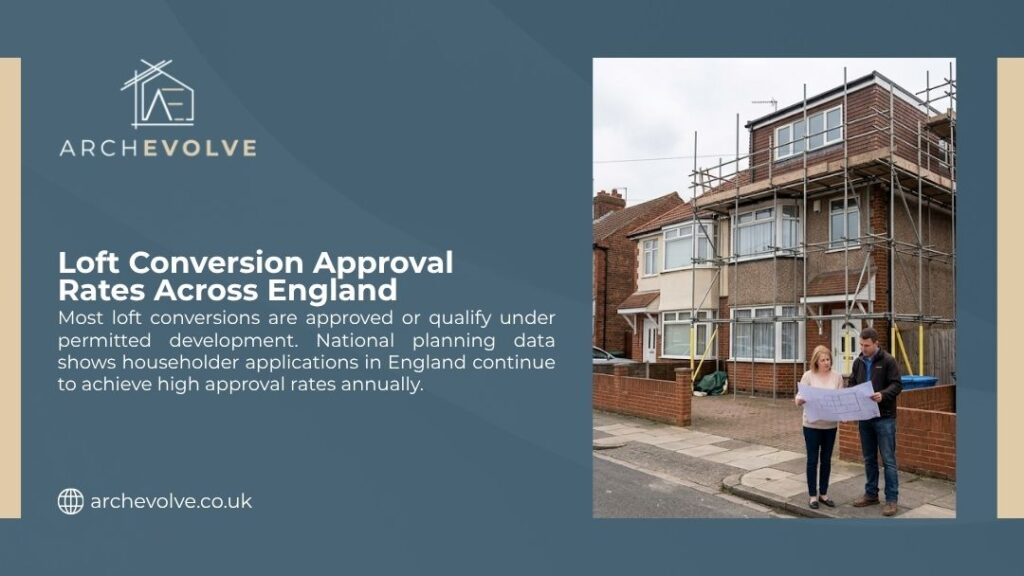
In the year ending September 2025, authorities across England granted 90% of all householder planning applications, according to GOV.UK data.
Projects that stay within permitted development limits avoid the application process entirely.
The core conditions for permitted development are:
- Total additional roof space must not exceed 40 cubic metres for terraced houses
- For detached and semi-detached houses, the limit is 50 cubic metres
- The conversion must not rise higher than the existing roof’s highest point
- Materials must match the appearance of the original house
- No side-facing windows overlooking neighbouring properties
- No verandas, balconies, or raised platforms
- The property must not be a flat, maisonette, listed building, or in a designated area
| Condition | Terraced House | Detached or Semi-Detached |
| Maximum additional roof volume | 40 cubic metres | 50 cubic metres |
| Must not exceed existing ridge height | Yes | Yes |
| Side windows permitted | No | No |
| Flats and maisonettes included | No | No |
House Types That Are More Likely to Qualify
Standard dwellinghouses, including terraced, semi-detached, and detached homes, are the most likely to qualify under permitted development. Flats and maisonettes do not benefit from the same rights and will almost always require a full application.
This distinction catches many homeowners off guard. Schedule 2, Part 1, Class B of the GPDO applies specifically to dwellinghouses. A converted house split into flats is treated differently, even if it looks like a standard property from the outside.
| Property Type | Permitted Development Available? |
| Terraced house | Yes, within limits |
| Semi-detached house | Yes, within limits |
| Detached house | Yes, within limits |
| Flat or maisonette | No |
| Listed building | No |
| Conservation area property | Restricted |
Common Features That Can Stay Within the Rules
Many standard designs fall comfortably within permitted development. A rooflight conversion, which fits Velux-style windows into the existing roof slope without altering the roofline, is the most straightforward case.
A rear dormer within the cubic metre limits is also commonly achievable, provided it does not face a highway, does not exceed the ridge height, and uses matching materials.
Why Building Regulations Still Matter Even Without Planning Permission
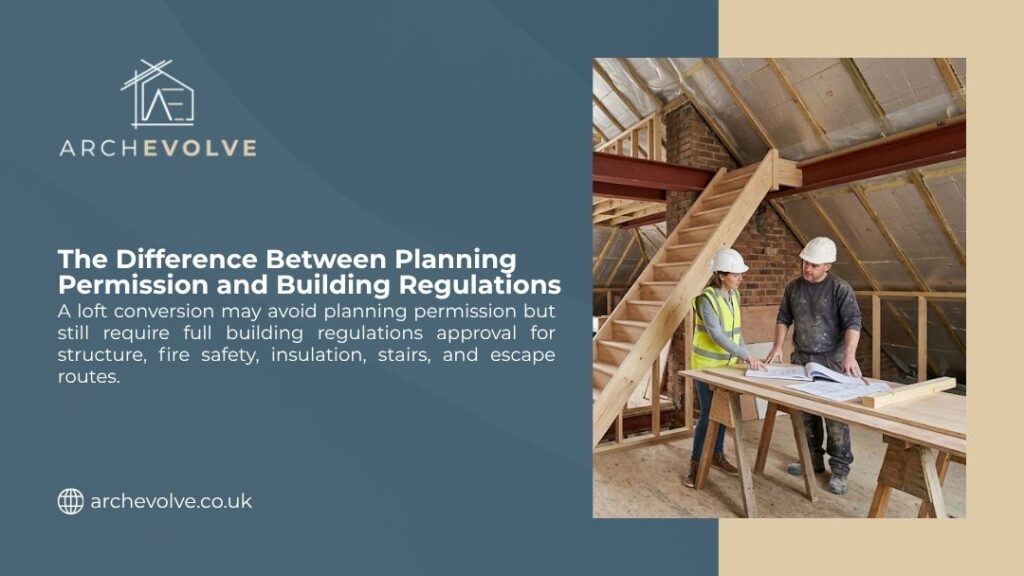
Permitted development only addresses whether the work can proceed in planning terms. It says nothing about how the work is built. Building regulations approval is a separate legal requirement and applies to almost all loft conversions.
The most recent update to building regulations for loft conversions came into force in January 2024, with changes to stair accessibility, energy efficiency, and fire safety standards. A compliant build is not optional.
The Situations That Usually Trigger Planning Permission
Some loft conversion designs fall outside permitted development automatically. Knowing these triggers before commissioning any drawings is the clearest way to avoid wasted spend.
Extending your house without planning permission in any form carries real risk when the project has not been properly checked against the permitted development conditions. The same applies to loft work that exceeds the limits but proceeds without a formal application.
| Trigger | Why It Matters | Permission Needed? |
| Conversion exceeds volume limits | Breaches PD conditions | Yes |
| Front dormer facing a highway | Affects street appearance | Yes |
| Balcony or raised platform added | Explicitly excluded from PD | Yes |
| Mansard conversion | Alters the entire roof profile | Yes |
| Property in a conservation area | PD rights restricted or removed | Yes |
| Flat or maisonette | Not covered by standard PD | Yes |
Roof Height or Roof Volume Changes
Exceeding the volume allowance is the most common trigger for planning permission for a loft conversion. Once additional roof space passes 40 cubic metres for a terraced property, or 50 for a detached or semi-detached home, permitted development no longer applies.
Raising the ridge line is a separate trigger. In older properties where the existing roof space lacks sufficient headroom, this is a common temptation. Any alteration that pushes the roof higher than its current peak falls outside permitted development regardless of volume.
Dormer Windows, Balconies, and Side-Facing Windows
Dormers are widely misunderstood. A rear dormer within the volume limits, set back at least 20cm from the existing wall face, can fall under permitted development. A front dormer facing a highway cannot, regardless of size.
Balconies and raised platforms are excluded from permitted development entirely. Any conversion incorporating one requires a full application from the outset.
| Feature | Permitted Development? |
| Rear dormer, within limits | Yes |
| Front dormer facing highway | No |
| Side dormer | No |
| Balcony or raised platform | No |
| Rooflight (Velux-style) | Yes |
| Hip-to-gable, within limits | Often yes |
Conservation Areas, Listed Buildings, Flats, and Maisonettes
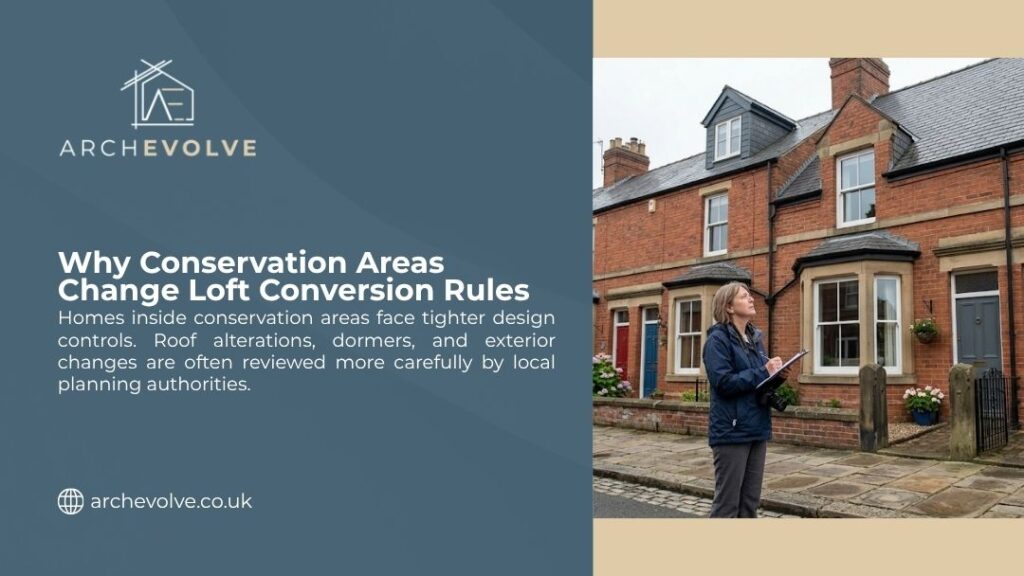
Properties in conservation areas, national parks, Areas of Outstanding Natural Beauty, or with listed building status do not benefit from standard permitted development rights for loft conversions. A formal application is always required.
For homeowners also considering a ground-floor project, the rules around extending your house in a conservation area follow a similarly strict framework, with design, materials, and street visibility all assessed as part of the decision.
Planning Permission vs Building Regulations
This is the distinction that causes the most confusion. They are separate approvals with different purposes, and one does not replace the other. For a side-by-side look at which body signs off each stage of your loft project, see our guide on how planning and building regs differ.
| Planning Permission | Building Regulations | |
| Purpose | Controls if the work is acceptable | Controls how the work is built |
| Who assesses it | Local planning authority | Building control officer |
| When it applies | Before work starts | Throughout and after construction |
| If missing | Enforcement action, possible removal | Safety issues, problems at resale |
What Planning Permission Actually Checks
Planning permission looks at the external impact of the proposal. It asks whether the loft conversion is acceptable in principle, considering how it affects the property’s appearance, its neighbours, and the surrounding area.
If permitted development applies, this check is carried out by the rules themselves.
What Building Regulations Actually Check
Building regulations cover the technical and safety aspects of the build. For loft conversions, the five areas assessed are:
- Structural stability, including floor joists, steels, and load-bearing walls
- Fire safety, covering fire doors, escape routes, and smoke detection
- Staircase design, including headroom, pitch, and width
- Thermal insulation and energy performance
- Ventilation for habitable rooms
These apply to all conversions, including those under permitted development. Our full guide to building regulations for loft conversions walks through each approved document in turn, with practical examples. The January 2024 update tightened requirements specifically around stair accessibility and energy efficiency standards.
Why Both Approvals Matter Before You Start
A loft conversion that proceeds under permitted development but without building regulations approval creates a compliance gap. This surfaces during conveyancing.
Buyers’ solicitors routinely request building regulations sign-off as part of the sale process, and missing documentation can reduce a property’s value or cause a transaction to stall.
How to Check Your Own Loft Conversion Before Spending on Drawings
| Step | Action | Why It Matters |
| 1 | Confirm your property type | Flats and maisonettes are excluded from standard PD |
| 2 | Check your location | Conservation areas and listed buildings need full applications |
| 3 | Measure your proposed additional volume | Volume limits are fixed and non-negotiable |
| 4 | Confirm your design intent | Front dormers and balconies always trigger an application |
| 5 | Check for Article 4 Directions | These remove PD rights in specific areas |
Check Your Property Type First
| Property Type | PD Available? | Notes |
| Terraced house | Yes | 40m³ limit applies |
| Semi-detached | Yes | 50m³ limit applies |
| Detached house | Yes | 50m³ limit applies |
| Flat or maisonette | No | Full planning required |
| Listed building | No | Listed building consent also required |
Check Your Location and Planning Restrictions
A property’s location can change the planning position entirely. Conservation areas and listed buildings require full applications for all loft conversions.
Some areas also carry Article 4 Directions, which remove specific permitted development rights at a local level.
The local planning authority’s online portal is the most reliable place to check this before any design costs are committed.
Check the Design Changes You Are Planning
| Design Element | Small Scale | Large Scale |
| Roof alteration | May stay within PD | Likely exceeds PD limits |
| Dormer | Rear within limits: PD | Front-facing or oversized: full application |
| Window addition | Rooflights: PD | Side-facing: full application |
| Balcony or platform | Never PD | Always requires a full application |
What to Do Next If Your Loft Conversion Needs Planning Permission
A formal application is more manageable than most homeowners expect.
A well-prepared application with the right drawings and supporting documents has a strong chance of success.
| Step | Purpose | Outcome |
| Pre-application advice | Reduces refusal risk | Early steer from planning officer |
| Appoint an architect | Produces compliant, approvable drawings | Scheme aligned with local planning policy |
| Submit planning application | Formal council assessment | Decision within 8 weeks for standard applications |
| Obtain building regulations approval | Ensures structural and safety compliance | Required before and throughout construction |
| Apply for Lawful Development Certificate | Written confirmation of PD status | Legal protection at sale or remortgage |
When to Speak to an Architect or Planning Consultant
Early professional advice prevents the most common and expensive mistake: commissioning detailed drawings for a scheme that cannot be approved.
A small investment in professional guidance at the start costs far less than redesigning after a refusal or, worse, removing unauthorised work.
What Documents and Drawings Are Usually Needed
| Document | Purpose |
| Existing floor plans and elevations | Establishes the current property layout |
| Proposed floor plans and elevations | Shows the planned changes in detail |
| Roof plan | Identifies changes to the roof profile |
| Site plan | Locates the property within its plot |
| Design and access statement | Explains design decisions and compliance |
FAQs
Do I need planning permission for a loft conversion in the UK?
Most standard loft conversions fall under permitted development and do not require a formal planning application, provided the project stays within volume limits, does not alter the front roofline, and is carried out on a standard house rather than a flat or maisonette.
What loft conversions need planning permission?
Planning permission for a loft conversion is required when the project exceeds permitted development volume limits, involves a front-facing dormer, includes a balcony, or is on a flat, listed building, or property within a conservation area.
Does a dormer loft conversion need planning permission?
A rear dormer within permitted development size limits can proceed without an application. A front-facing dormer, an oversized dormer, or one on a restricted property will require full planning permission.
Do I still need building regulations approval if I do not need planning permission?
Yes, building regulations approval is separate and applies to almost all loft conversions regardless of the planning route. The January 2024 update introduced tighter requirements for stair design, fire safety, and energy efficiency.
Getting the Process Right From the Start
Planning permission for a loft conversion is not the obstacle most homeowners fear.
With 90% of householder applications approved across England in 2025, and a clear permitted development route available for most standard houses, the process is far more achievable than it often appears.
The homeowners who run into problems are usually those who skip the early checks, assume permitted development applies without confirming it, or build without securing building regulations approval.
With 15+ years of experience and over 500 completed projects across residential loft conversions, Archevolve guides UK homeowners through every stage, from feasibility and design through to planning submission and building regulations sign-off.
Get in touch with Archevolve today and find out exactly where your project stands before any money is committed.