
Most homeowners searching this question already have a project in mind. They know what space they need. What they do not know is how much of it they can legally build before a formal planning application becomes necessary.
The answer is never one number. It shifts depending on your house type, the direction of the extension, its height, what has already been built, and where the property sits. This article covers:
- The core size limits for rear, side, and two-storey extensions
- The three approval routes and when each one applies
- Which conditions silently change the answer
- Real-world scenarios that show the rules in practice
- What to check before spending money on drawings or builders
What Actually Decides How Far You Can Extend
There is no single distance that applies to every home. The limit depends on five things working together: house type, extension direction, height, original house measurements, and whether the property sits within a designated area or has had permitted development rights removed.
Understanding the rules around planning permission for a house extension in the UK is the first step before any design work begins.
The Three Approval Routes Every Homeowner Needs to Know
| Route | What It Is | When It Applies |
| Permitted development | A right granted by Parliament; no application needed | Extensions within size and condition limits |
| Prior approval (Larger Home Extension) | Lightweight council check; neighbour consultation required | Single-storey rear extensions beyond standard PD limits |
| Full planning permission | Formal application assessed by local authority | Double-storey, over-limit, or restricted area projects |
Think of these as a scale. A modest rear extension sits comfortably at the first level. A larger rear extension moves to the second. Anything more complex or ambitious requires a full application.
Why the Original House Matters More Than the Current Layout
The rules do not measure from where your house currently ends. They measure from the original house, meaning the property as it was first built, or as it stood on 1 July 1948 for older properties.
If a previous owner added a 2m rear extension, that 2m already counts against your permitted development allowance. You are not starting from scratch.
The Main Rules for Rear, Side, and Double-Storey Extensions
Which type of extension are you planning? Each carries a different set of limits, and knowing which rule applies to your case saves time before any professional is involved.
Single-Storey Rear Extensions
For a detached house, a single-storey rear extension can go up to 4 metres under standard permitted development. For a semi-detached or terraced home, that limit drops to 3 metres.
If the project needs more depth, the Larger Home Extension route allows up to 8 metres for detached homes and 6 metres for all other types, through a prior approval process.
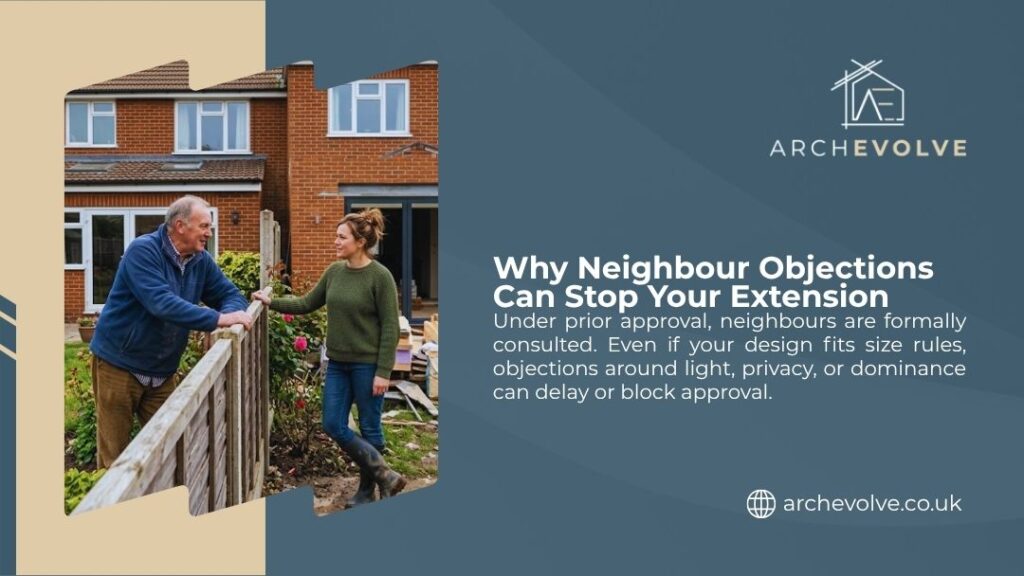
The council notifies neighbours and has 42 days to respond. The prior approval application currently carries a fee of £120 and has no planning fee equivalent to a full householder application.
| Scenario | Route |
| Rear extension within standard depth limits | Permitted development, no application needed |
| Rear extension beyond standard PD limits | Prior approval, neighbour consultation required |
| Rear extension on conservation area or designated land | Full planning permission typically required |
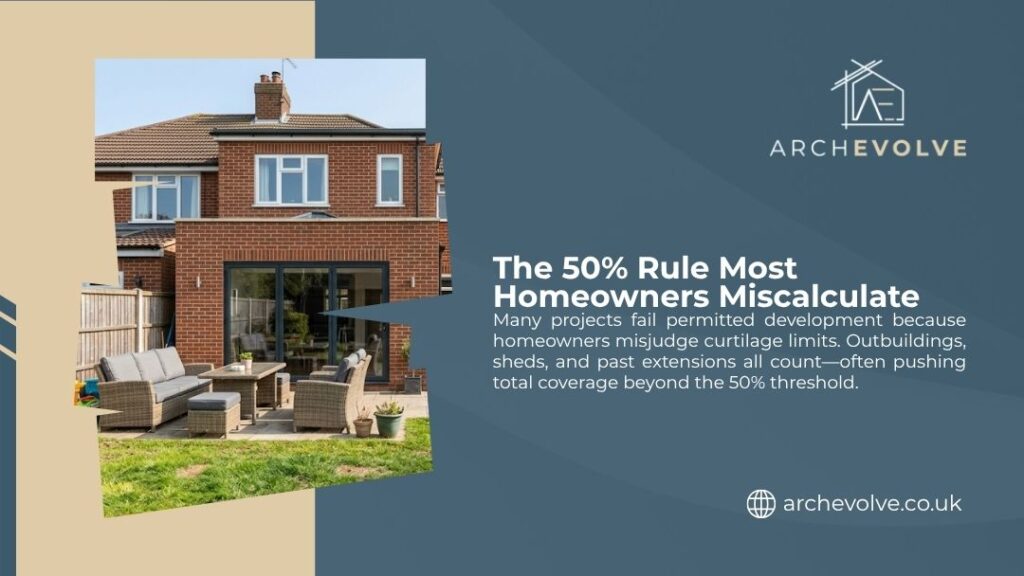
All rear extensions must also stay within 50% of the original curtilage, use materials that match the existing house, and keep eaves and ridge height within the existing roofline.
Side Extensions and Why Width Limits Matter
Side extensions follow a different logic. The key restriction is not just how far the extension projects but how wide it is relative to the original house.
Under permitted development, a side extension cannot exceed 50% of the original house width. It must be single-storey only, with a maximum eaves height of 4 metres. Where the extension comes within 2 metres of a boundary, that leaves height drops to 3 metres.
| Condition | Requirement |
| Width | Maximum 50% of the original house width |
| Height (standard) | Eaves must not exceed 4m |
| Height (near boundary) | Eaves must not exceed 3m within 2m of boundary |
| Number of storeys | Single-storey only under PD |
A narrow kitchen side return is generally straightforward under these rules. A full-width side addition that pushes past the width limit, or combines with a rear element to create a wraparound, is where most homeowners run into difficulty.
Double-Storey Extensions and Wraparound Designs
Double-storey extensions are more restricted. Under permitted development, the extension cannot project more than 3 metres beyond the rear wall of the original house and must sit at least 7 metres from the rear boundary.
The roof pitch must match the existing house, and eaves and ridge height cannot exceed the existing structure.
All side extensions of more than one storey require full planning permission. On designated land, rear extensions of more than one storey also require a full application.
| What Usually Makes a Double-Storey Fail PD |
| ✔ Projection beyond 3m from the original rear wall |
| ✔ Less than 7m clearance from the rear boundary |
| ✔ Side element of more than one storey |
| ✔ Located on conservation area or designated land |
| ✔ Roof pitch that does not match the existing house |
Wraparound extensions combine rear and side elements. They often fail PD because the combined footprint exceeds the width limit or the total curtilage coverage passes 50%, even when each component looks modest on its own.
The Rules That Quietly Change the Answer
Two identical-looking homes can have completely different planning positions. The difference usually comes from location, history, or previous alterations.
Conservation Areas, Listed Buildings, and Designated Land
Properties in conservation areas, national parks, Areas of Outstanding Natural Beauty, the Broads, or World Heritage Sites face tighter controls. Extensions that qualify as permitted development in a standard residential area often require a formal application in these locations.
The rules around extending your house in a conservation area apply strict assessment to materials, scale, and visual impact on the surrounding streetscene.
| Area Type | Impact on Permitted Development |
| Standard residential area | Standard PD conditions apply |
| Conservation area | Additional restrictions; materials and appearance assessed |
| National Park or AONB | Scale and design more tightly controlled |
| Listed building | Listed Building Consent required alongside any planning |
Previous Extensions and Why Cumulative Work Matters
If a rear extension was built after 1948, it does not become part of the original house. Any further extension is measured from the original rear wall, not the end of the existing addition.
This means a 2m existing extension and a proposed 3m new extension together produce a 5m projection from the original house, which exceeds the standard limit for an attached property.
The same principle applies to curtilage coverage. Any outbuildings, garages, or existing additions all count toward the 50% total.
Planning Permission Is Not the Same as Building Regulations
Even when no planning application is needed, most extensions still require building regulations approval. These are two separate processes. Planning controls whether the development is acceptable in principle.
Building regulations control how it is built, covering structure, thermal performance, fire safety, ventilation, and drainage.
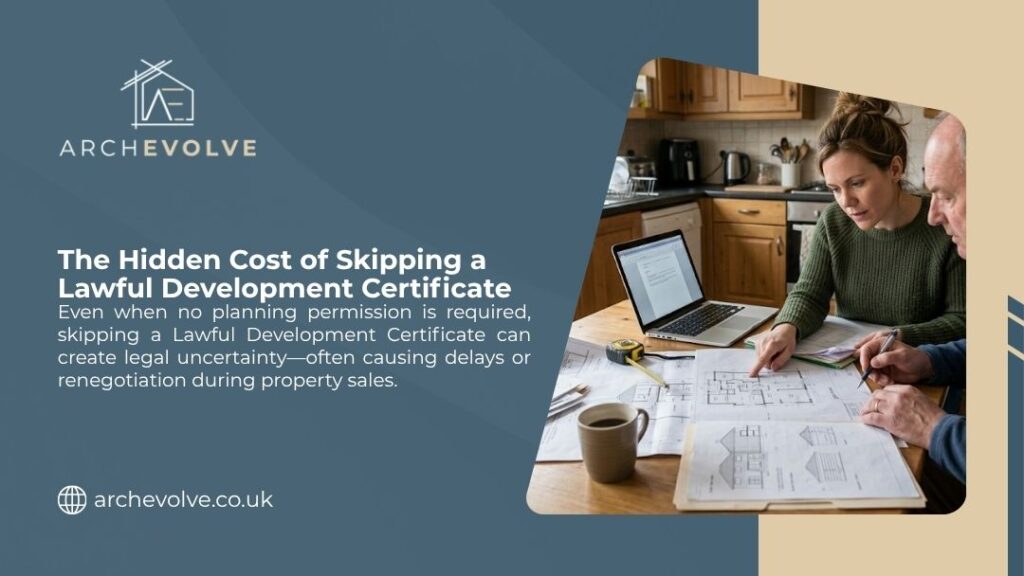
Missing either approval creates a compliance gap that will surface during any future property sale. To follow an application from submission through to completion certificate, read how extension building regs approval works.
How to Check Your Project Before You Commit
Measure the Original House Correctly
Always measure from the original rear wall, not the current end of the property. If there is an existing extension, find the original build line from planning records or title deeds before taking any measurements.
Decide Whether You Need Prior Approval or Full Planning Permission
- Identify the extension type and direction
- Measure the proposed depth from the original house
- Check whether the total curtilage coverage stays below 50%
- Confirm the property is not in a designated area or under an Article 4 Direction
- Check the local planning authority’s online records for prior approvals or conditions on the site
If the rear extension exceeds 4m on a detached home or 3m on any other type, move to prior approval. If it exceeds 8m or 6m respectively, or involves a second storey, a full application is required.
When to Speak to the Council or an Architect
Some situations call for professional input before any other cost is committed:
- The property has been extended before and the original measurements are unclear
- The site sits near or within a designated area
- The proposed design combines rear and side elements
- There is any uncertainty about whether PD rights have been removed
For homeowners also considering the roof space, the rules around planning permission for a loft conversion follow a similar framework, with PD conditions shaped by cubic volume limits and the extent of roof alterations.
Real-World Scenarios: What Usually Fits and What Usually Does Not
| Home Type | Extension Type | Likely Route | Why |
| Detached house | 4m single-storey rear | Permitted development | Within standard depth limit |
| Detached house | 6m single-storey rear | Prior approval | Exceeds 4m but within 8m limit |
| Semi-detached | 3m single-storey rear | Permitted development | Within standard limit |
| Semi-detached | 5m single-storey rear | Prior approval | Exceeds 3m but within 6m limit |
| Any house type | Wraparound single-storey | Full planning likely | Combined footprint often exceeds PD limits |
| Any house type | Double-storey rear | Full planning required | Not permitted under standard PD |
Detached Home Rear Extension Scenario
A detached property in a standard residential area with no prior extensions wants a 4m single-storey rear addition. Materials match the existing house, eaves stay below the existing roofline, and total curtilage coverage remains under 50%.
This project sits comfortably within permitted development. No application is required, though a Lawful Development Certificate is strongly recommended.
Semi-Detached or Terraced Home Scenario
A terraced house wants an open-plan kitchen extension of 4m depth. Under standard PD, the limit for a terraced home is 3m.
The project needs prior approval through the Larger Home Extension scheme, which involves notifying the council, a 42-day neighbour consultation, and a £120 application fee.
If no valid objections arise, the extension can proceed.
Frequently Asked Questions
How far can I extend my house without planning permission in the UK?
For a detached house, a single-storey rear extension can go up to 4 metres under standard permitted development, or up to 8 metres through the prior approval route.
For semi-detached and terraced homes, those limits are 3 metres and 6 metres respectively. Side extensions must stay within 50% of the original house width and be single-storey only.
Do I need planning permission for a rear extension?
Not always. Many rear extensions fall within permitted development and require no application. Larger single-storey rear extensions beyond the standard limits can use the prior approval route.
If the project is a double-storey, or sits on designated land, full planning permission is required. That planning burden is one of several reasons to review the case for single versus double storey extensions before you finalise your plans.
Can I do a side extension without planning permission?
Sometimes. A single-storey side extension within 50% of the original house width, with eaves below 4 metres, can fall within permitted development. Any side extension of more than one storey requires a full planning application.
What is the difference between planning permission and building regulations?
Planning permission controls whether the extension is acceptable in principle, including its size, location, and impact on neighbours. Building regulations control how it is built, covering structural safety, insulation, fire compartmentation, and drainage. Most extensions require both. Before you size up your plans, it is worth reading what separates planning from building control in practice.
Get Your Extension Right From the Start
Extending a home without a clear picture of what the planning system allows is where projects stall, cost more than they should, and sometimes have to be redesigned from scratch.
Archevolve has spent 15 years guiding UK homeowners through exactly this process, with over 500 completed projects across residential extensions, new builds, and planning applications.
We know which projects qualify under permitted development, which need prior approval, and which require a full application from day one.
From initial feasibility through to planning submission and construction documentation, we handle every stage with the same precision. No guesswork, no wasted spend on designs that were never going to get approved.
Book a free consultation with Archevolve today and find out exactly where your project stands before any money is committed.