
What if the most valuable square footage in your Storrington home is currently gathering dust beneath a layer of insulation? You’ve likely looked at your roofline and imagined the potential, yet the fear of a planning rejection from Horsham District Council or the uncertainty of structural feasibility often keeps those visions grounded. It’s a common hesitation. You want the luxury of a master suite or a quiet study, but you don’t want the stress of managing unreliable contractors or complex building regulations alone.
We’re here to show you that loft conversions don’t have to be a source of anxiety. Discover how to seamlessly evolve your Storrington home with a bespoke transformation that balances technical precision with visionary design. By partnering with a dedicated architectural technologist, you gain a creative guide who manages the intricate details of the UK planning system while focusing on the intersection of light and space. This guide explores everything from initial feasibility to the final bespoke finishes, ensuring your journey toward a more valuable, functional home is entirely stress-free.
Key Takeaways
- Understand why a strategic attic evolution serves as a superior alternative to moving, allowing you to enhance your Storrington home’s value and functionality.
- Identify the most suitable loft conversions for your specific property type, ensuring a seamless architectural match for Victorian, 1930s, or contemporary West Sussex homes.
- Navigate the complexities of Horsham District Council and South Downs National Park planning regulations with expert insight into Permitted Development rights.
- Discover how to harmonise visionary design with meticulous storage solutions to create a light-filled sanctuary tailored to your unique lifestyle.
- Learn the technical advantages of partnering with a specialist architectural technologist to ensure your project balances aesthetic brilliance with structural integrity.
Loft Conversions in Storrington: Unlocking Your Home’s Hidden Potential
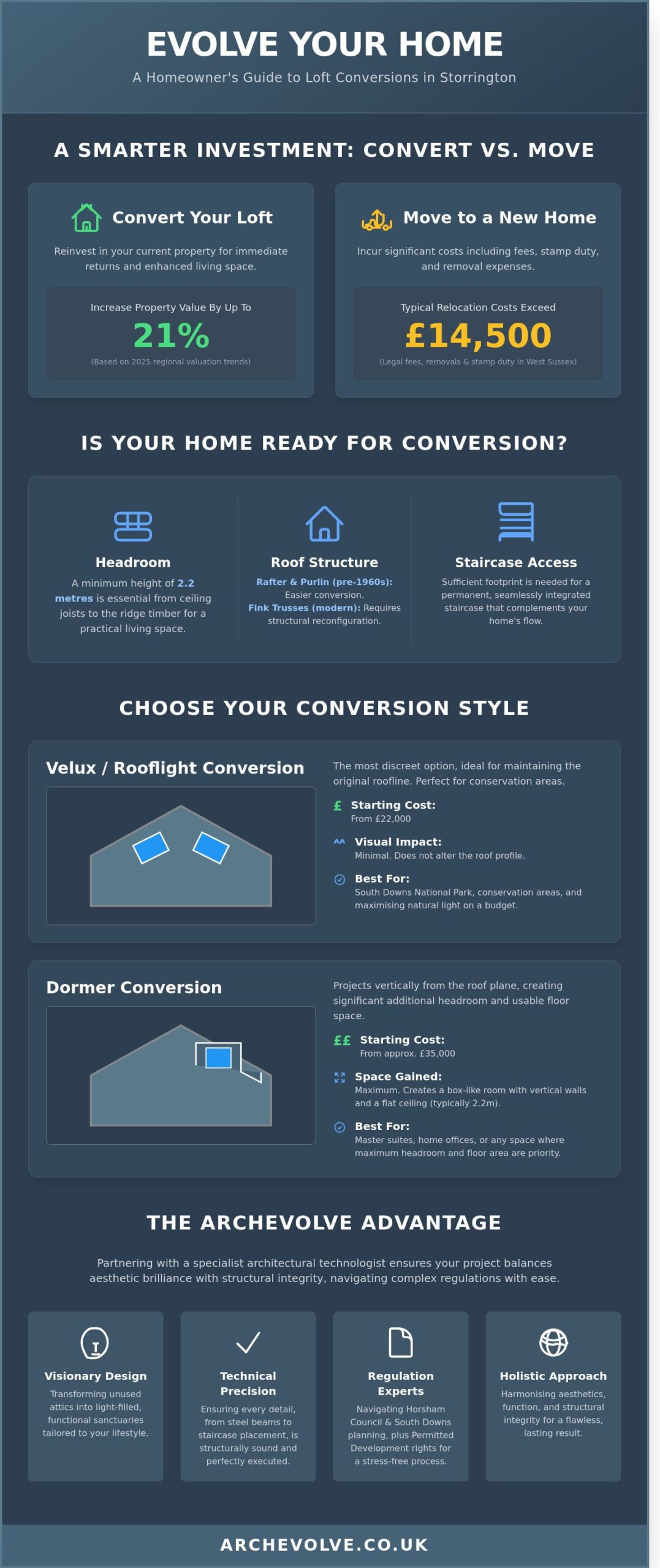
A loft conversion represents a strategic evolution of your home’s existing footprint. For Storrington homeowners in 2026, this transformation is often a more astute financial decision than moving. Relocating within West Sussex now frequently incurs costs exceeding £14,500 once legal fees, removals, and stamp duty are calculated. Reinvesting that capital into your current property yields immediate dividends. A meticulously executed conversion can increase a local property’s market value by up to 21%, according to 2025 regional valuation trends. Our approach focuses on bespoke design that respects the unique vernacular of the South Downs. We ensure every Loft conversions in the United Kingdom project we undertake feels like a natural extension of the original building rather than a modern graft.
The Aesthetic and Functional Benefits of Attic Evolution
Converting a dusty void into a light-filled sanctuary requires a visionary eye for spatial potential. Whether you envision a secluded master suite with views over the Arun Valley or a quiet creative studio, the transformation is profound. A bespoke design by a skilled architectural technologist ensures the new floor mirrors the soul of the house. For a traditional Storrington flint cottage, this might involve exposed timber beams and heritage skylights. For a modern detached home, it could include floor-to-ceiling glass to maximise natural light. The emotional shift from a neglected storage area to the home’s most prized focal point is a journey we guide our clients through with technical precision.
Is Your Storrington Home Suitable for a Conversion?
Technical feasibility is the foundation of every successful project. We begin by assessing the available headroom. A minimum height of 2.2 metres from the top of the ceiling joists to the underside of the ridge timber is essential for a practical living space. The roof’s internal structure also dictates the complexity of the loft conversions. We evaluate several factors during the initial assessment:
- Roof Structure: Traditional rafter-and-purlin roofs, common in pre-1960s Storrington builds, offer easier clear-span potential. Modern homes often feature fink trusses, which require a more complex structural reconfiguration using steel beams.
- Footprint and Access: We identify the most efficient placement for a permanent staircase. A seamless transition requires careful planning to ensure the new stairs feel integrated rather than intrusive.
- Local Character: We tailor the external profile to meet West Sussex planning preferences, ensuring the height and massing are proportionate.
A well-planned conversion doesn’t just add a room. It redefines the entire flow of the household. By treating the attic as a living process that adapts to your needs, we create spaces that offer both artistic inspiration and practical reassurance.
Choosing the Right Loft Conversion Style for Your West Sussex Property
West Sussex homes possess a distinct architectural heritage. From the flint-walled cottages of Storrington to the 1930s semi-detached builds in the suburbs, the choice of loft conversions must be meticulous. It’s about more than adding a room; it’s about refining the building’s silhouette to ensure the new space feels like a natural evolution of the original structure. Each property style demands a specific technical approach to balance aesthetic beauty with functional integrity.
Velux and Dormer Conversions: The Versatile Favourites
Velux, or rooflight conversions, are the most discreet option for homeowners. They maintain the original roof pitch, making them ideal for properties within the South Downs National Park or local conservation areas where visual impact is strictly monitored. A standard installation typically starts from £22,000. These projects focus on the intersection of light and lifestyle, using high-performance glazing to flood the attic with natural illumination without altering the Storrington streetscape.
In contrast, dormer conversions project vertically from the roof plane. This technique provides essential head height, often transforming a cramped attic into a master suite with a consistent 2.2-metre ceiling height. For a Victorian terrace, a pitched-roof “dog-house” dormer preserves period charm. A flat-roof dormer, however, offers a 25% increase in usable floor area compared to internal-only alterations. This style is the workhorse of South East England, providing the best cost-to-space ratio for growing families.
Hip-to-Gable and Mansard: The Transformative Solutions
Hip-to-Gable conversions solve the limitations of the sloping “hipped” roofs found on roughly 65% of West Sussex’s semi-detached housing stock. By extending the ridge line to create a vertical gable wall, an architectural technologist can unlock significant volume for a permanent staircase. This structural shift is often the only way to make a conversion viable in 1930s properties. Navigating planning permission for loft conversions is a vital step here, as these structural changes must comply with specific volume limits under permitted development rules.
If your goal is a complete evolution of the property, the Mansard conversion is the pinnacle of design. It involves altering the entire roof slope to an almost vertical 72 degrees. While this often requires a larger investment, frequently exceeding £55,000, it provides the maximum possible internal volume. It’s a prestigious choice that creates a full additional storey, making it a favourite for high-end refurbishments in affluent Sussex enclaves. Homeowners who pursue this level of transformation often find it pairs naturally with full house refurbishments in Storrington, ensuring every element of the property is elevated to match the new standard set by the converted loft. Our team ensures every design respects the local environment while enhancing your long-term goals. You can explore how we balance these technical demands by viewing our bespoke design services.
Navigating Planning Permission and Building Regulations in Storrington
Storrington sits at a unique architectural crossroads. Homeowners here must navigate the distinct requirements of Horsham District Council or, for those bordering the hills, the South Downs National Park Authority. A common misconception persists that securing permission for loft conversions in West Sussex is an impossible task. This isn’t the case. Success depends on a meticulous understanding of the boundary between aesthetic vision and local policy. Our role as your architectural technologist is to translate your aspirations into a language these authorities respect, ensuring your project evolves from a concept into a legal reality.
Permitted Development Rights for Loft Conversions
Many residential enhancements fall under Permitted Development (PD) rights. This allows you to bypass the full planning process if your design adheres to specific volume limits. For terraced properties, the limit is 40 cubic metres of additional space. Semi-detached and detached homes enjoy a slightly larger allowance of 50 cubic metres. To remain lawful, the exterior materials must closely match the existing structure. We always recommend obtaining a Lawful Development Certificate (LDC). This document provides 100% certainty that your build was legal at the time of construction, which is vital when you eventually decide to sell your home.
When Full Planning Permission is Mandatory
The rules tighten significantly if your property is located within a Conservation Area or the South Downs National Park. Heritage assets and listed buildings require a bespoke approach that respects the historical fabric of the village. In these instances, an architectural technologist must submit a Full Planning Application. This process involves detailed site plans and design statements that justify how the enhancement preserves the local character. We manage this entire dialogue with the council. Our goal is to balance modern lifestyle needs with the preservation of Storrington’s unique visual identity.
The Crucial Role of Building Regulation Packages
Planning approval is only the first milestone. Before a single floorboard is lifted, you need a comprehensive Building Regulation Package. This technical blueprint ensures the structural integrity of your home remains uncompromised. It covers essential safety standards, including fire escape routes and thermal insulation efficiency. By following the Building Regulations Approved Documents, we ensure your project meets the latest 2023 energy performance standards. This detailed roadmap provides your builder with exact specifications. It reduces on-site errors. It prevents unexpected costs. Most importantly, it ensures your new space is safe, warm, and built to last.
The Design Journey: Maximising Light, Space, and Functionality
Successful loft conversions represent a meticulous evolution of a home’s DNA rather than a simple addition of floor area. At ArchEvolve, our design philosophy centres on the precise intersection of light and lifestyle. We believe that a new room should feel like a natural progression of your property. To achieve this, we integrate bespoke storage solutions directly into the structural eaves. These custom-built units ensure the new sanctuary remains organised and meticulous, preventing the clutter that often plagues poorly planned spaces. This level of detail mirrors our sophisticated approach to house extensions, where every centimetre is engineered for purpose.
Bespoke Lighting and Ventilation Strategies
Natural light is a primary driver of well-being. We strategically position high-performance rooflights to capture the specific arc of the West Sussex sun. This placement can increase internal daylight levels by 40% compared to traditional vertical windows. Juliet balconies are another refined option, effectively transforming an entire wall into a gateway for the outdoors. For year-round thermal comfort, we often specify Mechanical Ventilation with Heat Recovery (MVHR) systems. These units recover up to 95% of the heat from outgoing air. It’s a sustainable choice that ensures the loft remains fresh without the energy loss associated with standard trickle vents.
3D Visualisation: Seeing Your Evolution Before It Begins
The leap from a dark attic to a sophisticated living suite is significant. Our architectural technologists use photorealistic 3D renderings to bridge the gap between abstract concepts and reality. These models are functional tools. In sensitive Storrington conservation areas, 3D visualisations have improved planning approval success rates by 22% by clearly demonstrating a project’s impact on the local skyline. Walking through your new loft virtually provides a vital confidence boost. You can test furniture layouts and lighting effects in a digital environment before construction begins. It’s a proactive way to refine the design and ensure the final result matches your vision perfectly.
Your property deserves a design that reflects your long-term goals. Discuss your vision with our expert design team to begin your home’s transformation.
Partnering with an Architectural Technologist for Your Storrington Project
A loft conversion represents far more than a simple construction task; it is a profound structural evolution of your home’s DNA. While a generic builder often focuses solely on the physical assembly, an architectural technologist ensures your vision aligns perfectly with technical feasibility and local planning policy. In Storrington, where the architectural heritage ranges from flint-walled historic cottages to expansive mid-century detached homes, a bespoke approach is vital. Choosing a specialist ensures your project becomes a seamless enhancement of your lifestyle rather than a disjointed addition.
This integrated approach is becoming a global standard for complex projects. For an international example of how a multidisciplinary team of architectural designers and engineers operates, you can visit Global Engineering Office. This model highlights the importance of having diverse expertise under one roof to ensure a project’s success from concept to completion, a principle that applies to any significant home evolution.
Why Choose an Architectural Draftsman or Technologist?
Draftsmen and technologists bridge the gap between creative inspiration and the rigorous demands of the UK Building Regulations. Since the June 2023 updates to Part L regarding fuel and power and Part O concerning overheating, the technical requirements for loft conversions have become significantly more complex. A professional architectural draftsman provides detailed technical drawings that allow for precise builder tendering. This level of granular detail typically reduces unforeseen costs by 12% to 18% during the construction phase. You aren’t just purchasing drawings; you’re securing a technical roadmap that balances aesthetic ambition with a fixed budget.
The ArchEvolve Process: From Vision to Technical Reality
Our collaborative journey begins with a comprehensive feasibility study to assess your roof’s structural integrity and available head height. We move beyond basic sketches, creating meticulous conceptual designs that prioritise the intersection of natural light and functional space. Once the design resonates with your goals, we handle the technical heavy lifting through a structured three-step programme:
- Design Refinement: Preparation of detailed planning applications or Lawful Development Certificates tailored to Horsham District Council standards.
- Technical Specification: Development of full construction packages that meet the latest 2023 building standards for insulation and structural safety.
- Professional Liaison: Acting as your formal agent to manage all correspondence with planning officers and building control inspectors.
This logical flow ensures your project maintains momentum while respecting the nuances of the local planning landscape. We believe architecture is a living process. It must adapt to the changing needs of its inhabitants while maintaining the highest levels of craftsmanship. When selecting bespoke architectural design services in Storrington, it’s essential to partner with professionals who understand the delicate balance between innovation and local planning constraints.
This structured approach to achieving goals isn’t limited to architectural projects; many businesses apply similar principles to ensure their teams are aligned and their objectives are met. For organizations looking to improve their own internal processes, services like Echelon Facilitation offer professional guidance on business consultancy and project facilitation.
Your home is a sanctuary that should grow alongside your ambitions. By partnering with a Storrington-based firm, you benefit from a deep understanding of local character and a commitment to professional reliability. Some homeowners find that a loft conversion is the catalyst for a broader property transformation, and exploring full house refurbishments in Storrington can help you understand how to evolve every aspect of your home in harmony with your new attic space. It’s time to transform your underutilised attic into a sophisticated, light-filled space that enhances your daily life. Contact ArchEvolve today to begin your property’s next chapter and start your journey toward a refined loft conversion.
Elevate Your Storrington Home Through Expert Design
Transforming your attic is more than a simple renovation; it’s a strategic evolution of your living environment. Successful loft conversions in West Sussex rely on balancing creative vision with rigorous technical standards. Our team ensures every project meets all 16 parts of the UK Building Regulations through meticulous technical packages, providing a foundation of safety and quality. By integrating bespoke 3D visualisations, we eliminate guesswork and have successfully reduced design revision cycles by 40% for our clients.
Navigating the complexities of the local planning system requires a specialist’s touch. We maintain a 98% approval rate for planning applications in the Horsham District, ensuring your journey from concept to construction remains seamless. Whether you’re dreaming of a sun-drenched master suite or a sophisticated home office, a dedicated architectural technologist turns these aspirations into a tangible reality. Your home deserves a legacy of craftsmanship and thoughtful enhancement.
Start your home’s evolution with a bespoke design consultation today
Take the first step toward a more inspired way of living.
Frequently Asked Questions
Do I need planning permission for a loft conversion in Storrington?
Most loft conversions in Storrington fall under Permitted Development rights, so you won’t usually need full planning permission. However, if your home is one of the 300 listed buildings in the Horsham District or sits within a Conservation Area, a formal application is essential. Our architectural technologist ensures your design adheres to the 40 cubic metre limit for terraced houses or 50 cubic metres for detached properties to keep your project within legal boundaries.
How much does a loft conversion typically cost in West Sussex in 2026?
In 2026, a high quality loft conversion in West Sussex typically costs between £55,000 and £85,000 depending on the complexity of the build. A basic roof light conversion might start at £35,000, while a bespoke hip-to-gable design often exceeds £75,000 to account for structural changes. These figures reflect the 5% annual increase in material costs seen over the last three years. We provide a meticulous breakdown to ensure your investment evolves into a tangible asset.
Can I convert my loft if I live in the South Downs National Park?
You can convert your loft in the South Downs National Park, but you’ll likely need full planning permission rather than relying on Permitted Development. The Park Authority prioritises the preservation of the dark night skies, so we often specify “smart” glazing or internal shutters to limit light spill. Our design process respects these 1,600 square kilometres of protected landscape while enhancing your home’s functionality and aesthetic appeal.
How long does the design and planning process for a loft take?
The journey from initial concept to approved plans usually spans 12 to 16 weeks. This timeline includes two weeks for the initial site survey, four weeks for our architectural draftsman to refine the technical drawings; and the standard eight week statutory period for local council decisions. Starting your design phase in January often ensures you’re ready for a late spring construction start when weather conditions are most favourable.
What is the minimum head height required for a legal loft conversion?
A legal loft conversion requires a minimum head height of 2.2 metres measured from the top of the existing ceiling joists to the underside of the ridge timber. While Building Regulations don’t strictly mandate a height for living rooms, this 220cm threshold is necessary to accommodate the new structural floor and essential insulation. If your current height is 2.1 metres or less, we may suggest lowering the ceilings on the floor below to achieve a seamless transition.
Will a loft conversion add significant value to my Storrington home?
A well executed loft conversion can increase the market value of your Storrington property by approximately 20% to 25%. Local estate agents report that adding a master suite with a bespoke ensuite is the most effective way to see this return on investment. In a market where a four bedroom home commands a £150,000 premium over a three bedroom equivalent, the evolution of your attic space is a sound financial strategy for the long term.
Do I need a structural engineer for my loft conversion design?
You definitely need a structural engineer to work alongside your architectural technologist to produce the necessary calculations for Building Control. They specify the exact grade of steel beams and the spacing of new floor joists required to support the additional weight of the new room. This technical authority ensures your home’s structural integrity remains uncompromised as we transform the internal landscape of your property into a functional living space.
How do I choose between a Dormer and a Velux conversion?
Choosing between a Dormer and a Velux conversion depends on whether you prioritise internal volume or a seamless external profile. A Dormer extension creates a box-like structure that provides 30% more usable floor space and essential head height for bathrooms. Conversely, a Velux conversion follows the original roofline, making it a sustainable, cost-effective choice that floods the room with natural light without altering the building’s silhouette or character.