
What if your home could evolve to meet modern demands without losing its historic soul? In Storrington, where the heritage of the South Downs National Park meets the aspirations of 2026 living, a property is more than bricks and mortar. It’s a legacy. You likely understand the delicate balance required for full house refurbishments in this protected landscape. It’s natural to feel overwhelmed by the 2025 updates to building regulations or the fear that structural requirements will compromise your aesthetic vision. We believe that technical constraints shouldn’t limit your creativity; they should refine it.
This guide promises to show you how to meticulously evolve your property through bespoke design and technical precision. You’ll discover how a skilled architectural technologist can navigate the planning process to deliver a home that is both sustainable and breathtaking. We’ll outline the journey from your first conceptual spark to the delivery of construction-ready drawings, ensuring your transformation is seamless, compliant, and deeply personal.
Key Takeaways
- Understand the “Evolution” philosophy, which transcends basic renovation to adapt Storrington’s historic property stock for sophisticated 21st-century living.
- Learn how an architectural technologist translates conceptual visions into buildable 3D realities, ensuring every design choice is both aesthetically inspiring and technically sound.
- Discover how full house refurbishments elevate functional integrity by improving EPC ratings through sustainable “fabric first” enhancements and the meticulous integration of smart technology.
- Navigate the intricate planning landscapes of West Sussex, from Horsham District Council requirements to the specific constraints of the South Downs National Park Authority.
- Explore why bespoke, site-specific design is essential to honour the unique character of your Storrington home while realising a legacy of high-end craftsmanship.
What is a Full House Refurbishment? Defining the Storrington Standard
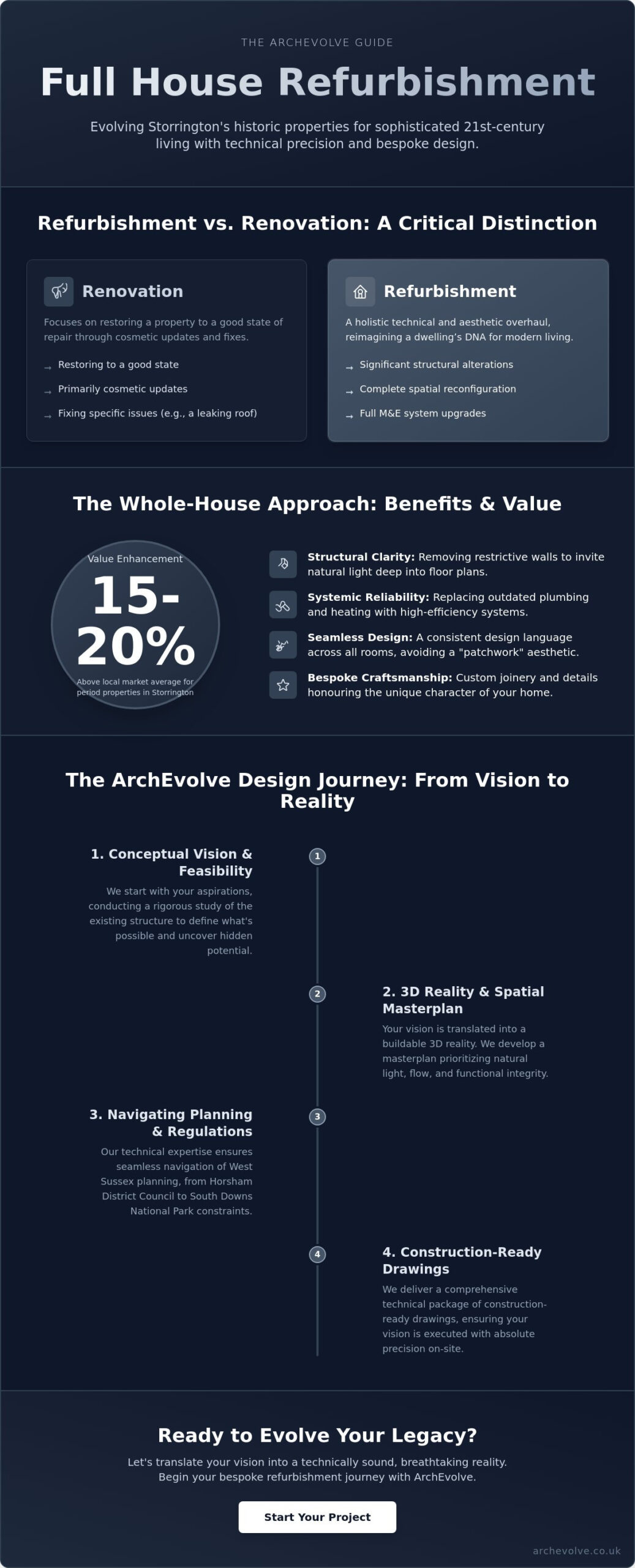
In the context of Storrington’s refined property market, full house refurbishments represent a complete reimagining of a dwelling’s DNA. This process transcends the superficial application of paint or the installation of a new kitchen; it’s a holistic technical and aesthetic overhaul that addresses the very bones of a building. For 2026, the Storrington standard is defined by the “Evolution” philosophy. This approach treats your home as a living entity that must adapt to modern lifestyles while respecting the heritage of West Sussex’s historic property stock. It requires a meticulous blend of artistic vision and technical authority to ensure a property remains relevant for the next fifty years.
A comprehensive project typically involves significant structural alterations, spatial reconfiguration, and a total upgrade of mechanical and electrical (M&E) systems. As we move into 2026, the local market is shifting. Homeowners are increasingly prioritising sustainability and thermal efficiency, driven by the 2025 Future Homes Standard. This regulatory shift makes 2026 the ideal year to commit to a full-scale transformation. By integrating air-source heat pumps, advanced insulation, and smart home technology during a refurbishment, you future-proof your asset against rising energy costs and evolving building regulations.
Refurbishment vs. Renovation: Which Does Your Home Need?
The terms are often used interchangeably, but the distinction is vital for your planning phase. To understand the baseline, one might ask What is Renovation? and find it focuses on restoring something to a good state of repair. A refurbishment goes further. It’s the difference between a cosmetic update and a full technical package. While a renovation might fix a leaking roof, a refurbishment involves an architectural technologist redesigning the internal flow to create an open-plan living space or a bespoke loft conversion. If your property’s wiring is over 25 years old or the floor plan feels restrictive, a full technical package is the only way to ensure long-term functional integrity.
The Benefits of a Whole-House Approach
Opting for a whole-house strategy avoids the disjointed “patchwork” aesthetic common in incremental DIY projects. It allows for a seamless design language where every room speaks to the next through consistent materials and lighting. This approach also yields significant logistical benefits. Site mobilisation and material procurement are far more cost-effective when handled as a single, large-scale scope. In Storrington, where period properties are prevalent, full house refurbishments can lead to a value enhancement of 15% to 20% above the local market average. This is achieved by:
- Structural Clarity: Removing restrictive walls to invite natural light into deep floor plans.
- Systemic Reliability: Replacing outdated plumbing and heating with high-efficiency, sustainable alternatives.
- Bespoke Craftsmanship: Utilising an architectural draftsman to detail custom joinery that fits the unique proportions of a period home.
The journey from a dated structure to a modern sanctuary is complex; it’s a transformative experience that requires a creative partner who understands the nuances of the UK planning system. By choosing a comprehensive refurbishment, you aren’t just repairing a house. You’re evolving a lifestyle.
The Design Journey: From Conceptual Vision to 3D Reality
The evolution of a property begins long before the first sledgehammer strikes. It starts with the technical precision of an architectural technologist. This professional acts as the vital bridge between your aesthetic aspirations and the structural realities of the site. During the initial stages of full house refurbishments, we conduct a rigorous feasibility study. We assess the existing masonry and timber to determine exactly what’s possible within your current footprint. It’s about finding the hidden potential in every square metre while ensuring buildability remains at the forefront of the design.
A successful transformation requires more than a simple floor plan; it demands a spatial master plan. We prioritise the flow of natural light and the rhythm of movement through the building. When designing full house refurbishments, we analyse how light penetrates the core of the home throughout the day. This meticulous approach ensures that even the deepest rooms feel connected to the Sussex landscape. This focus on wellness and spatial harmony aligns with the 2026 Home Improvement Trends that highlight the growing importance of flexible, light-filled living environments. Achieving this level of intentional design is precisely what distinguishes spaces designed by architectural designers from standard renovation work.
Visualising the Transformation
Seeing is believing. Our process integrates 3D visualisations in Storrington at the earliest possible stage. These photorealistic renderings serve a dual purpose. They allow you to experience the emotional resonance of the space before a single brick is moved. They also provide planning officers with a clear, unambiguous view of the proposed changes. This level of detail often accelerates the approval process by eliminating the guesswork inherent in traditional 2D sketches. Internal data from 2024 projects shows that high-quality visualisations can reduce design revisions by up to 25% during the planning phase.
The Meticulous Planning of Bespoke Interiors
Interior design isn’t an afterthought; it’s an integral part of the structural evolution. We focus on “zoning” to create distinct areas within open-plan layouts. This technique provides functional integrity without sacrificing the sense of space. In a 2024 project involving a cramped Storrington cottage, spatial reconfiguration added 15% more usable floor area without extending the external walls. By removing non-load-bearing partitions and repositioning the staircase, we unlocked a sense of flow that was previously impossible. If you’re ready to explore these possibilities, our team can help you visualise your next project with technical authority and creative flair.
Strategic Enhancements: Balancing Aesthetic Beauty with Functional Integrity
True transformation requires more than a fresh coat of paint; it demands a meticulous reassessment of a building’s soul. In Storrington, full house refurbishments in 2026 are increasingly defined by the “fabric first” approach. This methodology prioritises the building’s thermal envelope before aesthetic layers are applied. By upgrading insulation and window specifications, homeowners can target an EPC B or A rating, which is becoming a baseline expectation in the West Sussex market. It’s a process of refinement where the hidden technical details are just as vital as the visible finishes.
Respecting a property’s history is a hallmark of our design philosophy. Our architectural technologists focus on preserving original timber beams or local flint walls while discreetly integrating smart home technology. We don’t believe you should choose between heritage and high-speed connectivity. This creates a seamless dialogue between the past and the future, ensuring the home remains relevant for decades. Often, a project reveals that the existing footprint is no longer sufficient. This is where the synergy between internal updates and house extensions becomes apparent. Expanding a floor plan allows for a more logical flow, ensuring the renovated core of the home breathes properly and serves the inhabitant’s evolution.
Future-Proofing Your Property
2026 standards demand a shift away from fossil fuels. Integrating air-source heat pumps requires careful calculation of heat loss, a task our team manages with technical precision. We prioritise sustainable materials like reclaimed timber and low-VOC paints to ensure the environment is as healthy as it is beautiful. Designing for longevity means creating flexible spaces. A room might serve as a nursery today and a sophisticated home library in a decade. It’s about building adaptability into the very walls of the property.
Refurbishing for Lifestyle and ROI
High-impact areas drive both daily joy and financial value. Kitchen and bathroom reconfigurations remain the most potent ways to boost property worth during full house refurbishments. Industry data suggests that a bespoke, high-specification kitchen can add between 5% and 10% to a home’s valuation in the South East. The “home hub” is another growing priority. These integrated spaces combine professional-grade home offices with relaxed living zones, catering to the permanent shift toward hybrid lifestyles. A bespoke design differentiates your property, turning a standard house into a visionary statement that stands out in the competitive West Sussex market.
Navigating the Technical Landscape: Planning and Building Regulations in West Sussex
Storrington sits at a unique geographical crossroads where the landscape dictates the law. Your property’s specific location determines whether you answer to Horsham District Council or the South Downs National Park Authority. This distinction is vital; National Park regulations are often more stringent regarding external finishes, roof heights, and dark skies policies. For many full house refurbishments, Permitted Development rights offer a streamlined route to transformation. These rights allow for significant alterations without a full planning application, provided they meet strict criteria regarding volume and materials. However, relying on “design-only” sketches is a significant gamble that often leads to onsite delays. Without a comprehensive building regulation package, you risk structural non-compliance or costly retrofitting. Technical drawings are the essential bridge between a creative vision and a legal, safe reality.
The Planning Application Process
- Step 1: Pre-application advice. This feasibility check for Storrington properties identifies potential hurdles, such as bat surveys or flood risks, before you invest heavily.
- Step 2: Preparing the planning set. This involves the creation of precise drawings, design and access statements, and heritage reports if your home is listed or within a conservation area.
- Step 3: The consultation period. Local authorities typically take 8 to 12 weeks to reach a decision. We manage this dialogue to ensure your project maintains its momentum.
Building Control and Technical Compliance
A successful refurbishment must satisfy rigorous 2026 Building Regulations. Part L focuses on fuel and power conservation, demanding high-performance insulation and efficient heating systems. Part M ensures accessibility, a crucial factor for long-term lifestyle enhancement. These aren’t just boxes to tick. They are benchmarks for craftsmanship. Detailed construction drawings are essential for accurate builder tendering; they prevent the “guesswork” pricing that causes 15% budget overruns in unplanned projects. Engaging an architectural draftsman is essential during this phase to translate aesthetic concepts into technical blueprints. This precision ensures your home’s evolution is both beautiful and structurally sound.
Ready to secure your property’s future? Contact our architectural technologists today to begin your technical consultation.
Realising Your Legacy: The ArchEvolve Approach to Refurbishment
Storrington’s architectural landscape is a rich tapestry of history and potential. Standardised, off-the-shelf designs frequently fail the unique character of West Sussex homes because they ignore the subtle nuances of local flint work or the specific light patterns of the South Downs. When undertaking full house refurbishments, the goal is to create a home that feels like a natural extension of your personality. We view every project as an evolution. It’s a process where your lifestyle requirements merge with technical precision to create something enduring.
The ArchEvolve journey begins with a creative spark, a vision of what your property could become. We then guide that vision through the rigorous demands of the UK planning system and building regulations. By collaborating closely with an architectural technologist, you ensure that your design is not just a beautiful concept but a buildable reality. This technical authority is what prevents delays on site. It ensures that every structural enhancement and aesthetic choice is grounded in professional reliability.
Why a Boutique Design Firm Makes the Difference
Boutique firms provide a level of personalised attention that larger practices often lack. We focus on the intricate details that define a premium finish, from the placement of a light switch to the seamless joinery of a bespoke staircase. Our deep knowledge of the West Sussex architectural vernacular allows us to navigate local planning constraints with confidence. We ensure your vision survives the transition from a digital model to a physical building site without losing its soul.
Your Refurbishment Roadmap
A successful transformation requires a structured timeline. For comprehensive full house refurbishments in 2026, we recommend allowing six to nine months for the design and technical stages before construction begins. This period is vital for refining your “must-haves,” such as structural stability and energy efficiency, versus your “nice-to-haves,” like high-end kitchen finishes or smart home integration. Defining these priorities early prevents budget creep and keeps the project’s momentum high.
Preparation is the foundation of excellence. Before your initial consultation, gather reference images and list the functional frustrations of your current layout. Think about how you want to feel in each room. Whether you are planning a complex flat conversion or a sensitive restoration of a period cottage, we are here to provide the technical expertise and creative direction required. Start your Storrington property evolution with ArchEvolve and take the first step toward a home that truly reflects your legacy.
Realising the Potential of Your Storrington Heritage
A home is a living entity that must adapt to the rhythms of modern life. Successful full house refurbishments in Storrington demand a precise blend of artistic vision and technical mastery. We’ve explored how the journey moves from initial conceptual sketches to the delivery of comprehensive Technical Building Regulation Packages that ensure every structural change meets the rigorous standards of West Sussex authorities. By prioritising the intersection of light and lifestyle, you create a space that isn’t just renovated, but truly evolved.
Our team serves as your dedicated architectural technologists, navigating the unique planning complexities of the South Downs with seasoned expertise. We utilise Red Dot-inspired 3D visualisations to eliminate uncertainty, allowing you to walk through your future home before a single brick is moved. This meticulous approach guarantees that your investment enhances both the functional integrity and the long-term value of your property. It’s time to move beyond the ordinary and craft a legacy that reflects your personal journey.
Begin your property transformation with a bespoke design consultation
Your vision for a refined, modern home is within reach, and we’re ready to help you build it.
Frequently Asked Questions
Do I need planning permission for a full house refurbishment in Storrington?
Most internal full house refurbishments in Storrington fall under Permitted Development rights and don’t require formal planning permission. However, if your property is one of the 150 listed buildings in the Horsham District or involves structural changes to the roofline, you’ll need Listed Building Consent or full planning approval. It’s vital to verify your specific project’s requirements with the local planning authority to ensure your home’s evolution remains compliant with 2026 regulations.
How much does a full house refurbishment cost in West Sussex in 2026?
A comprehensive refurbishment in West Sussex typically costs between £1,500 and £2,500 per square metre in 2026. For a standard three-bedroom semi-detached home, this represents an investment starting from £75,000. These figures fluctuate based on the bespoke nature of your finishes and the structural complexity involved. High-end transformations featuring premium materials often exceed these baseline estimates to reflect superior craftsmanship and technical precision.
How long does a typical whole-house refurbishment take from design to completion?
A typical whole-house transformation takes between 6 and 10 months from the initial design phase to final completion. The technical design and planning stage usually occupies the first 12 weeks; the physical construction phase spans the remaining 4 to 7 months. Timelines vary depending on the scale of structural enhancements. Meticulous scheduling ensures your journey from concept to reality remains seamless and efficient throughout the entire process.
Can I stay in my house during a full refurbishment project?
You can remain in your home during a refurbishment, but it’s rarely recommended for projects involving significant structural work or utility upgrades. Living on-site often extends the construction timeline by 15% due to the need for phased working and daily site clearing. For a more refined and stress-free experience, most homeowners relocate for the duration of the heavy works. This allows the delivery team to maintain a faster, uninterrupted pace.
What is the difference between an architectural technologist and a draftsman?
An architectural technologist focuses on the science of building, ensuring technical integrity and long-term performance through detailed material specifications. In contrast, an architectural draftsman primarily focuses on producing the technical drawings required for planning and construction. While both are vital, a technologist provides a deeper level of technical authority regarding building regulations. Choosing the right professional ensures your property’s evolution is both beautiful and structurally sound.
Will a refurbishment add more value than a house extension?
A high-quality full house refurbishment can increase property value by up to 15%, though extensions often provide a higher total return by adding essential square footage. In the Storrington market, modernising an existing layout often yields a more immediate aesthetic impact than a simple addition. The most successful transformations combine both, refining the internal flow while strategically expanding the footprint. This dual approach maximises both lifestyle benefits and financial equity.
What technical drawings do I need to give to my builder?
Your builder requires a comprehensive technical pack including 1:50 scale floor plans, sections, and detailed elevations. You’ll also need a structural engineer’s calculations and a detailed specification of works to ensure accurate pricing. These documents act as a precise blueprint for your project’s evolution. Providing meticulous drawings reduces the risk of onsite errors and ensures the final result mirrors your original vision perfectly without costly delays.
How do I ensure my period property refurbishment is sustainable?
Improving sustainability in a period property involves a fabric-first approach, focusing on breathable wood fibre insulation and high-performance slimline double glazing. According to the Energy Saving Trust, upgrading to modern standards can reduce heat loss by 30% in older homes. Integrating low-carbon heating systems, such as air-source heat pumps, further enhances efficiency. This thoughtful integration of modern technology respects the heritage of your home while securing its future for generations.