
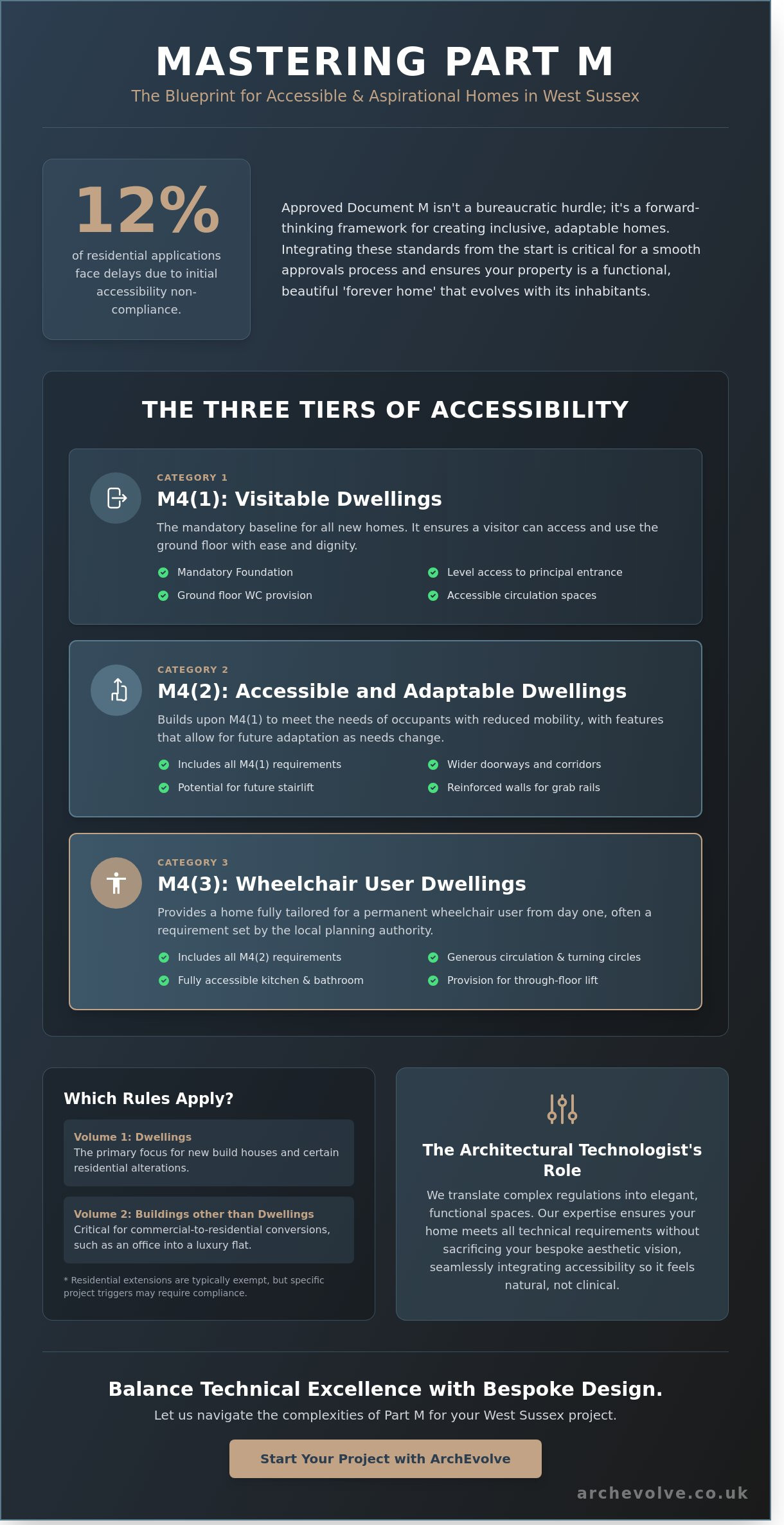
The most visionary homes in West Sussex are those that evolve alongside their inhabitants without sacrificing a single ounce of aesthetic soul. You likely recognize that meeting the stringent requirements of part m is essential for your Storrington project, yet the fear that complex M4 categories might stifle your bespoke design remains a valid concern. It’s frustrating when technical mandates feel like they’re at odds with high-end craftsmanship. In 2024, data from regional planning authorities indicated that nearly 12% of residential applications faced delays due to initial accessibility non-compliance, a hurdle that can easily be avoided with the right expertise.
We believe that accessibility should be invisible, integrated into the very fabric of a home’s evolution rather than bolted on as an afterthought. This guide will empower you to master the nuances of Approved Document M, ensuring your property is both legally compliant and breathtakingly beautiful. We’ll demystify the legal obligations that govern your development, providing you with the clarity needed to secure a smooth approval from building control in 2026 while protecting the meticulous vision of your architectural technologist.
Key Takeaways
- Discover how part m regulations serve as the essential blueprint for inclusive design, ensuring your Storrington property remains accessible and usable for all generations.
- Navigate the three distinct tiers of accessibility standards to understand which mandatory requirements apply to your specific new build or conversion project.
- Learn why residential extensions are typically exempt and identify the specific project triggers that could necessitate compliance for your property enhancement.
- Understand the meticulous journey an architectural technologist takes to integrate complex building regulations into a seamless, high-end design.
- Master the balance between technical excellence and bespoke aesthetics to create a home that is both legally compliant and visually stunning.
What is Approved Document Part M and Why is it Critical for Storrington Developments?
Approved Document M, commonly referred to as part m, represents the statutory baseline for accessibility within the Building Regulations in the United Kingdom. It dictates how buildings should be designed to ensure that everyone, regardless of age, mobility, or disability, can access and use a property with dignity. For projects in Storrington, this isn’t merely a bureaucratic hurdle. It’s a commitment to creating homes that adapt as we do. The local building control teams across West Sussex maintain a rigorous oversight of these standards. They ensure every new dwelling or significant conversion provides a seamless experience for residents. This technical compliance forms the backbone of the “forever home” concept. It allows a building to evolve alongside its inhabitants, supporting them through every stage of life.
The core philosophy of part m is inclusivity. It moves beyond the idea of a house as a static structure. Instead, it views a home as a living environment that must remain visitable and usable for a diverse range of people. Whether it’s a young family with a pram or an elderly relative with limited mobility, the design must facilitate easy movement. In Storrington, where bespoke new builds and high-end refurbishments are common, integrating these standards early in the design phase is essential. It prevents costly retrospective changes and ensures the final result is as functional as it is beautiful.
The Two Volumes of Part M
Understanding which rules apply to your Storrington site is vital for a smooth planning journey. The document is split into two distinct sections:
- Volume 1: Dwellings. This is the primary focus for residential homeowners and developers. It covers the essential requirements for new houses and certain alterations.
- Volume 2: Buildings other than dwellings. This volume is critical for commercial-to-residential conversions. If you’re transforming a village office into a luxury flat, these standards apply.
Identifying which volume applies depends on the existing use of your site and the nature of your proposed development. We analyze these technicalities during the initial feasibility stages to ensure your project remains on firm regulatory ground.
The Role of the Architectural Technologist
A skilled architectural technologist does more than draw lines; they translate complex regulations into elegant, functional spaces. Their role is to ensure that professional technical drawings demonstrate compliance while maintaining the project’s aesthetic vision. There is a nuanced difference between a “visitable” dwelling and one that is “fully accessible.”
While a visitable home meets the basic M4(1) standard for guests, a fully accessible design under M4(3) is tailored for permanent wheelchair users. An architectural technologist balances these requirements with meticulous precision. They ensure that doorway widths, threshold levels, and circulation spaces feel natural rather than clinical. This professional oversight ensures your Storrington development isn’t just a building, but a refined living space that welcomes everyone.
The Three Tiers of Accessibility: Navigating M4(1), M4(2), and M4(3)
Designing a home in Storrington requires a meticulous understanding of how spaces evolve over time. Part m of the Building Regulations provides a structured framework through three distinct categories, each defining a different level of physical accessibility and internal flow. These tiers represent a journey from basic visitability to fully bespoke, wheelchair-accessible environments. Our role as an architectural technologist is to ensure these technical standards integrate seamlessly with your aesthetic vision and lifestyle goals.
M4(1): The Minimum Requirement
M4(1) Category 1: Visitable Dwellings is the mandatory foundation for any new build home in the UK. This baseline ensures that any person, regardless of mobility, can enter and navigate the primary areas of a property without encountering insurmountable obstacles. It mandates level access to the principal entrance, avoiding steps that create immediate barriers for guests. Inside, the layout must provide a visitable WC on the entrance storey, accompanied by standardised widths for doorways and corridors. These measurements allow unhindered movement through the home’s most social spaces, ensuring the building remains inclusive for every visitor.
M4(2) and M4(3): Planning for the Future
While M4(1) is the legal floor, local planning authorities across West Sussex frequently elevate the standard to meet long-term housing needs. Horsham District Council, for instance, often stipulates M4(2) Category 2: Accessible and Adaptable Dwellings as a condition for 100% of new developments within their jurisdiction. This tier focuses on longevity. It requires specific features like reinforced bathroom walls to support the future installation of grab rails and dedicated space provisions for potential stairlifts. By following the technical guidance in Approved Document M, we create homes that adapt to the changing rhythm of your life.
M4(3) Category 3: Wheelchair User Dwellings represents the highest level of bespoke design. This category is typically required for specific housing needs or within larger flat conversions where a percentage of units must be fully accessible from the day of completion. The impact on internal layout is significant; M4(3) designs often require a 1.5-metre turning circle in key areas like hallways and kitchens to ensure full manoeuvrability. Kitchens require low-level work surfaces and clear knee space, while bathrooms transition into fully functional wet rooms. This level of detail ensures that every room remains empowering. If you are considering a complex new build or conversion project, understanding how light and space intersect with these tiers is vital for a successful planning outcome.
Extensions vs. New Builds: Does Part M Apply to Your Storrington Home Project?
The evolution of a home often begins with the desire for more space, yet the regulatory landscape can feel like a labyrinth. For many Storrington residents, the primary question is whether an extension needs to meet the stringent standards of part m. Generally, the legislation offers what we might call an “Extension Exception.” Under current UK building regulations, a residential extension to an existing dwelling doesn’t usually need to comply with the accessibility requirements of M4(1), M4(2), or M4(3). Part M is only one strand, and our overview of the other approved documents that apply to extensions sets out the rest. This freedom allows for creative flexibility, but it comes with a non-negotiable caveat: you cannot make the existing access worse than it already is.
If your current property has a level threshold and you replace it with a stepped entrance during a renovation, you’ve breached the regulations. It’s a meticulous balance. While you aren’t legally forced to install a disabled-access wet room in a new ground-floor extension, failing to consider future-proofing is often a missed opportunity. Integrating these principles voluntarily can increase property value. It appeals to a broader demographic of buyers looking for “forever homes” that adapt to their needs over time. A bespoke design that anticipates the future is always a sound investment.
Navigating the Extension Loophole
The exemption for extensions exists because the law recognises the difficulty of retrofitting old structures to modern standards. However, if your project involves creating a brand-new dwelling, such as a self-contained annex with its own entrance and facilities, part m requirements trigger immediately. An architectural draftsman can help you determine where this line is drawn. They’ll ensure your loft conversion or garage transformation doesn’t inadvertently violate the Planning Portal guide to Part M, which outlines the specific categories of access. Meticulous planning at this stage prevents costly remedial works later.
Commercial to Residential Conversions
The rules shift dramatically when moving from trade to tenure. Commercial to residential conversions trigger the more rigorous Part M Volume 2 requirements. Repurposing a historic shop or office in Storrington’s village centre presents unique challenges, particularly regarding level access and corridor widths. Transforming these spaces requires a visionary approach to ensure the building’s heritage remains intact while meeting modern accessibility mandates. Strategies often include internal ramping or the installation of bespoke platform lifts to bridge the gap between tradition and contemporary functionality. It’s about creating a seamless transition from a public space to a private sanctuary without losing the character of the original structure.
The Technical Journey: How an Architectural Technologist Ensures Compliance
Every successful project begins with a topographical reality check. An architectural technologist starts by conducting a rigorous initial site survey to map existing levels and identify potential access constraints. In Storrington, where the local terrain can shift from the gentle slopes of the South Downs to more restricted residential plots, understanding these gradients is vital. This data ensures that part m requirements are woven into the building’s DNA from the very first sketch, rather than being treated as a secondary addition.
The transition from concept to reality requires a robust building regulation package for council approval. This technical roadmap translates design aspirations into precise instructions for contractors. It bridges the gap between creative vision and the stringent demands of West Sussex building control, ensuring every corridor width and ramp gradient is mathematically sound.
Technical Drawings and Specifications
Precision is the hallmark of a compliant home. We produce detailed 1:50 scale drawings that illustrate more than just walls; they show clear turning circles for wheelchairs and the exact arc of door swings to prevent obstructions. Specifications go deep into the granular details. We define everything from 15mm low-profile thresholds that prevent trips to the exact placement of switches and sockets between 450mm and 1200mm from the finished floor level.
To help you inhabit the design before construction begins, 3D visualisations offer a window into the future. These renders allow you to experience the flow of the space, ensuring the accessibility features feel like a natural enhancement of your lifestyle. It’s about seeing how light and space interact with the functional requirements of an inclusive home.
Liaising with Building Control
Compliance is a collaborative process. We maintain a proactive dialogue with West Sussex building control officers throughout the construction phase. For complex refurbishments or heritage projects in Storrington, we often draft a formal ‘Access Statement’. This document is a critical tool. It justifies specific design solutions where standard part m applications might conflict with the structural integrity of a period property.
Managing the relationship with local inspectors is essential to keep a project on track. Unexpected site delays can be costly, sometimes exceeding £500 per day in lost labour and plant hire. By providing meticulous documentation and being present for key inspections, we ensure that final sign-off is achieved without friction. This technical oversight guarantees that the finished building is safe, legal, and perfectly tailored to your needs.
Ready to ensure your project meets every regulatory standard without compromising on style? Start your technical journey with ArchEvolve today.
ArchEvolve: Balancing Technical Excellence with Bespoke Design in West Sussex
Design shouldn’t feel like a compromise. At ArchEvolve, we believe that accessibility is an opportunity for innovation rather than a restrictive constraint. Our philosophy centers on the idea that a home must evolve alongside its inhabitants. We bridge the gap between the rigid technical requirements of part m and the fluid beauty of high-end residential design. For many Storrington homeowners, the technical labyrinth of building regulations feels daunting. We demystify this complex process, ensuring every threshold, corridor width, and sanitary facility meets the necessary standards while remaining visually stunning.
Every site in West Sussex presents unique challenges. From the undulating terrain of the South Downs to the historic character of Storrington’s village centre, a bespoke strategy is vital. We don’t believe in “off-the-shelf” solutions. Whether you’re planning a new build or sophisticated house extensions, we tailor our technical packages to reflect your specific lifestyle. This meticulous approach ensures that your home remains a sanctuary for decades, adapting to your needs without losing its aesthetic soul.
Why Choose a Local Architectural Technologist?
Choosing a local architectural technologist provides a distinct advantage for your project. We possess deep-rooted knowledge of the Horsham District Council planning landscape and the specific nuances of the South Downs National Park. Our focus remains on the interplay of light and space, ensuring that functional requirements like part m compliance feel integrated rather than bolted on. Our expertise includes:
- A 100% success rate in recent building regulation approvals for local refurbishments and new builds.
- Deep understanding of local craftsmanship and materials that define the West Sussex aesthetic.
- A meticulous focus on lifestyle-driven design that prioritises how you actually use your space.
- Proven ability to manage the delicate balance between modern innovation and heritage preservation.
Ready to Start Your Evolution?
Your project deserves a guide who understands both the creative spark and the structural reality. We handle the entire journey. This includes everything from initial feasibility studies to the delivery of final technical packages ready for construction. We transform your vision into a compliant, high-quality reality that enhances your property’s value and your quality of life. The process is transparent, professional, and entirely focused on your goals.
If you’re ready to explore the potential of your home, the first step is a conversation. We offer comprehensive design consultations to assess your site and discuss your aspirations. Contact ArchEvolve today to discuss your Storrington project. Let’s begin the evolution of your home together.
Elevating Your Vision Through Technical Precision
Designing a home in West Sussex is a journey of refinement, where the evolution of your living space meets the strict demands of modern construction standards. Navigating the complexities of part m requires more than just a basic understanding of accessibility; it demands a meticulous approach to the three distinct tiers of Approved Document M that govern everything from doorway widths to level access. Our expert architectural technologists specialise in bridging the gap between your creative aspirations and the technical realities of Storrington planning requirements.
By producing detailed building regulation packages, ArchEvolve ensures your new build or significant extension remains compliant while maintaining the bespoke feel of a high-end development. We focus on the intersection of light, space, and functionality, ensuring your project is inclusive and sustainable for years to come. Professional reliability is at the heart of every project we undertake in the Horsham District, providing you with the reassurance that every technical detail is handled with precision. It’s time to transform your property goals into a tangible, compliant reality.
Start your Storrington project journey with ArchEvolve
We look forward to helping you shape a home that truly adapts to your needs.
Frequently Asked Questions
Is Part M mandatory for all home extensions in Storrington?
Part M compliance isn’t usually mandatory for small domestic extensions in Storrington unless the work creates a new dwelling or negatively impacts the existing access. For most 30 square meter extensions, you won’t need to install a level threshold. However, if your project involves a material change of use, such as converting a garage into a habitable room, building control will require that the space doesn’t become less accessible than it was before. That is only one approval, so before work starts, check whether your garage project needs planning consent as well.
Can I get a waiver for Part M if my site has significant level changes?
You can’t typically secure a total waiver, but Approved Document M allows for stepped access when a site’s gradient is steeper than 1 in 15. In Storrington’s more undulating terrains, our architectural technologist will often demonstrate that a 1:12 ramp isn’t feasible due to space constraints. This technical justification ensures your design remains compliant while respecting the physical limitations of a 15 percent slope, keeping the project moving forward without compromising the vision.
What is the difference between M4(1) and M4(2) for a new build?
M4(1) represents the mandatory visitable dwellings standard, ensuring basic access to a ground floor WC and living space. In contrast, M4(2) defines accessible and adaptable dwellings, requiring higher specifications like reinforced bathroom walls for future grab rails. Since 2015, many local planning authorities in West Sussex have shifted toward M4(2) as a default requirement for 100 percent of new build developments to support the long term lifestyle evolution of residents.
How wide do my doors need to be to comply with Part M?
To satisfy part m requirements, a standard internal door must provide a minimum clear opening width of 750mm when approached head on from a corridor at least 1200mm wide. If the corridor is narrower, say 900mm, the door width must increase to 800mm to allow for a wheelchair’s turning circle. Our architectural draftsman meticulously calculates these clearances to ensure every bespoke doorway facilitates a seamless transition between your home’s various living spaces.
Does a loft conversion need to meet Part M accessibility standards?
Loft conversions are generally exempt from the more stringent accessibility requirements of Part M because they don’t constitute the primary entrance level of the home. Building regulations focus on the principal storey, which is usually the ground floor where the main living area and a WC are situated. While we don’t have to install a lift for a standard 2 bedroom loft conversion, we always prioritize ergonomic stair designs that enhance the home’s overall flow. For the other approved documents that govern an attic project, see our breakdown of which regulations a loft conversion triggers.
What is an Access Statement and do I need one for my project?
An Access Statement is a technical document that explains how your design accommodates everyone, regardless of mobility or age. You’ll definitely need one for commercial to residential flat conversions or any new build block of flats in Storrington. It serves as a vital narrative for planning officers, proving that your 5 unit development project isn’t just aesthetically pleasing but also functionally inclusive for the local community and potential future residents.
How does Part M affect the cost of my building project?
Compliance typically adds between 1 percent and 3 percent to the total construction budget, primarily through the requirement for larger floor areas in bathrooms and wider door sets. These costs are an investment in the property’s future value and its ability to adapt to your changing needs over a 25 year period. By integrating these elements during the initial design phase, you avoid the much higher costs of retrofitting accessible features later.
Will Part M compliance make my home look like a hospital or care facility?
Not at all, as modern architectural design focuses on invisible accessibility that feels high end rather than clinical. Features like level access thresholds and wider hallways actually create a sense of luxury and spatial generosity within a home. We view part m as a framework for enhancement, using bespoke joinery and thoughtful lighting to ensure your Storrington residence remains a visionary sanctuary that happens to be effortlessly accessible for everyone.