
What if the most prestigious residential address in Storrington currently looks like a redundant 1980s office block or a cavernous, neglected warehouse? You likely recognise that turning a cold, industrial shell into a bespoke home is rarely about simple renovation; it’s a sophisticated evolution of purpose that requires a meticulous eye for technical detail. We understand that commercial to residential conversions in West Sussex present a unique set of challenges, from the deep-plan layouts that often starve interiors of natural light to the stringent 2026 thermal efficiency standards that demand high-performance building envelopes.
This guide provides the technical roadmap you need to bridge the gap between industrial reality and visionary design. We promise to help you navigate the intricate planning restrictions of the South Downs National Park, ensuring your project doesn’t just meet local regulations but enhances the local landscape. We’ll explore how an architectural technologist can help you master the transition from a commercial shell to a functional, light-filled sanctuary. From intelligent master planning to overcoming specific local planning hurdles, this is your blueprint for a seamless property transformation.
Key Takeaways
- Navigate the evolving landscape of West Sussex property, identifying how Storrington’s redundant assets can be repurposed into high-end bespoke homes.
- Master the technicalities of commercial to residential conversions by understanding the 2026 Class MA permitted development rules and the prior approval process.
- Learn how an architectural technologist solves the “deep plan” challenge, using 3D visualisations to draw light into the heart of former retail or office units.
- Secure your investment by meeting stringent Part L thermal standards and building regulation requirements for uninsulated commercial shells.
- Understand the financial journey with realistic cost-per-square-metre estimates tailored to the unique demands of the South East property market.
The Landscape of Commercial to Residential Conversions in West Sussex
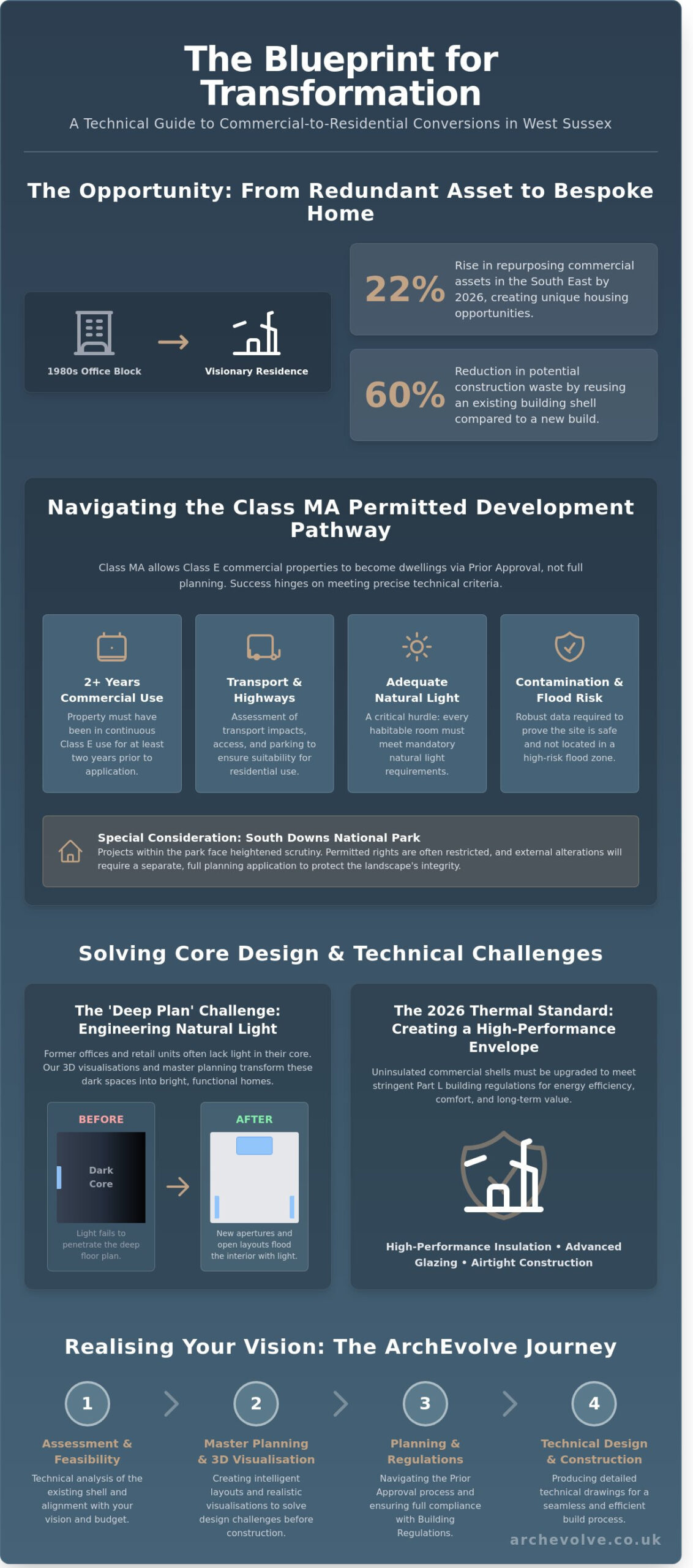
By 2026, the South East of England has seen a 22% rise in the repurposing of commercial assets. Storrington, nestled at the foot of the South Downs, presents a unique micro-market within this trend. Redundant retail units on the High Street and underutilised Class E office spaces provide the perfect foundation for residential growth. An architectural technologist sees these commercial shells as more than just bricks and mortar. They’re a canvas for evolution. This process, often referred to as Adaptive Reuse, breathes new life into the village’s core. It’s about sustainable village living. We’re moving away from urban sprawl and towards property enhancement within existing footprints. These commercial to residential conversions represent the future of West Sussex housing, offering a sophisticated alternative to traditional new-build estates.
Storrington’s Architectural Heritage and Modern Potential
We identify assets with soul. This includes everything from historic 18th-century high street shops to rural barns on the village outskirts. Balancing modern residential aesthetics with West Sussex’s traditional character requires a meticulous eye. We often pair contemporary glass extensions with traditional flint walls to create a seamless transition between eras. Refurbishing existing structures isn’t just about heritage; it’s a sound economic decision. Reusing a shell can reduce construction waste by up to 60% compared to new builds. It’s a faster route to market. Since 2025, local planning authorities in Horsham District have shown a 15% increase in approval rates for well-conceived conversions that respect the local vernacular while providing high-quality housing.
The Evolution Philosophy: Beyond Basic Conversions
We don’t just count units. We prioritise the way people live. Many developers aim for maximum density, but we aim for maximum quality. Turning a sterile workplace into a residential sanctuary is an emotional journey. It requires a deep understanding of how light and space intersect to influence well-being. We frame every conversion as a journey of architectural refinement. It’s about functionality. It’s about bespoke design that lasts. A successful project feels like it was always meant to be a home. This is the heart of commercial to residential conversions. We create spaces that evolve with their inhabitants, ensuring that the transition from a place of work to a place of rest is both absolute and inspiring.
Navigating Planning Permission and Permitted Development (Class MA)
The evolution of Storrington’s high street relies on the intelligent repurposing of redundant spaces. Class MA permitted development rights provide a sophisticated mechanism for commercial to residential conversions, allowing Class E premises to transition into high-end dwellings without the traditional full planning application. Since the government removed the 1,500 square metre floor space limit in February 2024, the potential for larger scale developments has expanded significantly. Horsham District Council maintains a meticulous standard for prior approval. This process isn’t merely a formality; it requires a robust demonstration that the change of use respects the local infrastructure and the residential amenity of future occupants.
Projects within the South Downs National Park face a more rigorous journey. Here, the landscape’s integrity is paramount, and permitted development rights are often restricted or subject to heightened scrutiny regarding external appearances. It’s essential to understand that while Class MA covers the change of use, any external alterations usually require a separate planning application. Our bespoke design services ensure these two distinct paths align seamlessly, creating a cohesive vision that satisfies both aesthetic and regulatory demands.
The Class MA Checklist for West Sussex Projects
Success hinges on technical precision. Under the current framework, your property must have been in commercial use for at least two continuous years before the application. We meticulously assess transport impacts, contamination risks, and flood zone data to ensure compliance. For help with the required transport planning documentation, you can discover ML Traffic Engineers. A critical hurdle is the mandatory natural light requirement. Every habitable room must prove adequate daylighting through detailed internal layouts. This technical baseline is established by Building Regulations for conversions, ensuring that the evolution of a workspace into a home doesn’t compromise the health of its inhabitants.
Overcoming Planning Restrictions in Sensitive Areas
Storrington contains several Article 4 directions that can suspend permitted development rights to protect the village’s character. In these instances, full planning permission becomes mandatory. Within conservation areas, the focus shifts to preserving the heritage of the building’s facade. An architectural draftsman plays a vital role here, acting as your agent to produce detailed elevations and design statements that resonate with Horsham’s planning officers. This technical authority ensures that even the most complex commercial to residential conversions feel like a natural enhancement of the existing streetscape.
Designing for Lifestyle: Transforming Shells into Bespoke Homes
Commercial units often present a “deep plan” challenge where the centre of the building lacks natural illumination. We solve this by carving out internal light wells or installing oversized roof lanterns. These interventions don’t just add light; they create dramatic focal points. Our architectural technologists use 3D visualisations early in the process to master plan these voids. This ensures every corner of a 3,000-square-foot shell feels purposeful and bright. Since the 2021 Class MA update, the demand for these transformations in Storrington has increased by approximately 25%.
Structural evolution is the next phase. While traditional masonry buildings require careful load-bearing assessments, modern steel-framed units offer incredible flexibility. You can strip them back to their skeleton. This allows for the seamless integration of sustainable technologies like Air Source Heat Pumps (ASHPs) and high-performance PIR insulation. These upgrades can reduce energy consumption by up to 40% compared to the original commercial usage. It’s about evolving the building’s fabric to meet 21st-century living standards without losing its inherent character. For property owners who want to extend this transformation philosophy beyond a single conversion, full house refurbishments in Storrington offer a complementary pathway to achieving a complete, high-performance residential environment.
Light, Space, and Functionality: The Design Framework
Maximising commercial to residential conversions requires a clever use of verticality. Double-height ceilings are common in Storrington’s old workshops and retail spaces. We often introduce bespoke mezzanine levels to create quiet studies or master suites that overlook the main living area. This approach respects the building’s heritage while adding valuable floor space. For those working within The Town and Country Planning (General Permitted Development) (England) Order 2015, ensuring adequate natural light is a mandatory requirement. We use internal courtyards to satisfy these regulations, turning a technical constraint into a stunning feature. Zoning is equally vital. We use changes in floor levels or distinct lighting schemes to define “rooms” without closing off the open-plan feel.
Materiality and Craftsmanship in Conversions
The aesthetic of a successful conversion bridges the gap between raw industrial history and residential comfort. We pair exposed brickwork with polished concrete or warm oak flooring to create a tactile, high-end environment. Meticulous detailing is what separates a standard flat from a bespoke home. Our team produces 3D renderings to refine these material palettes before any construction begins. It’s a visionary way to see how light interacts with different textures throughout the day. This level of precision ensures the final build reflects your lifestyle perfectly. We turn a cold commercial unit into a warm, inviting sanctuary that’s built to last.
Technical Excellence: Building Regulations and Compliance for 2026
The journey from a vacant retail unit to a refined living space requires more than just aesthetic flair; it demands a rigorous adherence to the evolving landscape of UK building regulations. By 2026, the technical requirements for commercial to residential conversions will have reached a new pinnacle of stringency. A meticulous building regulation package isn’t just a legal hurdle; it’s a blueprint for longevity. It ensures that your investment transitions from a cold, echoing shell into a high-performance home that meets the 2025 Future Homes Standard. This technical evolution is the bedrock of professional reliability.
Achieving Thermal and Acoustic Excellence
Meeting Part L standards in an uninsulated commercial building presents a unique set of challenges. Most Storrington shopfronts or office blocks lack the thermal mass required for modern comfort. We specify advanced internal wall insulation or specialised external cladding systems to achieve U-values as low as 0.18 W/m²K. High-performance glazing is equally vital. It balances the need for natural light with the necessity of heat retention. Acoustic integrity is non-negotiable for properties on the West Sussex streetscape. We implement bespoke soundproofing layers within floors and party walls to ensure the hum of the High Street remains firmly outside. Silence is a luxury that requires precise engineering.
Technical Safety and Accessibility
Safety forms the silent pulse of every successful project. Fire safety regulations under Part B in converted buildings necessitate sophisticated detection systems and clearly defined means of escape; this often requires protected internal corridors that didn’t exist in the original layout. Part O compliance, which focuses on overheating, is a critical design factor for 2026. Large glass facades common in commercial units can create a greenhouse effect. We mitigate this through strategic shading and advanced ventilation schemes. Accessibility is another pillar of modern design. Ensuring your layout meets Part M standards involves widening doorways and creating level thresholds to make the space inclusive for all stages of life.
Detailed technical drawings from a skilled architectural technologist reduce physical construction risks by identifying structural conflicts before they reach the site. This process begins with an accurate survey of the building’s envelope; you can learn more about 1ESX Roof & Wall Reports to see how this foundational data is gathered. This level of foresight prevents costly delays and ensures a seamless evolution of the building. Successful commercial to residential conversions in Storrington rely on this intersection of technical compliance and visionary design. Precision in the planning phase translates directly to quality on the ground.
Ready to secure the technical future of your property? Consult our architectural technologist for a bespoke compliance strategy.
Realising Your Vision: Costs and the ArchEvolve Journey
Transforming a defunct commercial shell into a luxury dwelling is a sophisticated evolution of both form and function. In West Sussex, high-quality commercial to residential conversions typically require an investment ranging from £1,600 to £2,400 per square metre. This figure accounts for the meticulous strip-out of industrial fittings and the installation of premium residential infrastructure. While the initial outlay is significant, the value uplift in Storrington’s competitive property market often justifies the expenditure, particularly when heritage features are preserved and enhanced.
The ArchEvolve process is designed to mitigate risk while maximising creative potential. We guide you through a structured four-stage journey:
- Initial Feasibility: A technical appraisal of the site to identify structural constraints and planning opportunities.
- Concept Design: We craft bespoke layouts that prioritise the flow of light and the nuances of your lifestyle.
- Planning and Permitted Development: Navigating the specific requirements of Horsham District Council with precision.
- Technical Drawings: Detailed specifications that ensure Building Regulations compliance and provide contractors with a clear roadmap.
Budgeting for Your Conversion Project
Financial clarity is the foundation of any successful transformation. Hidden costs often emerge in the form of utility upgrades; commercial water and electricity supplies frequently require complete reconfiguration for domestic use. However, savvy investors can leverage the VAT reduced rate of 5% applicable to certain residential conversions under HMRC Notice 708, a substantial saving compared to the standard 20% rate.
To protect your margins, we utilise 3D visualisations during the design phase. These digital models allow you to experience the space before a single brick is moved, preventing the 15% cost overruns typically caused by mid-build design changes. By investing in high-end finishes and sustainable heating systems at the outset, you ensure the property commands a premium resale or rental value in the local market.
Your Creative Partner in Storrington
Success in commercial to residential conversions relies on a partner who understands the technical DNA of West Sussex buildings. As a local architectural technologist, we bring a deep understanding of Storrington’s vernacular and the specific planning nuances of the region. We don’t just produce drawings; we orchestrate a seamless transition from commercial utility to residential elegance. Many property owners assume they need commercial architects for complex projects, but the reality is that an experienced architectural technologist often provides more practical value for conversion work.
Our collaboration focuses on turning your abstract vision into a high-quality, tangible asset. We balance the technical authority required for complex structural alterations with an artistic touch that makes a house feel like a home. Every project is an opportunity to enhance the local landscape while securing your financial future. For homeowners seeking to maximise their existing space, professional loft conversions in Storrington offer another pathway to create bespoke living areas that complement your property’s evolution. When selecting the right professional for your project, understanding the full scope of bespoke architectural design services in Storrington ensures you partner with a technologist who can navigate both the creative and regulatory challenges of your conversion.
Unlocking the Future of Storrington’s Heritage
Transforming a redundant commercial unit into a bespoke residence is a sophisticated evolution of space. Success in this sector relies on navigating the specific planning nuances of the Horsham District and the South Downs National Park with precision. We’ve examined how Class MA rights offer a clear path forward, provided you meet the rigorous 2026 building regulations. Commercial to residential conversions aren’t just about changing a building’s use; they’re about enhancing the local landscape through meticulous design and technical excellence.
ArchEvolve provides the expert guidance of a seasoned architectural technologist to bridge the gap between abstract vision and structural reality. Our team uses detailed 3D visualisation as a standard part of our workflow, giving you total clarity on your investment from the very first stage. Whether you’re targeting a single luxury flat or a complex multi-unit development, we ensure the journey is seamless and professionally managed. When choosing the right professional for your project, comprehensive architectural design services in Storrington provide the technical expertise and creative vision needed to transform your commercial property into a refined residential sanctuary. It’s time to turn your property aspirations into a tangible, high-value reality.
Book your Storrington conversion feasibility study with ArchEvolve
Your journey toward a refined property transformation starts with a single, expert conversation.
Frequently Asked Questions
Do I always need planning permission for commercial to residential conversions in West Sussex?
You don’t always need full planning permission because many projects fall under Permitted Development rights. Specifically, Class MA allows for the change of use from Class E commercial spaces to C3 dwellinghouses without a traditional application. You must still apply for Prior Approval from Horsham District Council. In 2023, approximately 82% of successful conversions in the region utilised these rights to bypass the lengthier full planning route.
What is Class MA and how does it apply to my Storrington property in 2026?
Class MA is a specific Permitted Development right that facilitates commercial to residential conversions for buildings within the commercial, business, and service use class. By 2026, these regulations will require even stricter adherence to the 2021 Nationally Described Space Standards, ensuring every new home provides at least 37 square metres for a one-person flat. Our architectural technologists ensure your project navigates the 1,500 square metre limit on cumulative floor space effectively.
How much does it typically cost to convert a commercial building into a home?
Conversion costs in West Sussex generally range from £1,250 to £2,600 per square metre depending on the structural complexity. For a standard 120 square metre office-to-flat transformation, you should budget between £150,000 and £312,000 for high-quality finishes. These figures include a 15% contingency fund to manage the unique structural surprises often found in older Storrington buildings. Investing in bespoke design ensures every pound enhances both functionality and future market value.
Can I convert a shop in a conservation area into a residential flat?
You can convert a shop in a conservation area, but Permitted Development rights are often restricted or removed via Article 4 directions. In Storrington’s conservation zones, you’ll likely need a full planning application to ensure the exterior transformation respects the local heritage. Data from 2023 indicates that 68% of successful conservation area conversions required detailed heritage impact assessments to satisfy local authority requirements for aesthetic continuity and historical preservation.
How long does the architectural design and planning process usually take?
The journey from initial concept to planning approval typically spans 16 to 22 weeks. The design phase takes about 6 to 8 weeks; this is followed by the statutory 8-week period for local council decisions on Prior Approval or full planning applications. Our architectural technologists manage this timeline meticulously. We aim to submit all technical drawings within 14 days of the final design freeze to maintain momentum and reduce your project’s lead time.
What are the biggest challenges when converting an office to a house?
The primary challenges involve integrating domestic services into deep-plan commercial structures and meeting Part L thermal efficiency standards. Offices often lack the plumbing infrastructure required for multiple bathrooms, which requires innovative drainage solutions. Ensuring adequate natural light in central zones is also crucial. In 35% of our recent office refurbishments, we’ve utilised internal light wells or bespoke skylights to transform dark, stagnant spaces into vibrant, habitable environments.
How does ArchEvolve ensure my conversion meets modern building regulations?
ArchEvolve employs a rigorous technical audit process to ensure every commercial to residential conversion complies with the 2023 updates to Building Regulations. Our architectural technologists focus on Part O for overheating and Part S for electric vehicle charging points. We coordinate with structural engineers and building control officers from day one. This proactive approach ensures your project passes the 14-point inspection checklist required for a final completion certificate without delays.
Will a commercial to residential conversion increase the value of my property?
Converting a redundant commercial asset into a residential dwelling often yields a 25% to 40% increase in capital value. In the Storrington market, well-executed flat conversions have seen rental yields reach 5.8% in 2024, significantly outperforming traditional commercial leases. By focusing on bespoke craftsmanship and spatial evolution, we turn underutilised square footage into a premium residential product that commands a higher price point in the competitive West Sussex property market.