
Your vision for a bespoke commercial space in Storrington doesn’t require a signature from a London-based firm to achieve planning success. Many business owners believe they must hire traditional commercial architectural designers to navigate the intricate requirements of the South Downs National Park Authority, which manages 1,600 square kilometres of protected landscape. In reality, the technical precision and aesthetic evolution of your property often depend more on local expertise and meticulous design than a specific title.
We understand that the prospect of high fees and complex building regulations can make any development feel like a daunting journey. You want a functional, high-quality environment that enhances your brand without the financial strain often associated with “big city” practices. This article reveals the truth about commercial property development in West Sussex; it explains why an architectural technologist or architectural draftsman is frequently the more practical choice for your project. We’ll debunk five common myths to provide you with a clear, professional roadmap for your next transformation.
Key Takeaways
- Realise the technical advantages of partnering with a local architectural technologist to ensure your commercial project is delivered with bespoke precision and meticulous attention to detail.
- Navigate the complexities of securing planning permission in West Sussex by understanding the realistic requirements of the South Downs National Park and Horsham District Council.
- Unlock the hidden potential of boutique spaces and shop fit-outs through design strategies that prioritise seamless flow and sophisticated functional elegance.
- Streamline your commercial-to-residential conversion using Permitted Development Rights, an area where local specialists often provide more practical reassurance than traditional commercial architectural designers.
- Maximise your investment by choosing a Storrington-based firm that combines the visionary expertise of a city studio with the competitive fee structures of a local partner.
Myth 1: You Must Hire an ‘Architectural Designer’ for Commercial Projects
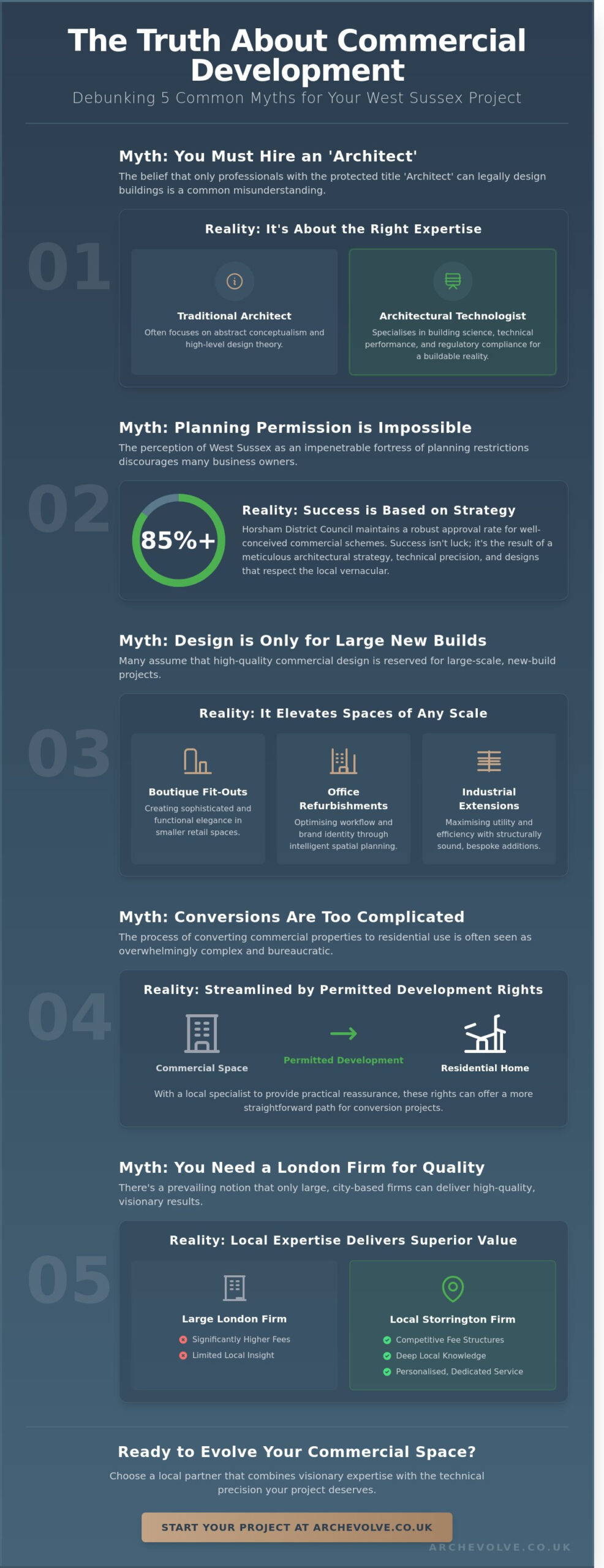
Many business owners in West Sussex believe that only those holding a specific protected title can lead a commercial development. This is a common misconception rooted in a misunderstanding of the UK’s legislative framework. The Architects Act 1997 protects the professional title itself, but it doesn’t grant an exclusive right to practice building design or submit planning applications. For most commercial ventures in Storrington, from high-street retail refurbishments to complex industrial extensions, an architectural technologist offers a robust, science-led alternative. While some clients initially search for commercial architectural designer, they quickly discover that a technical specialist provides the meticulous precision required for modern building regulations.
The distinction lies in the focus of the work. Traditional design often prioritises abstract conceptualism, sometimes at the expense of practical delivery. In contrast, an architectural draftsman or technologist focuses on the evolution of a building through the lens of technical performance. ArchEvolve provides this high-level design and planning service by blending creative vision with engineering reality. We ensure that your project isn’t just a beautiful drawing but a functional, buildable reality that meets every statutory requirement.
What is an Architectural Technologist?
These professionals are specialists in the science of architecture and building construction. They bridge the gap between a creative spark and the physical structure. When you’re investigating What is commercial property? in the context of a Storrington refurbishment, the focus must remain on longevity and thermal efficiency. Architectural technologists ensure every detail is bespoke and technically sound. They hold comprehensive professional indemnity insurance and adhere to rigorous standards, ensuring your technical drawings withstand the scrutiny of building control. This technical-first approach is particularly beneficial for flat conversions and two-story side extensions where structural integrity is paramount.
Choosing the Right Professional for Your Storrington Project
Local expertise is a vital component of a successful build. Navigating the specific planning nuances of Horsham District Council requires a partner who understands the West Sussex landscape. A boutique firm provides a level of personalised attention that larger, title-heavy practices often cannot sustain. The decision to move beyond the search for commercial architectural designer allows for a technical-first approach that streamlines the construction phase. We focus on the intersection of light, space, and commercial utility. By choosing an architectural draftsman with deep local roots, you’re investing in a partner who values your business’s long-term goals. We treat every project as a journey, guiding you from the initial conceptual vision to the final, physical transformation of your commercial space.
Myth 2: Planning Permission in West Sussex is Impossible to Secure
The perception of West Sussex as an impenetrable fortress of planning restrictions is a common fallacy. Many business owners believe that local authorities are inherently anti-development, especially within the picturesque confines of Storrington. While some believe commercial architectural designer face an uphill struggle here, the reality is that success depends on technical precision and a deep respect for the local vernacular. In the 2022/23 period, Horsham District Council maintained a robust approval rate for well-conceived commercial schemes, proving that the system rewards quality over quantity. Success isn’t a matter of luck; it’s the result of a meticulous architectural strategy that aligns with local growth targets.
Securing permission requires an evolution of thought. We don’t view planning officers as obstacles, but as stakeholders in the enhancement of our community. By presenting a bespoke design that addresses specific local concerns, we transform the application process from a gamble into a structured journey toward delivery. High-quality 3D visualisations play a pivotal role here. These renders allow planning officers to step inside the vision, seeing exactly how light and space will interact with the existing streetscape. It removes the guesswork and builds immediate trust in the project’s aesthetic integrity.
Navigating South Downs National Park Restrictions
Storrington’s unique position on the edge of the South Downs National Park adds a layer of complexity that requires a specialist touch. Development here isn’t impossible; it simply demands a higher level of environmental stewardship. We focus heavily on “dark skies” policies, ensuring that commercial lighting doesn’t disrupt the region’s famous nocturnal landscapes. Using traditional materials like Wealden flint or local timber allows a new refurbishment or extension to feel like a natural evolution of the site rather than a modern intrusion. Sustainable design isn’t just a buzzword; it’s a core requirement that, when handled by a skilled architectural technologist, becomes a powerful argument in favour of your project.
The Power of Pre-Application Advice
Early engagement is the most effective tool in our arsenal. Initiating a pre-application dialogue with Horsham District Council or the National Park authority allows us to identify potential objections before they become costly delays. This proactive approach turns planning hurdles into design opportunities, ensuring the final submission is already refined and familiar to the decision-makers. For those considering commercial to residential conversions, this early stage is where we align the project with the latest government consultations and local housing needs. Our Complete Guide to House Extensions illustrates how these same principles of early collaboration lead to successful outcomes in residential contexts. If you’re ready to see how your vision fits within the local framework, our architectural technologists can guide you through the initial feasibility phase.
Myth 3: Commercial Design is Only for Large-Scale New Builds
A common misconception persists that the services of commercial architectural designers are reserved exclusively for glass-fronted skyscrapers or sprawling industrial estates. In reality, the most profound transformations often occur within the tight constraints of a boutique shopfront or a modest office suite. For Storrington’s local business community, the evolution of a space isn’t defined by its footprint but by the precision of its execution. Small-scale refurbishments require a meticulous approach to ensure every square millimetre serves a dual purpose: aesthetic charm and functional efficiency.
Professional design influences how people navigate a room. In a retail environment, data from the 2023 High Street Trends report suggests a 15% increase in foot traffic can often be traced back to a more intuitive floor plan. For office spaces, a 2022 study on workplace design found that thoughtful lighting and ergonomic flow can boost employee output by up to 20%. This level of detail isn’t accidental. It’s the result of a visionary partnership between a business owner and an architectural technologist who understands the nuances of the West Sussex market.
This focus on human-centric design is especially critical in research and development settings. When designing labs for neurotechnology or cognitive science, for example, the architectural plan must accommodate highly specialized equipment. In such cases, even the MindRove EEG headset price can become a line item in the overall project budget to ensure the facility is state-of-the-art.
The same principles apply to the hospitality sector, where the design of a space directly impacts guest experience and brand perception. A well-executed refurbishment can turn a historic building into a sought-after destination, as seen with The Corner House Hotel in Taunton, which blends Victorian character with modern comfort.
Refurbishing Small Office and Retail Units
Storrington is home to numerous historic commercial buildings that require a sympathetic hand. Integrating high-speed data cabling and modern climate control into a centuries-old structure without compromising its heritage character is a delicate balancing act. An architectural draftsman can create bespoke interior solutions that respect the past while embracing the future. This process ensures that a 50-square-metre unit on the high street feels as expansive and professional as a corporate headquarters. By focusing on smart space planning, we ensure that boutique spaces remain competitive and vibrant.
ROI: How Good Design Increases Property Value
Investing in high-quality design is a strategic move for any asset owner. Properties that have undergone a professional renovation often command rental yields 10% to 15% higher than their unrefined counterparts. It’s about future-proofing your investment through flexible master planning. We use advanced 3D visualisations to help clients see the finished space before a single brick is laid. This clarity is essential for attracting premium tenants who value a polished image. While many look to the Royal Institute of British Architects (RIBA) for industry standards, the practical application of these principles happens on the ground in Storrington. Even though people often search for commercial architectural designers to lead these projects, an architectural technologist provides the technical rigour needed to turn these visions into profitable realities.
Of course, a polished physical image is most effective when paired with a professional online presence. For many local businesses, establishing that digital storefront is the next crucial step after a renovation. To complement your new space with an effective website, you can learn more about Super Fast Websites.
For retail businesses aiming to dominate the digital landscape, NB eCommerce & Design offers expert Shopify design and development, ensuring your online presence is as sophisticated and functional as your new Storrington shopfront.
To ensure your digital strategy is as robust as your physical storefront, Cornerstone Marketing Solutions provides comprehensive digital marketing services designed to build a powerful online presence and drive sustainable growth.
Myth 4: Commercial to Residential Conversions are Too Complicated
The belief that repurposing a business unit is an insurmountable legal hurdle is a persistent misconception. In reality, the evolution of Permitted Development Rights (PDR) has streamlined the process significantly. By 2026, the Class E to residential pathway allows for the transformation of redundant offices and shops into high quality flats without the exhaustive requirements of a full planning application. For Storrington landlords facing vacancies in traditional office blocks, this represents a vital opportunity for property enhancement. While many developers initially seek out commercial architect designers to explore these possibilities, the technical delivery of a conversion is a specialised journey that requires a meticulous approach to building logic.
Converting an empty office into a residential dwelling isn’t just about changing the sign on the door; it’s a profound evolution of the building’s soul. Our architectural technologists manage this transition by balancing the aesthetic desire for open, light filled spaces with the rigid demands of domestic safety. This process turns underutilised assets into vibrant homes, enhancing both the streetscape and the landlord’s portfolio. While commercial architect designers might focus on the broad conceptual vision, our team provides the granular technical detail needed to navigate the building control process successfully.
Understanding Change of Use in Storrington
Transforming a Class E space into residential dwellings requires a keen eye for detail and a deep understanding of local constraints. Common pitfalls often involve failing to meet the Nationally Described Space Standards, such as the 37 square metre minimum requirement for a one person flat. To navigate these complexities, we recommend reviewing our Master Guide to Property Transformation for conversion details. Success lies in early feasibility studies that assess natural light levels and ceiling heights before the first brick is moved.
Technical Building Regulation Packages for Conversions
Myth 5: You Have to Use a Large London Firm for Quality Results
There’s a persistent misconception that prestige and quality are exclusive to firms within the M25. Many West Sussex developers and business owners assume that a high-end commercial project requires a global London agency. In reality, choosing a local Storrington firm often yields more refined and sustainable results. Large city firms carry immense overheads. Their fee structures often reflect expensive postcodes rather than the technical depth of the work. When you partner with a local expert, your investment is directed entirely into the design and execution of your space.
While some initially search for commercial architect designers to lead their projects, they quickly find that the technical authority of an architectural technologist provides a more practical and innovative edge. We focus on the synergy between aesthetic vision and buildability. This ensures that your project doesn’t just look stunning on paper but performs exceptionally in the physical world. Our commitment to transforming local visions into high-quality spaces means we’re personally invested in the success of every West Sussex development.
The Benefits of Local Proximity
Proximity is a significant asset in the construction process. A local firm can be on-site within minutes, not hours, allowing for more frequent inspections and face-to-face consultations. We possess a deep understanding of the West Sussex aesthetic and the specific community needs of Storrington. This local insight is invaluable when navigating the nuances of the planning system. By working with us, you also support the regional economy. We maintain a robust network of trusted West Sussex contractors and consultants, ensuring a seamless flow of communication from the first sketch to the final brick.
While technical design is the foundation, the overall success of a commercial development—whether in West Sussex or further afield—often requires high-level coordination. FALKE Atlantic Corporation provides expert owner representation and project management services, ensuring that even the most complex construction projects are delivered efficiently and to the highest standards.
Managing the administrative details of a construction project, from coordinating with contractors to handling paperwork, can be a significant undertaking. For business owners juggling these tasks, support from a service like Cheshire Virtual PA can be essential for keeping the project on track.
This commitment to the regional economy extends beyond the build itself. Once your new commercial space is ready to welcome customers, partnering with a local digital marketing team can be the next step in ensuring your business’s growth. For instance, many successful West Sussex companies work with Eightfold Marketing to build a strong online presence that drives footfall to their new premises.
Alongside marketing and administrative support, talent acquisition is a key pillar of business expansion. For those looking to recruit for their newly developed spaces, Altum Recruitment offers specialist services to help you secure the top-tier talent required to make your commercial vision a success.
Bespoke Service vs. The ‘Factory’ Model
Large London firms often operate on a high-volume “factory” model where projects are passed down to junior staff. At ArchEvolve, we offer a bespoke service that prioritises meticulous craftsmanship. You work directly with a senior architectural technologist who knows your project inside out, from the initial loft conversion concept to the final flat conversion handover. This collaborative approach leads to more creative and functional solutions tailored to your lifestyle and business goals. We don’t believe in one-size-fits-all designs; we believe in the evolution of space through technical precision. Ready to evolve your space? Contact ArchEvolve for a consultation and let’s begin the journey together.
Evolving Your Commercial Vision in Storrington
Debunking these myths reveals that high-end design isn’t reserved for London skyscrapers or massive new builds. Local expertise in West Sussex planning remains the most effective tool for navigating the 2024 National Planning Policy Framework. Whether you’re planning a sophisticated commercial-to-residential flat conversion or a bespoke refurbishment, the focus should be on technical precision and functional beauty. Many businesses begin their search by looking for commercial architect designers, yet they often find that the specialized technical authority of an architectural technologist provides a more seamless bridge between creative vision and site reality.
ArchEvolve brings this meticulous approach to every project in Storrington. We provide bespoke 3D visualisations and comprehensive technical packages that ensure your development isn’t just a concept, but a viable evolution of your property portfolio. Our team understands the specific nuances of local planning regulations, helping you avoid the delays that often stall ambitious projects. Start your commercial property transformation with ArchEvolve. Your property’s next chapter starts with a single, visionary step.
Frequently Asked Questions
Is it a legal requirement to use commercial architect designers for projects in the UK?
It isn’t a legal requirement to use any specific title for your project, though over 70% of successful commercial applications involve professional technical drawings. While many business owners search for commercial architect designers, you can legally appoint an architectural technologist or an architectural draftsman to lead your development. These professionals ensure your Storrington project adheres to the Building Regulations 2010 while managing the intricate planning process on your behalf.
How much do commercial architectural design fees typically cost in West Sussex?
Professional fees for commercial projects in West Sussex generally range between 7% and 12% of the total construction budget. For a mid-sized office refurbishment costing £200,000, you should budget approximately £14,000 to £24,000 for a comprehensive design and technical package. These costs cover the evolution of your project from initial concepts through to the final building regulation approvals and site oversight.
Can I convert my Storrington shop into a residential flat without full planning permission?
You can often perform this transformation under Class MA Permitted Development rights, which were introduced in August 2021. This route allows for the conversion of commercial premises into residential flats without a full planning application, provided the building has been vacant for 3 continuous months. You must still submit a Prior Approval application to Horsham District Council to address specific criteria such as flood risks and natural light levels.
What is the difference between an architectural technologist and an architectural draftsman?
An architectural technologist focuses on the technical science of building, ensuring that a design is both sustainable and structurally sound. They possess a deep understanding of construction technology and the UK planning system. An architectural draftsman typically focuses on the creation of the technical drawings themselves. Both roles provide the precision needed to guide your commercial project from a creative spark to a tangible reality.
How long does it take to get a commercial planning application approved in Horsham District?
Horsham District Council typically reaches a decision on commercial applications within 8 to 13 weeks. Smaller refurbishments or changes of use often hit the 8-week target; more complex transformations may require the full 13-week statutory period. We recommend allowing a 4-week window for pre-application advice to ensure your submission is meticulous and avoids unnecessary delays during the formal review process.
What are building regulation packages and why are they needed for commercial work?
Building regulation packages are detailed sets of technical drawings and specifications that demonstrate compliance with the Building Regulations 2010. These documents are vital for commercial work because they cover essential safety aspects like fire escapes, structural stability, and thermal efficiency. Without these approved plans, you won’t receive the completion certificate necessary for securing commercial insurance or selling the property in the future.
Do I need 3D visualisations for a simple office refurbishment?
3D visualisations aren’t a mandatory part of the planning process, but they’re used in approximately 80% of our commercial projects to provide aesthetic reassurance. These renders allow you to see how light interacts with the space and how different materials enhance the professional atmosphere. Seeing a photorealistic version of your office before construction begins helps prevent expensive changes during the build phase.
How can I make my commercial building more sustainable and energy-efficient?
Improving your building’s thermal envelope can reduce heat loss by up to 30% through high-grade insulation and modern glazing solutions. Installing smart LED lighting systems and air source heat pumps further contributes to the UK’s 2050 Net Zero goals while lowering your annual utility bills. These enhancements don’t just protect the environment; they increase the long-term value and appeal of your commercial asset in the West Sussex market.