
Running out of space at home and weighing up whether to convert or move? The question most UK homeowners actually want answered goes beyond technical feasibility: does a loft conversion add value to your house, and does that value justify the spend?
According to Nationwide’s House Price Index Special Report, a loft conversion incorporating a double bedroom and bathroom can add as much as 24% to the value of a three-bedroom, one-bathroom house.
On a typical UK property, that translates to a cash increase of approximately £65,700.
That headline figure is accurate. It is also the best-case scenario. The actual uplift depends on conversion type, location, design quality, and whether the finished space genuinely qualifies as a bedroom at the point of sale.
| Factor | Impact on Value |
| Conversion type (Mansard vs Velux) | High |
| Bedroom creation | High |
| En-suite bathroom addition | High |
| Head height and usable floor area | High |
| Location (London and South East vs North) | High |
| Building regulations compliance | High |
| Natural light and layout quality | Medium-High |
Does a Loft Conversion Add Value to Your House in the UK?
The short answer is yes, but the degree of that value is entirely determined by what the conversion delivers. A loft fitted with Velux windows and basic insulation adds far less than one with full headroom, a proper staircase, and an en-suite bathroom.
Buyers assess loft space the same way estate agents price it: by usability. A room that cannot be listed as a bedroom on Rightmove or Zoopla contributes significantly less to sale value than one that can. Legal classification matters as much as construction quality.
Andrew Harvey, Senior Economist at Nationwide, put it directly:
“Home improvements that increase the size of the property, such as an extension or loft conversion, remain a compelling way to add value.
Having more usable space is generally thought to be consistent with better quality accommodation and people are prepared to pay for it.”
The ROI of a loft conversion is among the strongest of any residential home improvement in the UK. But the return is not guaranteed. Overcapitalisation, poor design, and missing compliance documentation all reduce it significantly.
| Loft Conversion Value Driver | Result When Present | Result When Absent |
| Habitable bedroom status | Full bedroom valuation uplift | Box room or bonus room pricing |
| Building regulations certificate | Buyer confidence, clean sale | Sale delays, potential lender refusal |
| En-suite bathroom | Strongest single value addition | Reduced appeal to most buyer profiles |
| 2.3m+ headroom over 50% of floor | Qualifies as proper double bedroom | Surveyor reclassifies as limited space |
For a detailed breakdown of project costs across every conversion type, our loft conversion cost breakdown UK guide covers structure, finish, and professional fees in full.
How Much Value Does a Loft Conversion Typically Add?
The 2025 and 2026 UK property and construction data consistently puts typical uplift at 20-25%, with a cash range of £50,000 to £120,000. That spread exists because conversion type and location produce very different outcomes.
| Scenario | Estimated Cash Uplift | ROI on Spend |
| Velux / Rooflight only | £25,000-£55,000 | Moderate |
| Dormer bedroom only | £40,000-£80,000 | 120-160% |
| Dormer bedroom + en-suite | £65,000-£120,000+ | Highest for most property types |
| Mansard with en-suite | £85,000-£180,000 | Highest cash value overall |
Nationwide’s HPI Special Report (2025) also breaks this down by bedroom count. Adding a third bedroom to a two-bed home adds 13-17% in value. Adding a fourth bedroom to a three-bed home adds 10-13%.
Both figures assume a standard double bedroom of approximately 13m². Smaller rooms, or those with restricted headroom, contribute considerably less.
The step from a dormer bedroom with no bathroom to one with an en-suite is where the strongest financial gain typically sits. That single design decision changes the buyer pool and the final valuation.
The Biggest Factors That Determine Loft Conversion Value
Two identical loft conversions on the same street can produce different valuations. The physical outcome matters, and so does how surveyors and buyers read the space.
| Feature | Buyer Impact |
| Double bedroom of 13m+ floor area | Very high |
| En-suite or bathroom addition | Very high |
| Head height of 2.3m+ over 50% of floor | High |
| Proper fixed staircase (not a loft ladder) | High |
| Natural light via dormers or Velux windows | High |
| Integrated storage without reducing floor area | Medium |
| Full building regulations certification | High |
A loft bedroom under 10m² with less than 2.3m of headroom over 50% of the usable floor is typically treated by valuation surveyors as a box room.
That classification reduces the value contribution to £15,000-£28,000, compared to £45,000-£85,000 for a compliant double bedroom.
Staircase positioning is one of the most underestimated decisions in loft conversion design. A poorly placed staircase reduces the effective floor area of the loft room itself.
An additional £1,200-£2,500 spent at architectural design stage on better staircase placement can add £20,000 or more to the final sale value.
Does Adding a Bedroom and Bathroom Increase Value the Most?
Yes, and the data across multiple sources is consistent on this point.
Nationwide’s research confirmed that a loft conversion incorporating a large double bedroom and bathroom can add up to 24% to the value of a three-bedroom, one-bathroom house.
Adding an extra bathroom alone, without the bedroom, adds around 4%. The combination of both is the most financially impactful single improvement available to most UK homeowners.
The reason is buyer behaviour. A home that moves from three to four bedrooms with an en-suite appeals to a fundamentally different buyer pool.
It commands higher offers, ranks better on property portals, and attracts more qualified interest across most UK markets.
When a Loft Conversion Does Not Add Value
A loft conversion is not automatically profitable. Several scenarios produce minimal or negative financial return.
| Risk Factor | Value Impact |
| High spend in a low-ceiling local market | Costs may exceed recoverable value |
| Headroom below 2.3m | Box room pricing applies |
| No building regulations certificate | Serious sale complications |
| Staircase design that cuts into bedroom space | Reduced room valuation |
| North East, Wales, or rural Scotland market | 85-100% cost recovery only |
| Conversion with no natural light | Reduced buyer appeal and confidence |
In lower-value markets such as parts of the North East, Wales, and rural Scotland, a loft conversion may only recover 85-100% of the build cost at resale.
In those areas, the financial logic is weaker. The conversion may improve daily life considerably while delivering limited uplift at the point of sale.
Non-compliance is the hardest problem to recover from. Missing building regulations documentation flags immediately in solicitor searches.
Lenders can refuse to mortgage properties with uncertified structural work. Retrospective certification or remedial work often costs more than the original compliance would have.
Loft Conversion Cost vs Value Reality Check
Is a loft conversion worth the money? That depends entirely on what you are measuring: financial return at resale, quality of life during ownership, or both.
In 2026, most UK loft conversions cost between £20,000 and £75,000 depending on type and specification. London projects typically run 20-40% higher.
| Conversion Type | UK Cost (2026) | London Cost (2026) | Typical Value Uplift |
| Velux / Rooflight | £20,000-£40,000 | £50,000-£65,000 | £25,000-£55,000 |
| Rear Dormer | £40,000-£70,000 | £55,000-£120,000 | £50,000-£120,000 |
| Hip-to-Gable | £45,000-£65,000 | £65,000-£95,000 | £55,000-£120,000 |
| Mansard | £55,000-£95,000 | £80,000-£120,000+ | £85,000-£180,000 |
Overall, loft conversions deliver a 60-75% return on investment across the UK, rising sharply in high-demand areas and where the build adds a full bedroom-and-bathroom combination.
A 10% increase in floor space adds around 5% to the value of a typical house according to Nationwide’s analysis. It is the bedroom count, and the quality of the room, that produces the strongest uplift.
For homeowners comparing renovation costs across different project types, our how much does a house extension cost UK guide provides a direct comparison for ground-floor alternatives.
Do Buyers Really Value Loft Conversions When Buying a Home?
Buyers value them significantly, but they are selective. A fully habitable, well-lit, and building-regulations-compliant loft bedroom commands a clear premium. A poorly executed or uncertified conversion can reduce buyer confidence rather than build it.
| Loft Type | Estate Agent Classification | Buyer Appeal | Value Impact |
| Storage loft (no conversion) | Not listed | Negligible | Minimal |
| Rooflight only (no bedroom status) | Bonus or hobby room | Low-medium | Low |
| Dormer bedroom (no bathroom) | Standard bedroom | High | Medium-high |
| Dormer bedroom + en-suite | Master or premium double | Very high | High |
| Mansard with bedroom + en-suite | Premium bedroom | Very high | Very high |
Nationwide’s survey of 2,000 homeowners found that 71% of those who renovated in the past five years focused on kitchens and bathrooms. Yet bedroom-creating projects like loft conversions deliver the highest financial uplift at resale.
The most popular home improvements and the most financially rewarding ones are not always the same project.
Only 4% of homeowners who carried out renovation work told Nationwide they regretted it. That figure suggests the lived experience of a loft conversion is broadly positive, even when the primary motivation was lifestyle rather than investment.
Does a Loft Room Always Count as a Bedroom in Property Valuation?
No, classification depends on compliance, headroom, floor area, and access quality.
For a loft room to be classified and valued as a habitable bedroom, it generally needs to meet all of the following:
- Minimum floor area of approximately 7.4m² for a single bedroom, around 13m² for a double
- Head height of at least 2.3m over 50% or more of the usable floor area
- A fixed staircase with appropriate balustrade rather than a loft ladder
- Full building regulations approval confirming habitable space status
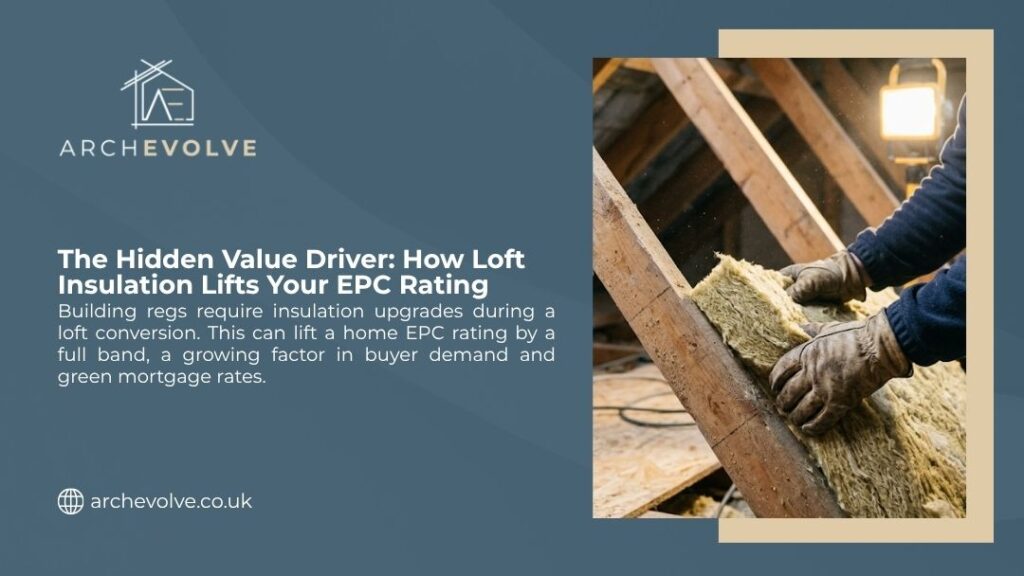
- Adequate fire separation, thermal insulation, and ventilation
A room meeting those standards commands double bedroom pricing. One that falls short is typically treated as a storage or bonus space by surveyors and estate agents, which directly affects the final valuation figure.
Planning Permission, Building Regulations, and Their Impact on Value
Planning permission and building regulations are two entirely separate processes. Confusing them is one of the most common misunderstandings on residential loft projects, and mixing them up leads to genuine compliance gaps. We go through the key differences between both consents, with worked examples, in a separate guide.
| Compliance Pathway | Who Approves | What It Covers | When Required |
| Planning permission | Local planning authority | Design, scale, visual impact | Only when PD limits are exceeded |
| Building regulations approval | Building control body | Structure, insulation, fire safety | Always, on every loft conversion |
| Permitted development (PD) | Self-assessed against GPDO rules | Confirms no planning needed | Most standard loft conversions |
| Certificate of Lawful Development | Local authority | Legal confirmation of PD status | Strongly recommended for future sale |
Most loft conversions in England fall within permitted development rights, meaning no formal planning application is required. The volume limits are 40 cubic metres for terraced houses and 50 cubic metres for detached and semi-detached properties.
Every loft conversion, regardless of planning route, requires building regulations approval. That approval confirms the structure is safe, thermally compliant, and legally habitable. It is also the document buyers’ solicitors check.
In Q2 2025, the grant rate for householder development applications in England reached 88%, confirming that well-prepared applications succeed consistently. The current householder planning application fee in England is £258 (2026).
For a full breakdown of what qualifies under permitted development and when full permission is required, our guide on whether you need planning permission for a loft conversion covers the criteria in detail.
Loft Conversion vs Moving House: Which Adds More Value?
For many UK homeowners, this is the real decision. Moving house in 2026 costs between £15,000 and £30,000 in transaction fees alone, before a single fitting is changed in the new property. That covers stamp duty, solicitor fees, estate agent commission, and removals.
Research from the HomeOwners Alliance found that over 800,000 homeowners have shelved their moving plans entirely because the costs make it financially unviable.
One in five UK homeowners (20%, up from 13% two years prior) would like to move but cannot afford to.
| Factor | Moving House | Loft Conversion |
| Upfront cost | £15,000-£30,000+ in fees | £20,000-£75,000 build cost |
| Value added to current home | None | 15-25% property uplift |
| Disruption | Very high (school, commute, community) | Medium (typically 4-10 weeks) |
| Mortgage implications | Larger loan on new property | Often funded without remortgaging |
| Flexibility of outcome | Limited by available stock | Designed to your specification |
The jump from a three-bed to a four-bed property costs an average of £178,132 more at the point of purchase in the UK.
A well-designed dormer loft conversion creating that same fourth bedroom costs a fraction of that, and simultaneously raises the value of the property you already own.
For homeowners also considering a ground-floor option as part of this decision, our guide on [does a house extension add value to your property] covers the financial comparison across both routes.
How to Maximise the Value of a Loft Conversion
The difference between a strong financial return and an average one usually comes down to design decisions made before construction begins.
| Design Decision | Value Impact |
| Adding an en-suite bathroom | Very high |
| Dormer extension over rooflight | High |
| Optimising staircase position at design stage | High |
| Achieving 2.3m+ head height throughout | High |
| Maximising natural light front and rear | Medium-high |
| Integrated storage that protects floor area | Medium |
| Materials that match the existing property | Medium |
The highest-return approach combines a double bedroom with an en-suite, a well-positioned staircase, good natural light, and full building regulations compliance from day one.
Dormer conversions consistently outperform rooflight conversions financially, particularly in urban and suburban markets.
Spending the extra on quality architectural design before the build begins protects both the layout and the budget. The decisions made at design stage are the ones you cannot change cheaply once construction starts.
Is a Loft Conversion Worth It for Your Property Type?
| Property Type | Best Conversion Type | Typical ROI | Notes |
| Terraced house | Dormer or Mansard | 15-20% | High buyer demand for extra bedrooms |
| Semi-detached | Dormer or Hip-to-Gable | 15-20% | Hip-to-Gable maximises space effectively |
| End-of-terrace | Hip-to-Gable + Dormer | 15-20% | Strong structural opportunity |
| Detached property | Dormer or combined styles | 10-15% | Greater design flexibility |
| Flat or maisonette | Generally not feasible | N/A | Structural and ownership barriers apply |
Detached properties offer more design freedom but tend to show a slightly lower ROI percentage. They already have more living space to begin with, which reduces the marginal value of the additional room.
Terraced and semi-detached homes in cities and commuter towns show the strongest and most consistent returns, because buyer demand for additional bedrooms in those locations remains reliably high.
FAQs
Does a loft conversion add value to your house?
In most cases, yes. A building-regulations-compliant loft conversion that creates a habitable bedroom adds measurable value in the UK. The uplift ranges from 10-13% in lower-demand regions to 20-25% or more in London and the South East.
The exceptions are conversions that do not meet bedroom classification standards, projects with missing compliance documentation, and builds in markets where costs already approach the local property ceiling.
What type of loft conversion adds the most value?
A dormer conversion with a double bedroom and en-suite delivers the strongest return for most UK properties. Mansard conversions add more in cash terms, particularly in London and high-value urban areas, but carry higher build costs.
The bedroom-plus-bathroom combination is consistently the highest-performing configuration across all conversion types.
Is a loft conversion worth the money?
It depends on the market and the design quality. In high-demand urban and suburban areas, a well-executed loft conversion returns significantly more than the build cost.
In lower-value markets, the financial return may only break even. In those cases, the case for converting rests on improved daily living rather than investment return.
Do I need planning permission for a loft conversion?
Most loft conversions in England proceed under permitted development rights without a formal planning application, provided volume limits are respected: 40 cubic metres for terraced houses, 50 cubic metres for detached and semi-detached homes.
Flats, listed buildings, and conservation area properties require full planning permission. Building regulations approval is required on all conversions regardless of planning status.
What is the ROI of a loft conversion in the UK?
Typical UK figures put the ROI of a loft conversion at 60-75% across the market as a whole. Dormer conversions in high-demand markets achieve 120-160% of the build cost in added value.
The strongest returns consistently come from conversions that create a double bedroom with an en-suite in areas where property prices are high and buyer demand for extra bedroom space is sustained.
Key Considerations Before You Commit
A loft conversion is one of the most financially reliable improvements available to UK homeowners, but the return depends on execution.
A habitable double bedroom, an en-suite, and full compliance documentation are what separate a high-performing conversion from one that barely covers the build cost.
Understand your local property ceiling before committing to a premium specification. Confirm the loft can achieve the headroom and floor area needed to qualify as a proper bedroom.
Ensure building regulations documentation is in place from the outset, because missing paperwork creates problems at sale that are expensive and slow to resolve.
With 15+ years of experience and over 500 completed projects across loft conversions, extensions, and residential developments, Archevolve supports homeowners across England from initial feasibility assessment through to planning approval and full construction documentation.
If you are planning a loft conversion and want an accurate picture of the value it could add to your specific property, contact Archevolve today.