
Does a house extension add value to your property, or does it only make your home more comfortable to live in? For most UK homeowners, the financial case matters just as much as the lifestyle benefit.
But the exact property value increase any extension delivers is never guaranteed, and the drivers behind that uplift are more nuanced than a headline percentage suggests.
This guide explains when an extension genuinely adds value at resale, which types perform best, what the full cost picture looks like, and how planning and compliance change the outcome.
Does a House Extension Add Value to Your Property?
For most homeowners, yes, but the degree of that value depends entirely on what the project delivers.
According to Nationwide’s House Price Index Special Report (October 2025), an extension or loft conversion that adds a large double bedroom and bathroom can increase the value of a three-bedroom, one-bathroom house by up to 24%.
Expanding the floor area by 10% typically adds around 5% to property value. Buyers pay for usable space, not square footage in isolation.
Value to Live In Versus Value to Sell
There is a genuine difference between what an extension delivers day-to-day and what it adds at the point of sale. The Houzz UK Survey (2025) found that 61% of renovating homeowners plan to stay in their property for at least 11 years after completing work.
When the design improves the layout in a way the local buyer market recognises and rewards, both cases align. When it is driven purely by personal taste, the resale return can fall short.
What Actually Determines Whether an Extension Adds Value?
Two extensions of the same size can produce very different financial outcomes. The value drivers matter far more than the dimensions alone.
Location and Local Price Ceiling
Every local market has a ceiling. An £80,000 extension in a £250,000 street carries considerably more risk than the same project in a £500,000 market.
Local price per square metre sets the upper limit on what any improvement can realistically return. Researching that ceiling before committing to a specification is a basic but often overlooked step.
Size Is Not the Same as Usefulness
Nationwide’s HPI analysis found that a 10% increase in floor space adds around 5% to property value. That relationship holds when the space is genuinely liveable.
A modest rear extension that improves the ground-floor layout often outperforms a larger project built without spatial logic.
Design Quality and Finish Influence Perceived Value
Proportions, natural light, material choice, and how the extension connects to the existing building all affect buyer perception.
Estate agents consistently report higher valuations for properties with well-specified extensions. Poor proportions or clashing materials limit buyer appeal and reduce the return considerably.
Why Compliance and Approval Status Matter
A buyer’s solicitor checks planning and building control records during every residential purchase. Non-compliant or undocumented work creates uncertainty for lenders. Full compliance directly protects property resale value and keeps the transaction clean.
| Value Driver | Why It Matters | Practical Implication |
| Local price ceiling | Sets the cap on recoverable investment | Research sold prices before fixing your specification |
| Spatial quality | Buyers pay for layout and flow | Prioritise design quality over raw floor area |
| Design and finish | Affects buyer perception and valuations | Use architectural expertise from the start |
| Compliance and documentation | Required for mortgage approval and clean sale | Confirm full documentation before project completion |
Which Types of House Extension Tend to Add the Most Value?
Extension type shapes house extension value in different directions. Some project types consistently outperform others at resale.
- Rear and Kitchen Extensions
Open-plan kitchen-diner extensions rank among the strongest-performing improvements in the UK market. RICS data (2025) puts the typical property value increase at 10 to 15% for a well-designed kitchen extension.
Buyer demand for larger kitchen-family spaces is consistent across most property types and locations. Homeowners chasing that open-plan kitchen-family space often look at wrap around extensions and their costs, since combining rear and side footprints creates the largest ground-floor gain.
- Loft Conversions and Extra Bedrooms
Bedroom count is a direct driver of sale price. Nationwide’s research found that adding a double bedroom adds 12% to the value of a three-bed house, rising to 23% when an en-suite is included.
For a detailed ROI breakdown on this specific route, our guide on whether a loft conversion adds value to your house covers the full picture.
- Side-Return and Wraparound Extensions
These work particularly well on Victorian and Edwardian terraced properties, where the side return tends to sit unused. Combining rear and side gains creates an open-plan ground floor that suits how most families actually use their homes.
The transformation in layout quality often exceeds what the additional square footage alone suggests.
- When a Smaller Extension Can Outperform a Bigger One
A well-proportioned rear extension that improves daily flow can outperform a larger project with poor spatial planning. Buyer relevance, proportion, and fit matter more than scale for its own sake.
| Extension Type | Main Benefit | Strongest Value Driver | Main Limitation |
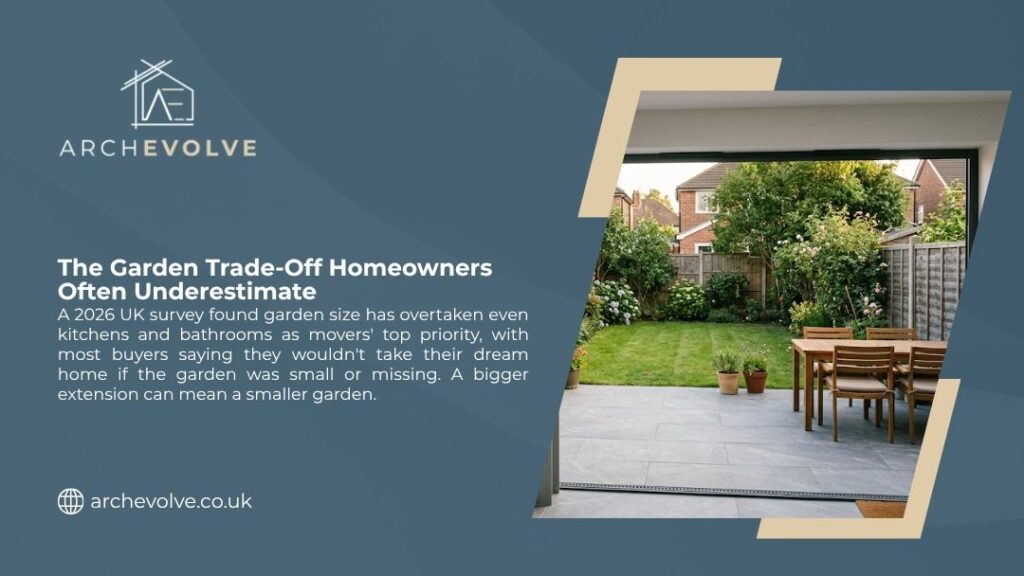
| Rear / kitchen | Larger kitchen-family space | Open-plan buyer demand | Garden space reduction |
| Loft conversion | Extra bedroom or bathroom | Bedroom count uplift | Head height and compliance |
| Side-return / wraparound | Improved ground-floor layout | Spatial transformation | Plot constraints |
| Double-storey | Major floor area gain | Multiple room improvement | Planning complexity |
How to Tell Whether Your Extension Is Worth the Money
The right comparison is total project cost versus likely value uplift, not just the builder quote against a rough estimate.
For a detailed breakdown by extension type and specification, our guide on house extension cost in the UK is a practical starting point.
Add Every Cost, Not Just the Builder Quote
Before assessing home improvement ROI, account for the full project budget. Beyond the construction contract, a complete cost picture typically includes:
- Architectural design and structural engineering fees
- Planning application fee (currently £258 for householder applications in England)
- Building regulations approval
- Party wall surveyor fees where required
- VAT at 20% on construction work
- A contingency of 10 to 15% on the build figure
For a full view of where costs accumulate beyond the headline build figure, hidden costs of a house extension is worth reading before you commit.
Compare the Extension Against the Cost of Moving
Moving house in 2026 costs an average of £13,018 nationally, based on buying and selling an average-priced UK property of £292,000 (HomeOwners Alliance, 2026).
In 2025, that figure reached a record £17,831, up 27% year-on-year, driven largely by stamp duty reverting to lower thresholds in April 2025.
According to reallymoving.com, moving costs in England now represent 46% of the median annual salary. Once those numbers enter the comparison, extending often becomes the clearer financial choice.
Signs the Project May Overcapitalise
Overcapitalisation happens when total project cost approaches or exceeds the likely value uplift. The risk is highest in lower-value markets and when the specification is shaped by personal preference rather than by what local buyers actually want.
A Simple ROI Decision Rule
If total cost sits close to the expected uplift, the financial case rests on lifestyle benefit alone. If total cost is meaningfully below the likely uplift, the project has a commercially sound basis worth pursuing.
| Scenario | Total Cost | Likely Uplift | Assessment |
| Strong | £55,000 | £80,000+ | Commercially viable with lifestyle gain |
| Borderline | £65,000 | £65,000-£75,000 | Lifestyle-led; marginal financial return |
| Risky | £80,000 | £50,000-£60,000 | Overcapitalisation likely; review scope |
Planning Permission, Building Regulations, and Hidden Risks That Affect Value
A project can look financially sound on paper but lose value if it is delayed, undocumented, or non-compliant.
Our guide on planning permission for a house extension in the UK covers the full criteria for when formal applications are required and when permitted development rights apply.
Do You Need Planning Permission for a House Extension?
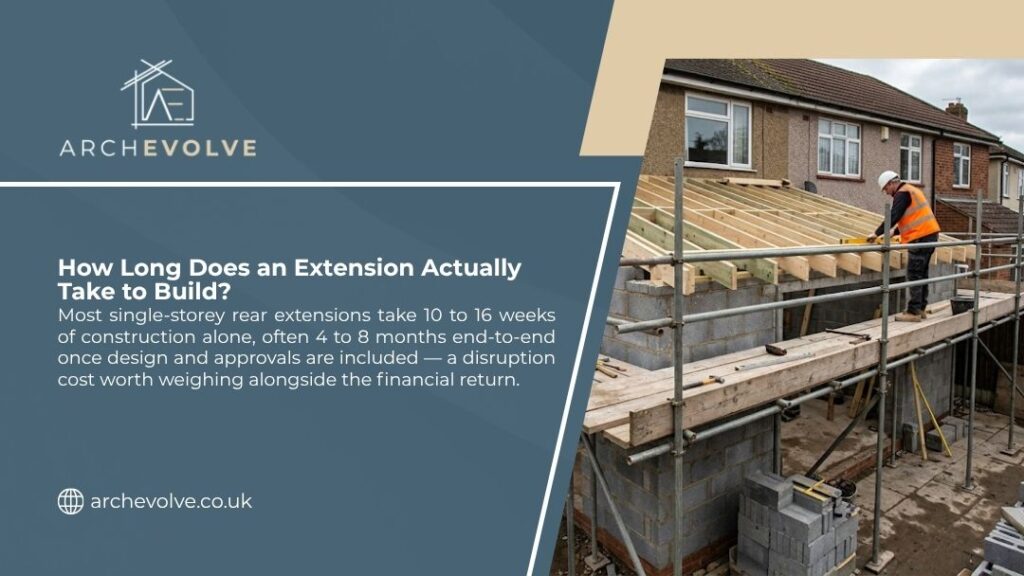
Many single-storey rear extensions fall within permitted development rights, meaning no formal application is required. Full planning permission is needed when the extension exceeds PD limits, sits in a conservation area, or involves a listed building.
In England, 87% of all planning applications were approved in the year ending September 2025, and 89% of householder development applications were granted, per DLUHC Planning Statistics. Well-prepared applications succeed at a consistently high rate.

Why Building Regulations Affect Resale Confidence
Planning permission and building regulations are entirely separate processes. Even where no planning application is needed, building regulations approval is always required on every extension project.
A buyer’s solicitor and their lender will check for completion certificates. Missing documentation creates complications that are slow and costly to resolve after the fact.
Common Mistakes That Reduce Perceived Value
- Building outside permitted development limits without a formal application
- Failing to obtain a building regulations completion certificate
- Using materials that visually clash with the original property
- Overlooking party wall obligations with neighbouring properties
| Risk | Likely Impact |
| No building regs certificate | Mortgage refusal or sale delays |
| Conservation area breach | Enforcement action or forced removal |
| Poor massing and proportions | Reduced buyer appeal and lower valuation |
| Unresolved party wall issues | Legal costs and construction delays |
How to Maximise the Value of a House Extension Before You Build
Design decisions made before construction begins shape the financial return more than any choice made during the build itself.
Design for the Local Buyer, Not Just Personal Taste
The extension that adds most to your home is the one a likely future buyer recognises as an improvement. A home office addition may be commercially less effective than a kitchen-diner if family buyers dominate your street.
Understanding your local buyer profile before the design process starts is a step many homeowners skip.
Prioritise Layout, Light, and Flow
An extension that improves how the whole ground floor connects and performs adds more buyer appeal than one that simply adds floor area.
Natural light, a clear connection to the garden, and appropriate ceiling height are consistently valued across most UK buyer profiles.
Keep the Project Commercially Realistic
Overbuilding for the street is how value gets lost. A well-targeted project costing £55,000 to £100,000 all-in is commercially realistic for most UK homeowners considering a single-storey rear extension, including VAT and professional fees.
| Value-Adding Choice | Why It Helps | Common Mistake to Avoid |
| Open-plan kitchen-diner | Matches buyer demand across most markets | Removing too much garden space |
| Rear extension with glazed doors | Maximises light and garden connection | Poor glazing quality or specification |
| Proportionate scale | Fits the property type and the street | Overbuilding for the local price ceiling |
| Consistent material palette | Reads as intentional, not added on | Mismatched brickwork or rooflines |
FAQs
Does a house extension add value to your property
A house extension does not automatically add value. House extension value depends on location, design quality, how the new space is used, and full compliance with planning and building regulations.
How much value does a house extension add in the UK?
A well-designed extension typically adds 10 to 15% to property value, per RICS data (2025). An extension incorporating a large double bedroom and bathroom can add up to 24%, according to Nationwide’s House Price Index Special Report.
Which extension type adds the most value?
Open-plan kitchen-diner extensions consistently deliver strong property resale value across most UK markets. Loft conversions with a double bedroom and en-suite show the highest percentage return, particularly in London and the South East.
Is it better to extend or move to a bigger home?
For many homeowners, extending makes clearer financial sense once moving costs are factored in. The average cost of moving in 2026 is £13,018 nationally. In 2025, that figure reached a record £17,831, representing 46% of the median annual salary in England.
Does planning permission increase value?
An approved planning application for a well-conceived extension can raise perceived value, particularly for buyers planning further development. The value comes from the merit of the approved design rather than from the permission itself.
Key Takeaway
House extension return on investment is real. It is earned through design quality, compliance, and commercial targeting, not build volume alone.
The properties that deliver the strongest returns are those where the project improves layout, buyer appeal, and documentation at the same time.
With 15+ years of experience and more than 500 completed projects across home extensions, loft conversions, and residential developments, Archevolve supports homeowners across England from initial feasibility through to planning approval and full construction documentation.
If you are planning an extension and want to understand what it could realistically add to your specific property, contact Archevolve today.