
Securing planning permission for your Storrington extension is merely the prologue to your build, not the final chapter. You’ve likely felt that initial surge of excitement after a planning approval, only to be met with the daunting reality of technical compliance and structural safety. It’s a common hurdle where the vision for your West Sussex home meets the rigorous demands of the latest UK safety standards. This is where comprehensive building regulation packages become your most vital asset, bridging the gap between a conceptual design and a safe, habitable reality.
We understand the anxiety that stems from technical non-compliance, especially when a single oversight can halt a construction project in its tracks. Our expert guide will help you master these requirements, ensuring your build is seamless and fully compliant. You’ll gain a clear understanding of the 2026 technical standards and receive a build-ready set of drawings for accurate contractor quotes. We’ll explore how a skilled architectural technologist can evolve your initial ideas into a meticulously detailed technical blueprint that guarantees legal peace of mind.
Key Takeaways
- Distinguish the aesthetic vision of planning from the technical rigour of building control to ensure a seamless transition from concept to construction.
- Identify the critical technical drawings and material specifications needed to provide your builder with a meticulous roadmap for structural success.
- Master the 2026 technical landscape by utilising bespoke building regulation packages that prioritise the latest energy efficiency and ventilation standards.
- Decipher the complexities of the building control process in West Sussex, helping you choose the most efficient application route for your specific property enhancement.
- Gain professional reassurance by understanding how the expertise of an architectural technologist ensures your project meets the highest standards of safety and performance.
Understanding Building Regulation Packages for Storrington Home Enhancements
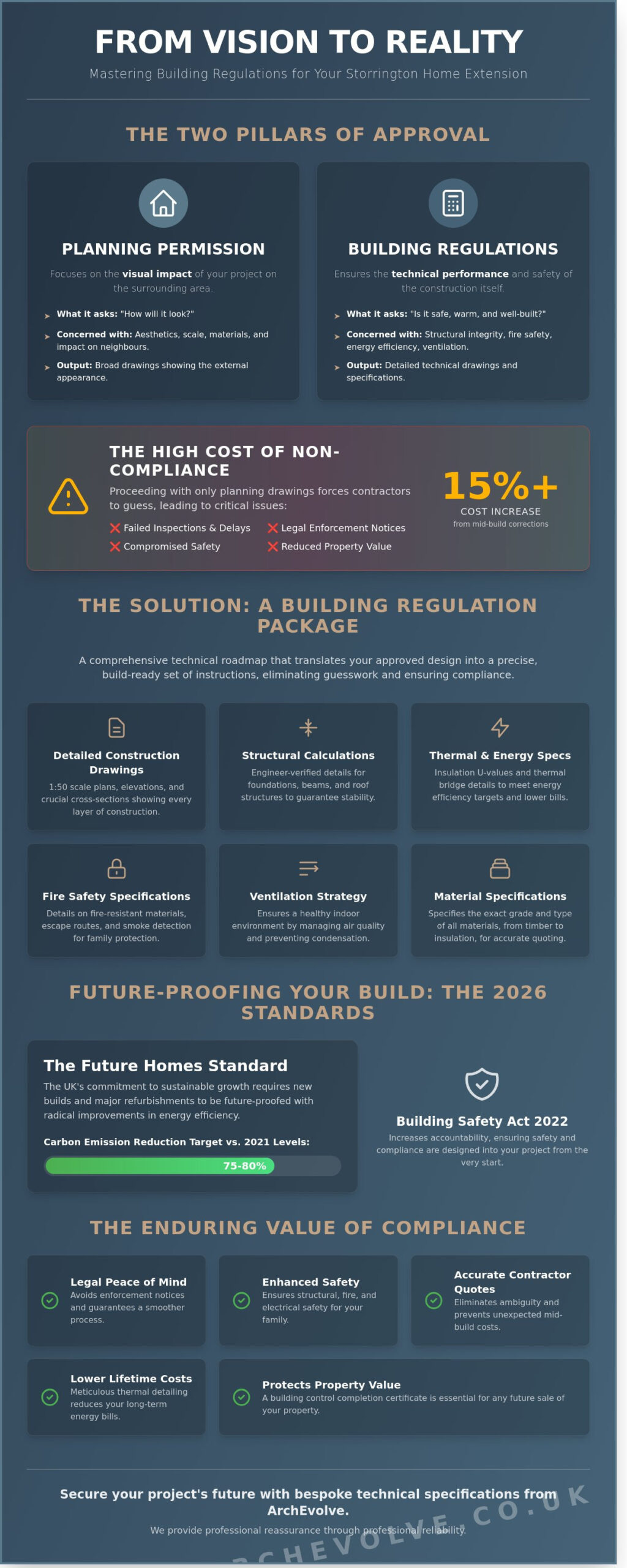
A building regulation package acts as the definitive technical manual for your construction team. It transforms conceptual ideas into a precise set of instructions that ensure structural integrity and thermal efficiency. While planning permission focuses on the external impact and aesthetic harmony of your Storrington extension or loft conversion, building control ensures the interior is safe, warm, and durable. In West Sussex, the transition to 2026 standards means a heightened focus on the Building Safety Act 2022 and stringent carbon reduction targets. Detailed building regulation packages eliminate the ambiguity that leads to expensive remedial work. Industry data suggests that mid-build corrections can increase project costs by 15% or more when technical errors are discovered during a site inspection.
The evolution of these standards in 2026 reflects a commitment to sustainable growth. New builds and refurbishments must now align with the Future Homes Standard, which aims for a 75% to 80% reduction in carbon emissions compared to 2021 levels. This shift requires a meticulous approach to technical design; for projects requiring specialized guidance on green building standards, Ekocentric provides professional consulting to help navigate these sustainable certifications. We don’t just provide drawings; we provide a roadmap for evolution. By detailing every thermal bridge and structural connection, we ensure your project moves seamlessly from the drawing board to the site. It’s about providing practical reassurance through professional reliability.
Why Planning Drawings Are Not Enough
Planning drawings are designed to win the approval of local authorities by showcasing scale, massing, and external materials. They’re intentionally broad. They don’t specify the grade of timber for your floor joists or the specific U-value of your wall insulation. Without the technical depth of building regulation packages, contractors are forced to make assumptions. This guesswork often results in delays or failed inspections from building control officers. A building regulation package is the bridge between design vision and physical reality.
The Legal Necessity of Compliance
Proceeding without a formal building control application is a gamble that risks enforcement notices or even the forced demolition of unapproved works. Under the Building Safety Act 2022, the accountability for compliance has become significantly more rigorous for residential projects. This legislation ensures that safety is designed into the building from the first brick. Beyond the legal requirement, compliance protects the long-term capital value of your property. When you eventually sell your Storrington home, solicitors will demand completion certificates to prove the work meets national standards. Compliance isn’t just a hurdle; it’s an investment in your home’s future legacy.
- Detailed structural calculations prevent foundation failure.
- Meticulous thermal detailing reduces lifetime energy costs.
- Fire safety specifications provide essential protection for your family.
- Verified ventilation strategies improve indoor air quality.
The Essential Components of a Technical Building Control Submission
A building regulation submission is the bridge between a conceptual vision and a physical reality. It’s a set of instructions that leaves nothing to chance. Our building regulation packages provide a comprehensive technical roadmap, ensuring your Storrington project complies with the latest 2025 safety and energy standards. This technical phase transforms a planning approval into a buildable reality, protecting your investment and ensuring the longevity of your home.
Detailed Construction Drawings and Sections
Precision is the hallmark of a successful build. We produce floor plans, sections, and elevations at a 1:50 scale to provide the granular detail required by building control officers. A “section” drawing is particularly vital; it acts as a vertical slice through the property. This reveals the intricate layers of the wall build-up, the exact depth of foundations, and the complex junctions where the roof meets the walls. In Storrington, where soil conditions often require specific foundation depths of 1 metre or more, these drawings are essential. Our architectural technologist team organises these documents to eliminate ambiguity, allowing local contractors to follow a clear, logical sequence during construction.
Technical Specifications and Material Schedules
The performance of a building depends entirely on the materials chosen. We document exact insulation types, such as 150mm PIR boards or high-density mineral wool, to ensure walls achieve the 0.18 W/m²K U-value required by modern standards. Fire safety is another critical pillar. We specify 30-minute fire-rated doors and integrated smoke detection systems to ensure the safety of all inhabitants. Every package also includes detailed drainage layouts and ventilation strategies. This prevents issues like damp or poor air quality, which can often plague poorly planned refurbishments. If you are ready to move from concept to construction, our technical design services provide the clarity your project needs.
Integration is the final piece of the puzzle. Structural engineering calculations, which specify the exact steel beam sizes for open-plan extensions, are woven directly into the wider package. This prevents conflicts between the structural frame and the aesthetic finish. For any significant property enhancement, SAP calculations (Standard Assessment Procedure) are now a mandatory requirement. This thermal performance data proves that your new extension or loft conversion won’t lead to excessive CO2 emissions or heat loss. By coordinating these technical threads into one cohesive document, we ensure your project remains on track, on budget, and fully compliant with the law.
Your 2026 Building Regulations Checklist: Technical Standards for West Sussex
Navigating the technical evolution of a property requires more than just a vision; it demands meticulous adherence to an ever-shifting statutory landscape. In Storrington, 2026 marks a pivotal era for construction standards as the UK moves closer to the Future Homes Standard. Our building regulation packages provide the essential framework to ensure your project, whether a bespoke new build or a refined flat conversion, meets these rigorous demands without compromising on design integrity.
- Part A: Structural integrity, focusing on loading and ground stability.
- Part B: Fire safety, including domestic detection and escape strategies.
- Part F: Ventilation and air quality, which is vital for airtight modern builds.
- Part L: Conservation of fuel and power, the cornerstone of 2026 sustainability.
- Part M: Access to and use of buildings, ensuring inclusivity in every entrance and floor level.
- Part P: Electrical safety in domestic dwellings, mandatory for all refurbishments.
- Part S: Infrastructure for electric vehicle charging, now a standard for new residential spots.
Energy Efficiency and Thermal Performance (Part L)
The 2026 standards demand a significant reduction in carbon emissions, targeting a 75% to 80% decrease compared to 2021 levels. For extensions in West Sussex, this translates to stringent U-values. External walls must typically achieve 0.15 W/m²K, while roofs often require 0.11 W/m²K to pass inspection. An architectural technologist performs precise SAP calculations to model heat loss, ensuring the thermal envelope is seamless. Integrating renewable technologies, such as air-source heat pumps or solar PV arrays, is now a fundamental step in achieving compliance and future-proofing your lifestyle investment.
Structural Integrity and Fire Safety (Parts A & B)
Technical excellence begins beneath the surface. In Storrington, the local geology, ranging from Lower Greensand to heavy Weald Clay, dictates specific foundation strategies. We ensure your building regulation packages account for these variations to prevent future movement. Safety is woven into the aesthetic through the following checks:
- Ensure foundation depths are verified against local soil plasticity and nearby tree root systems to prevent heave or subsidence.
- Verify that FD30S fire-rated doors and protected escape routes are integrated into the layout without disrupting the flow of natural light.
- Confirm that structural stability remains the foundation of every bespoke design, providing the reassurance needed for ambitious structural alterations.
Structural stability is the foundation of every bespoke design, ensuring that even the most daring architectural transformations remain safe for decades. By focusing on these technical details early, we transform a complex regulatory hurdle into a streamlined journey toward a superior home.
Navigating the Building Control Process in West Sussex: Local Authority vs Private
Securing the structural integrity of your Storrington home requires a calculated choice between two primary regulatory pathways. You can opt for Horsham District Council’s building control team or appoint a private approved inspector. Local authority officers possess an unrivalled knowledge of West Sussex soil conditions and historical building stock. Conversely, private inspectors often provide a more agile service; they typically offer next-day site visits and a dedicated point of contact for complex refurbishments. If your property sits within the South Downs National Park, which covers approximately 1,600 square kilometres of the surrounding landscape, specific aesthetic and environmental constraints may influence your choice of inspector.
Choosing Your Building Control Body
Local council officers offer a sense of permanent accountability and deep-rooted local presence. They are an excellent choice for standard extensions where local precedents are well-established. However, for high-end bespoke developments or commercial-to-residential flat conversions, a private inspector might offer the specialist expertise required for innovative fire safety or acoustic solutions. Speed is often the deciding factor. Private firms frequently guarantee plan check turnarounds within 10 to 15 working days, which keeps your project momentum high. We ensure your building regulation packages are tailored to meet the specific requirements of whichever body you choose, ensuring a frictionless approval process.
The choice of application route is equally vital. For most sophisticated property enhancements, the Full Plans route is the gold standard. This involves submitting comprehensive technical drawings for approval before construction starts. It removes the uncertainty inherent in the Building Notice route, which, while faster to initiate, leaves you vulnerable to expensive remedial works if an inspector identifies a non-compliant detail mid-build. Our role as your architectural technologist is to provide the technical certainty that prevents these costly setbacks.
The Inspection Journey
The evolution of a build is marked by critical site visits that validate the quality of the construction. These inspections typically follow a strict sequence:
- Commencement: Verification of the site set-out and initial excavation.
- Foundation and DPC: Checking the depth of footings and the integrity of the damp proof course.
- Drainage: Testing foul and surface water systems before they are covered.
- Structural Milestones: Inspection of floor joists, roof timbers, and steel beams.
- Pre-plaster: A final look at insulation and “first fix” services before they are hidden behind walls.
- Final Completion: The final walkthrough to ensure all life safety and energy standards are met.
ArchEvolve acts as your professional agent throughout this journey. We manage the technical dialogue with the building control officer, clarifying design intents and resolving site-specific challenges as they arise. This seamless coordination ensures that the building regulation packages we design are executed to the letter. The process culminates in the issuance of the Final Certificate. This document is essential for your peace of mind and your property’s future value. According to 2023 UK property market data, a missing completion certificate can delay a house sale by an average of 12 weeks or even cause the transaction to collapse entirely.
Prepare your project for a successful inspection schedule by exploring our technical design services today.
Securing Your Project’s Future with Bespoke Technical Specifications from ArchEvolve
ArchEvolve stands as the premier partner for homeowners in Storrington who demand excellence beyond the initial planning phase. We believe that a project’s success hinges on the seamless transition from a creative concept to a buildable reality. Our team of dedicated architectural technologists and draftsmen doesn’t simply tick boxes. We craft bespoke building regulation packages that serve as a definitive, high-fidelity blueprint for your contractor. This meticulous attention to detail prevents costly on-site delays and ensures that every structural element enhances the inherent beauty and functionality of your home.
The journey from a two-dimensional drawing to a physical structure is often the most complex phase of property development. We act as your technical guardian throughout this transformation. By focusing on the intersection of light, space, and structural integrity, we ensure your extension or conversion isn’t just a physical addition, but a meaningful evolution of your lifestyle. Our technical expertise allows us to solve complex engineering puzzles before they reach the building site, saving you time and protecting your investment.
The ArchEvolve Approach to Technical Design
Sustainability and high-end craftsmanship sit at the very heart of our design philosophy. We believe that a home should evolve alongside its inhabitants, adapting to new needs while maintaining peak performance. To achieve this, we utilise advanced 3D visualisations to inform our technical drawing process. This allows you to experience the volume and light of your new space before construction begins. It’s a visionary approach that identifies potential issues early, ensuring the technical reality matches the aesthetic dream.
This focus on visual media can extend beyond the planning stages. Many homeowners choose to document the craftsmanship of their finished home with professional video, creating a compelling showcase of the transformation. Digital agencies like REVI provide expert video production services that can capture the unique details and final aesthetic of such bespoke projects.
Our experience across West Sussex is extensive. We’ve delivered precision-engineered solutions for ambitious house extensions that redefine modern living. We also specialise in sophisticated loft conversions, where our architectural draftsmen maximise every millimetre of available head height and floor space. By integrating the latest 2026 thermal efficiency standards, we ensure your project is future-proofed against rising energy costs and changing environmental regulations.
Ready to Evolve Your Property?
The complexity of modern construction requires a steady, expert hand. There is an immense sense of peace of mind that comes with a professionally prepared package. It removes the guesswork for builders and provides a clear roadmap for building control officers. We’ve helped numerous Storrington residents navigate the 2026 technical landscape, ensuring their projects are delivered on time and to an exacting standard. Your home deserves a level of detail that reflects its value and your aspirations.
We invite local residents to move beyond the abstract and secure their project’s future. Don’t leave the structural integrity of your home to chance. Our technical consultations offer a deep dive into the specifics of your site, providing clarity and momentum for the build ahead. Contact ArchEvolve to discuss your building regulation package today and begin the journey toward a flawless property transformation.
Elevating Your Storrington Property with Technical Precision
Navigating the complex landscape of the 2026 technical standards requires a partner who understands the intricate nuances of West Sussex building control. Successful home enhancements, whether they involve ambitious new builds or sophisticated flat conversions, depend on meticulous documentation that anticipates every structural requirement. Our building regulation packages provide the robust technical foundation needed to move from conceptual design to tangible reality with absolute confidence. By integrating bespoke technical specifications from our experienced architectural technologists, you ensure your project adheres to the highest levels of safety and functional integrity. We’ve established a proven track record across Storrington, delivering excellence in extensions and complex refurbishments that stand the test of time. It’s about more than just compliance; it’s about the evolution of your living space into something truly extraordinary. Your project deserves a level of craftsmanship that mirrors your own aspirations for a refined lifestyle. Begin your technical journey with ArchEvolve today. We look forward to bringing your vision to life through technical mastery and dedicated partnership.
Frequently Asked Questions
Do I need a building regulation package if I have planning permission?
Yes, planning permission and building regulations are separate legal requirements that serve different purposes. Planning permission focuses on the aesthetic impact and local environment, while building regulation packages ensure the structural integrity, thermal efficiency, and fire safety of your Storrington project. Since the 2023 Building Safety Act, compliance has become even more rigorous. You’ll need detailed technical drawings to demonstrate that your loft conversion or extension meets current UK standards.
How much does a building regulations package cost in West Sussex?
Local authority fees in West Sussex vary by project type, with a typical single-storey extension plan charge starting around £250 according to Horsham District Council’s 2024 fee schedules. This fee covers the formal checking of your plans, while an additional inspection fee is paid once work commences on site. Professional fees for technical drawings are separate and depend on the complexity of your bespoke design. Investing in a comprehensive package prevents costly site delays and ensures a seamless evolution of your home.
Can I use a building notice instead of a full plans application?
You can use a building notice for minor domestic works, but a full plans application is the safer route for complex refurbishments or new builds. A full plans submission involves a meticulous review of your building regulation packages before construction begins, providing a notice of approval that protects your investment. This approach reduces the risk of being asked to pull down non-compliant work. For projects involving commercial-to-residential flat conversions, a full plans application is mandatory under Part B of the Building Regulations.
How long does it take to get building control approval in Storrington?
The statutory period for a local authority decision is five weeks, though this can be extended to two months with your consent. In Storrington, working with Horsham District Council or an Approved Inspector can influence these timelines. A well-prepared technical submission minimizes the need for clarifications and revisions. Ensuring your architectural technologist provides detailed specifications from the outset helps maintain momentum. This clarity allows your project to transition from concept to construction without unnecessary friction.
What happens if I build without building regulations approval?
Building without approval can lead to an enforcement notice under Section 36 of the Building Act 1984, requiring you to alter or remove the work at your own expense. You’ll also face significant challenges when selling your property, as 95% of buyers’ solicitors will request completion certificates during the conveyancing process. Without these documents, your property’s value is compromised. It’s a risk that undermines the long-term transformation of your home and can lead to unlimited fines in the Magistrates’ Court.
Does my building regulation package include structural calculations?
A comprehensive building regulation package typically integrates structural calculations provided by a qualified engineer. These calculations are essential for elements like steel beams in open-plan extensions or floor joists in loft conversions. They prove that the proposed enhancement can safely support its own weight and the loads placed upon it. Including these details within your technical drawings ensures a unified approach. This meticulous coordination is vital for achieving a high-end, functional finish that stands the test of time.
Who carries out the building control inspections during the build?
Inspections are conducted by either a Local Authority Building Control officer or a private sector Approved Inspector. These professionals visit the site at key stages, such as foundation excavation, damp proofing, and drainage installation. They ensure that the physical build aligns with the approved building regulation packages. Once the final inspection is passed, they issue a completion certificate. This document is the definitive proof of your project’s technical integrity and is essential for future property valuations.
Can an architectural technologist manage the entire building control process?
Yes, an architectural technologist possesses the technical expertise to navigate the entire building control journey on your behalf. They handle the creation of detailed technical drawings, coordinate with structural engineers, and act as the primary point of contact for inspectors. This professional oversight ensures your vision is translated into a safe, compliant reality. By managing these complex requirements, they allow you to focus on the creative evolution of your living space while they ensure every technical detail is addressed. This model of expert guidance is common across Europe; for example, independent consultants like Martin Bonauer provide similar comprehensive architectural and advisory services in Switzerland.